PACE leaders are watching the Version 28 (V28) transition closely, and with good reason. Across Medicare Advantage, the conversation has been loud, reactive, and often misleading: “V28 slashed our RAF.” In many organizations, that narrative has driven anxiety, defensive posturing, and an assumption that revenue erosion is unavoidable.
For PACE programs, that framing misses the point.
The more accurate, and operationally useful, truth is this: V28 does impact revenue, particularly through the removal of lower-value diagnoses and changes in risk weighting. That impact, however, is not uniform or automatic. The degree of financial disruption is largely determined by documentation patterns, clinical workflows, and audit discipline.
Where documentation lacks clarity, clinical intent, or evidentiary support, V28 exposes those weaknesses more quickly and more forcefully. Where documentation is deliberate, compliant, and defensible, the revenue impact is materially more contained, and, in many cases, predictable.
This distinction matters especially in PACE, where care is longitudinal, patient acuity is high, and diagnoses are not episodic artifacts but reflections of ongoing clinical reality. The same model change that destabilizes other populations can, in PACE, act as a forcing function, shifting attention away from low-value coding behaviors and toward documentation practices that accurately reflect the complexity of the population being served.
Understanding that context is essential before talking about mitigation strategies, compliance risk, or RAF preservation. Because PACE is not just entering V28 with different patients, it is entering V28 with a fundamentally different advantage.
PACE is different, and that’s the advantage
Unlike traditional MA populations, PACE participants tend to present with higher-acuity, clinically significant conditions: advanced cardiovascular disease, cancer histories, ESRD, or neurologic impairment. These diagnoses largely remain in the V28 risk model.
What is disappearing are the “low-yield, easy-to-capture” conditions that inflated RAF under prior models. Their removal creates a measurable revenue gap, but in PACE, the proportional impact is smaller because baseline RAF is higher and driven by serious disease burden.
In other words:
The revenue gap is real, but for PACE it is mitigable, not catastrophic.
Understanding RAF declines in PACE: A documentation perspective
The steepest RAF drops are rarely caused by CMS alone. They stem from documentation behaviors that V28 exposes more aggressively:
1. Carrying acute diagnoses forward
Acute inpatient conditions (e.g., acute stroke) copied into outpatient or follow-up notes without clear clinical relevance remain a top audit risk. In V28, this behavior is more likely to be flagged, and reversed.
2. “Resolved” vs. active confusion
If a condition is resolved, it must be documented as history, not blended into an active problem list. This is a frequent EDS and RADV failure point.
3. Template overuse
PACE clinicians see patients frequently. When notes repeat verbatim while diagnoses change, or vice versa, documentation credibility erodes quickly.
These issues don’t just threaten RAF. They undermine audit defensibility, which is where financial risk compounds.
V28 raises the bar on clinical intent
What V28 really changes is where effort must be applied.
Success now depends less on finding every possible diagnosis and more on:
Ensuring conditions are real, active, and supported
Demonstrating clinical reasoning for complex, high-value diagnoses
Aligning workflows to surface conditions that require evidence (e.g., imaging for Stage B heart failure)
For PACE programs, especially home-based models, this may require new logistics: transport to imaging, tighter screening protocols, and clearer physician education.
The compliance blind spot: documentation vs. submission
Many leaders conflate documentation loss with submission loss. They are not the same.
Documentation is what the clinician writes. Submission is how that data flows, through coders, vendors, and payers, to CMS.
While submission errors still occur, most V28 exposure originates in the note itself. That’s why relying solely on retrospective chart review is no longer sufficient.
This is where automation becomes leverage.
Operationalizing audit-ready documentation in PACE
High-performing PACE organizations are shifting from episodic audits to continuous documentation intelligence:
AI-driven note review that evaluates 100% of encounters for MEAT, internal standards, and audit risk, before submission
Point-of-care diagnosis guidance that helps clinicians focus on conditions that still matter under V28
Targeted, clinician-friendly education delivered in short, repeatable formats that actually change behavior
This is how documentation becomes defensible by default, not corrected after the fact.
At DoctusTech, these principles are operationalized through:
An AI Coder that scans every progress note for compliance and evidence alignment.
A Mobile Learning App that delivers individualized, weekly education to clinicians, supporting sustainable change without burnout
Not as add-ons, but as infrastructure.
So, when does PACE enter V28?
As of now, CMS has not finalized the exact implementation date for V28 within PACE programs. Industry guidance suggests alignment with upcoming payment years, anticipated in CY 2026, but PACE-specific timing has not yet been formally published by CMS.
That uncertainty makes one thing clear: waiting for a date is a losing strategy.
The bottom line for PACE leaders
V28 is not a documentation apocalypse for PACE. It is a stress test.
Organizations that:
Understand their true diagnosis mix
Eliminate risky documentation habits
Invest in real-time compliance infrastructure
will stabilize their RAF and defend it confidently.
Those that don’t will continue blaming the model while bleeding revenue in audits.
The difference isn’t V28. It’s how prepared your documentation culture is to withstand it.
Ready to protect your organization? Get a Free Demo of DoctusTech’s solutions today.
For many PACE organizations, CMS-HCC Version 28 has created confusion during audit review. Diagnoses that are documented in the medical record, and may even reflect real clinical history, are still being challenged, removed, or downcoded.
In most cases, the issue is not missing documentation. Instead, the issue is that the criteria CMS uses to validate diagnoses has changed.
Under V28, CMS is applying a narrower interpretation of what qualifies as a reportable condition. Auditors are placing greater weight on whether a diagnosis is actively managed, clinically relevant to the encounter, and supported by objective evidence. Conditions that were historically acceptable when documented may now fail validation if they do not meet these tighter standards, even when they appear reasonable to the care team.
This shift is especially important for PACE programs. High visit frequency, longitudinal care, and templated documentation can unintentionally increase audit exposure when diagnoses persist without clear evidence of reassessment. At the same time, many commonly documented conditions have been removed from the model entirely, eliminating reimbursement that cannot be recovered through documentation improvements alone.
And that distinction matters, because V28 did not simply change the codes. It changed what CMS considers acceptable in the first place.
V28 changed the definition of “acceptable,” not just the codes
Many diagnoses that were historically easy to capture and reliably reimbursed were intentionally removed. CMS has stated that these conditions did not materially influence patient management or cost and were often documented solely for payment purposes. Once removed, no amount of documentation quality can recover their value.
This is why organizations are experiencing revenue decline even when documentation practices appear unchanged. The diagnoses still exist in the chart, but they no longer exist in the model.
For PACE programs, the implication is not to document more aggressively, but to redirect clinical effort toward the remaining diagnoses that still matter, and ensure those diagnoses can withstand scrutiny.
Why “documented” diagnoses fail under audit
1. Over-documentation of non-active conditions
One of the most common failure points under V28 is the inappropriate carry-forward of conditions that are no longer active or managed.
Typical examples include:
Acute inpatient diagnoses documented in outpatient follow-ups without evidence of ongoing treatment
Conditions listed as both “resolved” and “active.”
Chronic diagnoses included in the assessment without monitoring, evaluation, or treatment activity
Under CMS rules, HCCs require evidence that the condition was addressed during the encounter. Historically accurate conditions that are no longer managed must be coded as history, not as active disease.
In PACE environments, where patients are seen frequently and notes are often templated, this risk is magnified.
Organizations mitigating this risk are increasingly using automated chart intelligence, such as the AI Coder from DoctusTech, to review 100% of progress notes before submission, flagging diagnoses that lack clinical support, show template persistence, or conflict with the plan of care. This shifts compliance from retrospective cleanup to pre-audit prevention.
While MEAT remains foundational, auditors now expect stronger objective substantiation, particularly for higher-value diagnoses.
Common audit failures occur when:
Diagnoses requiring imaging or diagnostics lack corresponding evidence
Asymptomatic but high-impact conditions are documented narratively but unsupported clinically
For PACE programs, where patients are often homebound, these gaps are operational, not clinical. However, CMS does not differentiate based on workflow constraints.
Audit-ready organizations address this by integrating diagnosis support directly into the clinical workflow. Platforms like the DoctusTechPDAPconsolidate external data, prior imaging, labs, and specialist notes at the point of care, enabling clinicians to document with evidence visibility rather than after-the-fact reconstruction.
3. Template risk in high-frequency visits
PACE patients are seen often. When clinical status changes slowly, documentation often changes even more slowly. Auditors view repeated diagnoses without reassessment as high risk.
They look for:
Alignment between the physical exam and the assessment
Evidence of reconsideration, not repetition
Updates to management plans
To address this, leading programs pair automated template-risk detection with continuous clinician education. Short, targeted reinforcement, delivered in the flow of work, helps clinicians understand when diagnoses must be reaffirmed, revised, or removed. This model of education at scale is increasingly delivered via mobile microlearning tools, including those offered by DoctusTech, rather than annual compliance refreshers.
Documentation vs. submission: The invisible failure point
Not all failed diagnoses originate in the note. Some fail downstream:
Incorrect ICD-10 selection
Mapping errors during EDS submission
Silent rejections by intermediaries
Organizations without visibility across documentation, coding, and submission often discover these failures only after audits, when recovery is no longer possible.
Audit-ready programs reconcile these steps proactively, ensuring what is documented is what is submitted, and ultimately what is defensible.
Why PACE is both more protected and more exposed
PACE populations are clinically complex. Serious, high-value conditions remain in V28, cushioning overall RAF decline relative to healthier populations.
At the same time:
High RAFs attract audit attention
Smaller compliance teams concentrate risk
Medical directors often assume audit responsibility without a dedicated infrastructure
Under V28, reliance on manual oversight alone is increasingly unsustainable.
The strategic takeaway for PACE leaders
Under V28, a diagnosis can be documented, clinically reasonable, and well-intentioned, and still fail audit review.
The difference between failure and defensibility is no longer a matter of effort. It is the alignment between clinical reality, evidentiary support, and CMS expectations.
PACE programs that embed continuous education, automated documentation review, and point-of-care diagnosis support into daily operations are not trying to outwork V28. They are adapting to it, building documentation systems that can defend every diagnosis that remains.
Because under V28, the objective is no longer to capture everything. It is to defend what matters.
The transition to CMS-HCC V28 represents a structural shift in risk adjustment economics. For PACE programs, this is not a routine coding update; it is a recalibration of how revenue is generated, sustained, and defended.
V28 removes a meaningful subset of diagnoses that were historically prevalent and operationally easier to capture under prior models. As a result, most organizations will experience a decline in risk-adjusted revenue that cannot be fully recovered through documentation improvement alone.
For PACE programs, however, the impact is more nuanced. While certain lower-impact conditions no longer contribute to RAF, many high-severity, high-cost diagnoses common in frail, dual-eligible populations remain intact. Organizations that respond with speed and discipline can mitigate losses more effectively than peers.
What follows are the fastest, highest-confidence actions PACE leaders can take to stabilize performance under V28.
6 wins to close the V28 revenue gap for PACE programs
1. Quantify structural revenue exposure before optimizing operations
Before pursuing workflow or documentation changes, leadership must establish a clear understanding of non-recoverable revenue loss. This requires analyzing which V22/V24 diagnoses are being retired and estimating their historical contribution to RAF and capitation.
This assessment enables organizations to:
Distinguish structural model changes from operational underperformance
Set realistic financial expectations with executive leadership and boards
Prioritize initiatives that can materially influence outcomes
Absent this clarity, teams risk investing in low-yield optimization efforts that cannot meaningfully close the gap.
Platforms like DoctusTech’s PDAP are designed to support this type of analysis by aggregating structured and unstructured data across EMRs and external sources, allowing leadership to quantify risk with greater confidence and less manual effort.
2. Preserve eligible revenue during the transition period
Until V28 is fully implemented, diagnoses that remain valid under current payment models should continue to be documented and submitted in full compliance with CMS guidance.
Prematurely abandoning eligible conditions accelerates revenue erosion without improving future readiness. Revenue preservation during transition periods is cumulative and time-sensitive.
3. Reallocate focus to clinically complex, high-impact conditions
Under prior models, organizations could achieve acceptable performance by efficiently capturing a broad set of lower-complexity conditions. V28 materially reduces the contribution of those diagnoses.
Sustainable performance now depends on a deliberate shift toward:
Conditions with higher clinical severity and cost impact
Diagnoses requiring structured screening, testing, or longitudinal assessment
Documentation that must meet stricter evidentiary and specificity standards
This is an operational challenge, not a theoretical one. Success requires intentional workflow design rather than passive identification.
4. Strengthen documentation defensibility as margins compress
As aggregate RAF declines, the financial consequences of audits, payment adjustments, and recoupments increase. Documentation weaknesses that were previously absorbed by larger margins now pose disproportionate risk.
High-performing organizations are responding by moving beyond sample-based audits to continuous, scalable review. This includes:
Verifying MEAT support across all submitted diagnoses
Identifying internal inconsistencies between assessment, plan, and exam
Detecting patterns of inappropriate acuity or status carryover before submission
Manual chart review cannot scale to this level. DoctusTech’s AI Coder scans 100% of progress notes against MEAT, DSP, TAMPER, and internal compliance standards before submission, flagging gaps while remediation is still possible. When documentation gaps are flagged before claims submission, compliance becomes preventive rather than punitive. Get a free demo to learn more.
5. Use prevalence benchmarking to identify missed clinical burden
Comparing internal diagnosis prevalence against peer or national benchmarks remains one of the most effective methods for identifying under-recognized clinical conditions.
For PACE populations, where disease burden is typically higher, material variance often reflects missed opportunity rather than overperformance. This approach does not inflate risk; it improves alignment between documented and actual clinical complexity.
Generic coding refreshers will not close V28 revenue gaps. Education must be:
Focused on diagnoses that continue to materially affect RAF
Grounded in current clinical and documentation standards
Reinforced consistently without disrupting care delivery
Organizations that succeed under V28 treat education as infrastructure, not remediation. Short, diagnosis-specific learning delivered regularly ensures clinicians stay aligned with evolving rules while minimizing disruption to patient care.
That’s why DoctusTech created a Mobile Learning App that supports weekly, personalized education tied directly to observed documentation behavior. This model supports consistency across teams and reduces downstream correction cycles for coding and compliance staff.
When education is individualized and operationally integrated, it becomes a mechanism for revenue protection and audit readiness, not a compliance afterthought.
Takeaway for PACE leadership
The V28 revenue gap is structural and unavoidable. Its downstream impact, however, is highly variable.
PACE organizations that quantify exposure early, refocus on clinically meaningful diagnoses, and operationalize defensible documentation will stabilize faster and with less disruption. Those that rely on legacy workflows or retrospective remediation will face prolonged financial pressure.
V28 rewards rigor, transparency, and scalability. Organizations that operationalize those principles (rather than treating them as aspirational goals) will remain financially resilient in the next phase of value-based care.
For years, compliance wasn’t prioritized because the system rewarded speed and volume over documentation depth. That used to be fine until audits started asking tougher questions.
Many organizations still teach that any one letter of MEAT is enough to prove compliant documentation. But if an audit lands on a note that says only “stable” or “monitor,” will it hold up?
Maybe.
But “maybe” isn’t a compliance strategy, and certainly not a safe one.
Especially when we consider CMS and its fame for not being clear on its RADV audit guidelines. So now, it’s not only about whether a diagnosis exists, it’s about how well it’s supported. And as audits tighten, “showing something” isn’t the same as proving compliance.
Because invalue-based care, one letter of MEAT isn’t enough anymore.
The Problem with “One Letter is Enough”
There was a time when chart reviewers were told to “just make sure there’s at least one letter of MEAT.” That culture wasn’t built on malice; it came from survival. Documentation requirements grew faster than most systems could adapt, and as long as something was written, it passed.
But that leniency is gone. CMS no longer rewards minimal effort. Payers are using AI to flag weak evidence at scale, and what once looked “good enough” now invites clawbacks.
If your documentation only mentions monitoring, without showing why it matters, you’re not compliant, you’re vulnerable.
RADV auditors follow a defined set of rules when reviewing documentation. These rules include basic requirements like patient identification, provider signature, and date of service. But one rule is less defined and far more powerful:
All codes must be assigned “according to the ICD-10-CM guidelines.”
At first glance, this sounds routine. The ICD-10-CM guidelines are mostly technical, including exclusions, seventh-character rules, and the use of terms like “and” or “with”. Yet hidden within these guidelines are a few lines that open the door for an auditor to perform a more clinical analysis.
Several sections of the ICD-10-CM guidelines give auditors authority to assess the clinical significance of a diagnosis. For example:
Section I.B.16: “There must be a cause-and-effect relationship between the care provided and the condition, and the documentation must support that the condition is clinically significant.”
Section I.B.16 (continued): “Code assignment is based on the provider’s documentation of the relationship between the condition and the care or procedure, unless otherwise instructed by the classification.”
Section IV.C: “For accurate reporting of ICD-10-CM diagnosis codes, the documentation should describe the patient’s condition, using terminology which includes specific diagnoses as well as symptoms, problems, or reasons for the encounter.”
In short, auditors are not just checking if a diagnosis is mentioned. They are allowed to review a note and decide whether the documentation present demonstrates that the condition is clinically significant and is being actively managed.
You may think this is insane, but consider the situation of people getting audited and fined for coding chronic past strokes as acute. The RADV audit guidelines say that as long as there is an appropriate date, signature, etc, the note and code should be valid. So, how do these companies get into trouble? Because an auditor determined that the condition was not clinically supported or not clinically significant.
So the real danger comes from the following: how does an auditor determine if a diagnosis is supported?
We don’t know.
The gray zone of auditor subjectivity
Here’s where it gets complicated. CMS allows auditors to create their own internal guidelines, as long as they document them, stay consistent, and share them with CMS.
These guidelines will vary from auditor to auditor, are internal, and not public. The names of the auditors and contractors are also hidden; you cannot see them, question them, or contact the auditors directly. This means interpretations can vary widely:
One auditor may accept a diagnosis that has been “stable” for three years.
Another may reject it, arguing that “stable” means the condition is not actively managed.
One might find “monitor” sufficient, while another may consider long-term monitoring without intervention as not clinically significant.
So, two auditors could look at the same note and reach opposite conclusions, both within the rules.
Subjectivity is what leads to confusion, frustration, and clawbacks.
Organizations are often penalized not because the diagnosis is wrong, but because an auditor decided the documentation did not prove active management or clinical relevance.
That’s how some groups end up losing revenue for conditions like chronic stroke sequelae. Even with dates and signatures intact, the audit may still fail if the note doesn’t show why the condition matters to the current care plan.
One auditor might approve a condition whose plan has just been “stable” for the last 3 years. Another auditor might say you are not actively treating it, so you are coding it just for reimbursement. One auditor might say a condition that just says “monitor” is appropriate, but another might say that if you are just monitoring for long periods of time, the condition is not clinically significant.
So how do you protect yourself?
Auditors won’t warn you, so check your documentation before they do
You’ll never get a memo announcing your turn. You’ll hear the rumors first, a neighboring group facing clawbacks, a colleague whispering that “CMS is reviewing hypertension codes,” a payer suddenly asking for additional records.
By then, it’s too late to fix patterns or retrain documentation habits. Compliance isn’t built in reaction; it’s built in prevention.
The most effective organizations treat every note as if it’s already under audit. They standardize review criteria, make MEAT visible in workflows, and give clinicians feedback in real time, before a code ever leaves the chart.
When prevention becomes muscle memory, compliance becomes culture.
How to Protect Your Organization
The safest approach is to strengthen your documentation until it can withstand any auditor’s interpretation.
Here’s what that looks like:
1. Include evaluative language Don’t just say “stable.” Add context: “Stable on current therapy, continue monitoring labs quarterly.”
2. Show logic for diagnoses For new conditions, include reasoning: “New diagnosis of hypertension based on repeated readings above 140/90.”
3. Cover multiple MEAT elements when possible Use as many components as naturally apply: monitoring trends, evaluating results, assessing impact, and treating as needed.
4. Document clinical significance clearly Make sure it’s obvious why the condition matters for that encounter or care plan.
These 4 ways make sure your documentation is robust enough to stand up to any variation in auditors. We, at DoctusTech, encourage all practices to follow these industry standards to give themselves the best chance to pass an audit.
The only reliable protection is comprehensive documentation that shows the provider’s active role in managing the condition.
When your notes tell the full clinical story, you are not only audit-ready, you’re also reinforcing better patient care.
If your organization is still relying on “one letter is enough,” it’s time to evolve. The first proof that it’s not enough won’t come as a warning; it’ll come as an overpayment notice.
See how DoctusTech helps health systems turn documentation from compliance risk into audit readiness. Book a demo today
For years, compliance conversations have circled one familiar acronym: MEAT (Monitor, Evaluate, Assess, Treat). It’s a helpful checklist, but it’s not the full story.
If you’re only documenting to hit each MEAT letter, you might be technically compliant, but you’re not necessarily audit-proof. Because at its core, compliant documentation isn’t about ticking boxes, it’s about showing that what you’re doing for the patient is medically relevant and clinically appropriate.
In practice, that means you shouldn’t code conditions that are no longer active, or go hunting for diagnoses you don’t plan to manage. Running labs to “find” something to upcode (without treating, monitoring, or following up) isn’t compliant care.
Compliance means your note reflects what you’re actually doing for the patient, not what could theoretically exist.
The real question isn’t “Did you document MEAT?”
The real question is “what are you doing about the disease?”
Let’s take diabetes as an example.
If your note says “Diabetes mellitus, stable.” That’s an evaluative statement. It checks the “E” in MEAT criteria, but does that show active management?
Not really.
A coder might say that’s an evaluative statement, supported and appropriate.
But if you’ve been writing “stable” for years with no other updates, someone will ask: Are you actually treating this? Especially if the History of Present Illness (HPI) says nothing more. It doesn’t tell anyone (not an auditor, not another clinician) what’s actually happening with that patient.
Now, let’s say someone just writes “Diabetes mellitus, A1C 8.”
If that’s all (and it’s always the same number), auditors will ask, “How old is that lab? Are you checking anything about it?” Even if a clinician updates the lab, just listing numbers without action says, “I’m documenting data, not managing a disease.”
But if you write “Diabetes mellitus, A1C 8, stable,” that’s different. It shows I’m evaluating current data and monitoring the condition, both MEAT components. It tells a story of ongoing care, not copy-paste documentation.
That’s MEAT criteria in action: evaluation, treatment, and context. It’s clear that you’re managing an ongoing condition, not just restating its existence.
When you combine these details (updated labs, rationale, treatment plan), you move from “supported” documentation to clinically meaningful documentation.
The more relevant detail you include, the more credible and compliant your note becomes. The less you write (or the more repetitive your notes are), the more they look suspicious or unsupported.
Bottom line: the more relevant documentation you include, the more likely your diagnosis is to be validated and audit-ready. The MEAT criteria is a framework to remind you to show evaluation, management, and follow-up, the real proof of care.
Compliant documentation starts with clinical intent
You shouldn’t code things that are no longer issues or that you went hunting for but aren’t managing. Documentation should reflect active, medically relevant conditions that you’re doing something about.
That’s why documenting something as active when it’s no longer clinically present (like coding a past stroke as current) is not just misleading, it’s technically incorrect.
That means:
Don’t code past problems as active.
Don’t list diagnoses you’re not treating.
Don’t rely on one-word notes like “stable” or “continue.”
Each diagnosis should be backed by clear evidence that it’s real, current, and part of your active management plan.
This is where many organizations go wrong. They assume that hitting one letter of the MEAT criteria is enough. It’s not.
Compliance demands you show your work, that your diagnosis is both medically justified and clinically appropriate.
Beyond MEAT criteria, the principles stay the same
Whether your organization uses MEAT, DSP, or TAMPR, the idea is the same: each framework is just a way to organize your thinking. What matters is that your documentation reflects:
Medical relevance: Is this condition still active and meaningful to the patient’s current care?
Clinical appropriateness: Is your diagnosis consistent with accepted clinical criteria and logic?
Clear rationale: If your assessment deviates from norms, did you explain why?
Any diagnosis a clinician writes is technically correct, but unless it’s supported, it’s an opinion. To be compliant, it must make sense clinically. If you’re diagnosing outside of standard criteria, you must document your rationale.
In other words, clinicians have broad authority to diagnose; technically, anything a clinician documents is valid. But to be clinically appropriate, that diagnosis must align with accepted clinical criteria.
If your reasoning departs from those standards, your documentation needs to explain why. For example, diagnosing diabetes with an A1C of 4.0 would raise eyebrows unless you clarify that the patient just had a pancreatectomy and their labs haven’t yet reflected the change.
In short, if your assessment isn’t typical, document your rationale. That’s what protects you in an audit.
More documentation ≠ more compliance — unless it’s relevant!
Some notes are long but say nothing.
Others are short but clearly justify the diagnosis, the treatment, and the next step.
The goal isn’t more words, it’s more relevance.
Auditors (and even internal reviewers) look for contradictions or missing links:
Are you coding a condition as active but describing normal findings in your physical exam?
Are you listing a treatment that doesn’t match the diagnosis?
Are your labs outdated or unrelated?
Conflicting documentation (like listing left-sided weakness but recording “strength normal” in your exam) instantly undermines the validity of the diagnosis. Each inconsistency raises a red flag, and each missing MEAT component makes the diagnosis look unsupported.
Why this matters beyond compliance
Unsupported documentation doesn’t just put yourRAFat risk; it can affect patient care.
If you don’t note that your diabetic patient’s A1C is climbing, or that you’ve started insulin, another provider might not know what’s being managed.
Improper documentation can affect patient care in any field. If you don’t document what you’re doing, the next provider might not know what to continue, what to stop, or what’s changed.
Bad documentation and bad coding share the same root problem: missing clinical context.
That’s why MEAT is only the beginning, not the end.
Just because the insurance company accepted the claim doesn’t mean you’re protected.
Passing an initial claim review isn’t the same as being audit-ready. Auditors can (and will) revisit your data years later. The only protection is detailed, relevant documentation that proves your diagnosis was both accurate and appropriate at the time of service.
The bottom line: Better documentation equals better protection
Compliant documentation isn’t about being verbose. It’s about being specific, defensible, and clinically sound.
The more relevant detail you include (your evaluation, rationale, and plan), the stronger your protection against both clinical errors and audit risk.
And tools like DoctusTech’s MEAT Sensor can help you get there, scanning every note in real time to flag missing elements before they become compliance gaps. Because in value-based care, it’s not enough to show you saw the patient. You have to prove you managed the condition.
Audit conversations get messy fast, mostly because the “rules” aren’t public.
Each payer has its own criteria, and few are transparent about what triggers a review, what counts as “supported,” or how findings are weighed. That leaves most physician groups navigating gray zones, trying to stay compliant without a clear map.
In this article, we’ll break down what typically happens during an insurer audit, how these reviews are structured, what triggers them, and how to reduce exposure without pretending anyone has all the answers.
To make sense of the process, it helps to first clarify what we’re actually talking about when we say “insurer audit.”
What we mean by “insurer audit”
This term often gets used loosely, but it usually covers two very different activities, and understanding that distinction is key before diving into how these audits really work.
1. Front-door approval checks
As diagnoses and encounters flow to the plan, the payer may flag items they won’t accept or forward to Medicare. Think of this as a gatekeeper function, sometimes automated, sometimes human-assisted. If something looks off, it’s bounced back.
2. Retrospective or targeted reviews run by the plan
Here, plans look backward. They review historical charts to identify documentation gaps and help providers correct processes going forward. These reviews are typically protective in intent: “Fix this now so neither of us gets in trouble later.”
Understanding the distinction between preventive gatekeeping and retrospective audits is key because each one requires a different strategy for documentation and follow-up.
How insurer audits usually work
At their core, insurer audits are designed to confirm that submitted claims reflect accurate, compliant, and medically necessary care. The process often starts with data analytics. Insurers use algorithms to identify outliers such as unusually high risk scores, frequent upcoding, or billing patterns that deviate from peers.
Once flagged, the insurer typically issues a records request, asking the provider group to submit documentation that supports the diagnoses and services billed.The insurer reviews progress notes, test results, and treatment plans to confirm coding accuracy, compliance, and medical necessity. The findings can result in:
Validation, confirming that claims were appropriate.
Adjustment, which may reduce payment or trigger repayment.
Education, where providers are offered guidance on documentation gaps.
If systemic issues or potential fraud are suspected, the review may escalate into a full audit or referral to external entities such as the Office of Inspector General (OIG) or the Centers for Medicare & Medicaid Services (CMS).
What triggers reviews or audits
Not all audits are random. Common triggers include:
Whistleblowing or complaints
Rapid growth or sudden revenue jumps
Random selection (especially at the CMS level)
Payer gatekeeping patterns (frequent rejects can prompt deeper looks)
Understanding these triggers helps organizations spot early warning signs before the notice arrives.
The pros: why audits exist
Audits aren’t purely punitive; they exist to protect data and the credibility of value-based care.
Improved Accuracy and Integrity Audits reinforce proper coding and documentation standards, ensuring that claims reflect the actual care delivered. For value-based organizations, this facilitates the development of more accurate patient risk profiles.
Opportunities for Education Some audits include provider feedback, revealing areas where documentation practices are lacking. These findings can lead to targeted retraining, improved compliance, and better alignment with payer expectations.
Protection for Payers and Providers Regular reviews help prevent fraudulent or accidental overpayments that could otherwise lead to larger liabilities down the line.
The cons: why audits are so challenging
Despite their purpose, audits often strain clinical and administrative teams.
Administrative Burden Reviewing hundreds of charts consumes valuable staff time, diverting resources from patient care and operations.
Inconsistent Criteria Each insurer may apply different standards or interpretations of the same coding guidelines. What one payer deems compliant, another might dispute.
Delayed Revenue and Clawbacks Payment holds, recoupments, or demand letters can disrupt cash flow. Even when the group ultimately prevails, the process may take months to resolve.
Audits balance accountability with ambiguity, and it’s in that gray space that most tension lives.
The Gray Areas (a.k.a. Why Reasonable People Disagree)
Four common gray areas explain most disagreements.
1) “Supported” vs. “Appropriate” (the biggest gap)
Coder lens: “Is there any evidence this diagnosis belongs here?” If the note cites a lab, study, or a brief assessment, the code is “supported.”
Auditor/clinician lens: “Does this diagnosis make clinical sense right now?” Example: coding acute stroke off an old imaging result. A coder might pass it; an auditor may call it non-compliant for the current encounter (and for risk purposes).
Why it matters: Minimal, one-letter MEAT tends to “support” codes without proving clinical relevance and active management, precisely what auditors scrutinize.
2) Risk adjustment vs. medical necessity (talking past each other)
Clinicians may code chronic conditions they evaluated and managed; payers may argue those conditions weren’t truly “addressed” at that visit. Depending on the rubric, both positions can be technically correct, one focusing on clinical reality, the other on documentation signals tied to payment rules.
3) Retrospective vs. concurrent standards (time travel problems)
Retrospective reviews look months or years back, often applying standards that evolved after the date of service. Teams must defend documentation created under older expectations, which feels unfair but happens frequently.
4) Intent vs. error (not all misses are fraud)
Many discrepancies are workflow or documentation habits, not malice. Yet outcomes can still be punitive, breeding mistrust when honest mistakes are treated like compliance failures.
Bottom line: Show why the diagnosis is clinically appropriate for this encounter and how you’re actively managing it. That’s the safest ground across these gray zones.
How do insurer audits differ from CMS/RADV audits?
It’s easy to lump them together, but payer audits and CMS/RADV reviews differ sharply in intent and consequence.
Aspect
Insurer/Payer Audit
CMS/RADV Audit
Intent
Reduce future risk and clean up submissions
Test compliance, recover overpayments
Outcome
Coaching or filtering
Punitive; repayment possible
Pros
Aligns incentives with integrity
Deters abuse
Cons
Opaque criteria, inconsistent standards
Punitive outcomes, repayment risk
Gray Areas
Few bright-line rules; unpublished pass/fail reasons
Evolving interpretations
In short, Payer reviews teach you how to stay compliant. CMS/RADV reviews decide if you have already failed.
How Organizations Usually Discover Problems
Few groups wait for payers to call. The smart ones look inward first.
Vendor health checks: Annual or periodic chart reviews
Escalation from payers: Higher rejection rates signal systemic issues
If CMS is the first to alert you, you’re likely very large and very late.
Finding balance: A collaborative path forward
Since no one outside the auditing entities has the full rubric, prevention is the only reliable path forward. Treat “supported” as the floor, not the finish line, and show medical relevance and active management.
Audits live in uncertainty by design. You can’t force transparency, but you can control documentation culture. Don’t stop at “a code is supported.” Prove clinical relevance and active management, review everything quickly enough to make fixes, and define what “enough” means so clinicians aren’t left guessing.
Technology now makes this easier. AI-assisted chart reviews, MEAT compliance sensors, and documentation feedback tools can screen 100% of notes, flagging small inconsistencies before they grow. Groups that self-audit regularly, train clinicians on evolving standards, and use these tools to ensure documentation completeness are far better prepared when payers come calling.
As payment models grow more complex, understanding audits and using technology to stay ahead turns exposure into stability.
If you’re ready to see how technology can make audit readiness part of your everyday workflow, book a demo with DoctusTech and discover what proactive documentation looks like in action.
If your organization is in value-based care, chances are you’re juggling multiple lines of business, including Medicare Advantage, Medicaid managed care, Medicare Shared Savings, and possibly even fee-for-service. But here’s the trap many leaders fall into: focusing all compliance energy on Medicare Advantage, while leaving other contracts exposed.
And that’s a costly mistake. Medicaid now covers more than 80 million Americans and commands billions of federal and state dollars. With that scale comes risk, and CMS is making it clear: Medicaid oversight is accelerating, and the liability is real.
Why Medicaid audits matter more than ever
For years, Medicare Advantage carried the reputation of being the “audit-heavy” program. Medicaid? Not so much. But those days are gone.
According to the FY 2023 Medicare and Medicaid Program Integrity Report to Congress, CMS has doubled down on program integrity efforts across Medicaid, increasing audits, tightening data analysis, and collaborating with state agencies to flag irregularities earlier. The emphasis is clear: documentation quality and coding accuracy are under a microscope.
MFCUs recovered $3.46 for every $1 spent in FY 2024
1,151 convictions, with 817 for fraud and 334 for patient abuse or neglect
$1.4 billion recovered, split between $961M in criminal cases and $407M in civil recoveries
1,042 individuals or entities excluded from federally funded programs
Those numbers send a powerful message: Medicaid oversight is not only aggressive but also financially effective. States see the ROI, and the federal government is pushing even harder for accountability.
In other words, Medicaid audits are here to stay, and they’re only getting sharper.
The high stakes of documentation
So, what’s really at risk when a Medicaid audit lands on your desk? Let’s start with the most obvious: money.
If CMS or a state Medicaid unit determines that documentation doesn’t support the services billed, they can and will recoup payment. The FY 2023 integrity report underscores that improper payments in Medicaid remain a persistent problem, estimated in the tens of billions annually.
But it’s not just about clawbacks. Providers face:
Civil and criminal liability for fraudulent or negligent documentation.
Exclusion from Medicaid and other federal programs effectively cutting off access to millions of patients.
Contractual consequences with payers, who may impose stricter terms after audit findings.
Reputation risks, especially for large health systems or provider groups, are highlighted when compliance failures make headlines.
The key takeaway: in Medicaid, documentation isn’t just compliance—it’s currency. Every claim you submit is only as strong as the notes, assessments, and coding that back it up.
Common pitfalls providers face in Medicaid audits
Even the most well-intentioned providers can get caught in audit traps. Here are some of the most common pitfalls:
1. Insufficient documentation for diagnoses
Auditors don’t just want to see a code; they want to see the complete MEAT framework: was the condition Monitored, Evaluated, Assessed, and Treated? A diagnosis code without corresponding clinical evidence is a red flag.
2. Copy-paste and template overuse
EHR shortcuts may speed things up, but they often introduce inconsistencies. Auditors are skilled at spotting cloned notes or vague templates that don’t demonstrate patient-specific care.
3. Failure to recapture chronic conditions
In Medicaid populations, chronic conditions drive both risk adjustment and reimbursement. When providers fail to consistently re-document ongoing conditions each year, risk scores drop, and auditors notice the discrepancy between claims and medical necessity.
4. Improper billing for services
From upcoding visits to billing for services not fully performed, small slips can cascade into major audit findings. RACs (Recovery Audit Contractors) in Medicare laid the groundwork for this scrutiny, and Medicaid audits follow similar patterns.
5. Neglect and abuse reporting
As the OIG data shows, a significant share of Medicaid-related convictions is tied not just to fraud but also to patient abuse or neglect. Documentation gaps in these sensitive areas can escalate beyond financial penalties to criminal charges.
Each of these pitfalls may look small in isolation, but in an audit, they add up fast. Unsupported diagnoses, cloned notes, or missed chronic conditions don’t just put revenue at risk. They undermine compliance and trust. The good news is, these gaps are preventable. With the right safeguards in place, providers can turn documentation from a liability into a strength and avoid seeing these pitfalls show up in their own audit findings.
The Role of AI in Navigating Medicaid Audits
AI and workflow automation are not a cure-all, but they are becoming essential tools to help organizations reduce audit exposure.
We already mentioned that in value-based care, the core focus is on Medicare Advantage, but the reality is that most organizations do not serve MA members exclusively. They also have Medicaid, MSSP, or commercial populations. Compliance gaps in these programs can trigger both financial and reputational fallout, and these risks often extend across the entire enterprise. The question is, can AI help in those cases, too?
What AI can realistically do
Modern AI tools can scan progress notes shortly after they are written and flag common gaps. If a condition like diabetes with neuropathy is documented without evidence of evaluation or treatment, the system can prompt the clinician to add exam findings or reference a lab. When data connections are in place, the tool can also pull in recent labs or specialist notes so the chart reflects the complete clinical picture. This is not a replacement for coding staff or compliance reviews, but it gives providers a chance to correct gaps before an encounter turns into an audit risk.
Consider a scenario
Imagine a provider group with a strong Medicare Advantage compliance program but only light oversight of its Medicaid charts. During a routine visit, a clinician documents “diabetes with complications” but leaves out today’s A1c results and a clear plan. In a practice with a strong MA compliance program, this gap would be flagged, since diabetes is part of CMS’s HCC model. An AI sidecar reinforces that process by prompting the clinician to add the most recent lab and note the plan for foot care. The clinician updates the note in less than a minute. That simple prompt prevents an unsupported diagnosis from being billed, which reduces risk if the chart is later pulled in a Medicaid audit.
On its own, that one chart might look minor. But scaled across thousands of visits, these gaps create liability in Medicaid, even as the organization thinks its value-based strategy is centered on MA. The truth is that regulators and payers do not care which line of business a gap appears in. A documentation failure is still a compliance failure. AI helps close those small but costly gaps, protecting revenue not just in Medicaid but across the broader set of contracts that most value-based providers manage.
In these cases, Medicaid audits serve as a reminder that every line of business is interconnected. Few organizations operate in a single silo.
Consider this scenario. A large provider group focuses heavily on its Medicare Advantage population, where risk adjustment drives financial performance. Their compliance program, training efforts, and internal chart reviews are all built with MA in mind. But this same group also serves a sizable Medicaid population through a state-managed care plan. When the state conducts a Medicaid audit, the reviewers uncover that several chronic conditions, such as hypertension, COPD, and diabetes, were coded without sufficient documentation. Claims are denied, clawbacks are issued, and the organization suddenly faces millions in repayment demands.
The ripple effect reaches far beyond Medicaid. Leadership must divert resources away from population health initiatives to cover compliance costs. Coders and clinicians spend time responding to audit requests instead of supporting proactive documentation improvement. Revenue losses strain the group’s ability to invest in care coordination and social determinants of health programs that benefit patients across all contracts. Even Medicare Advantage payers begin to scrutinize whether similar documentation gaps exist in MA charts.
This is why Medicaid matters in the context of value-based care. It is not because Medicaid reimbursement alone defines the model, but rather because the reality of modern healthcare is that most organizations manage multiple programs simultaneously. Weakness in one line of business exposes liability across the enterprise. Regulators, payers, and the public do not separate the lines the way providers do. To them, a compliance failure is a compliance failure.
For value-based leaders, the lesson is clear. You cannot build a sustainable care model on a foundation where one line of business is left exposed. Audit readiness across all contracts, whether Medicare Advantage, Medicaid, ACO, or commercial, is essential to protecting revenue, maintaining trust, and keeping your value-based strategy on track.
The takeaway: Turning audit risk into an opportunity
Medicaid audits may feel like a looming threat, but they’re also an opportunity. They’re a wake-up call to modernize documentation, close compliance gaps, and align coding with true patient complexity.
For directors of population health and risk adjustment, the path forward is clear: pair ongoing education with AI-powered workflow tools that make compliance second nature. The organizations that succeed won’t just avoid clawbacks, they’ll be better positioned to thrive in value-based care.
Your documentation is your defense. And with the right tools, it can also be your advantage.
If your organization is preparing for Medicaid audits or already feeling the pressure of documentation demands, now is the time to act. Explore how AI-powered compliance tools can protect revenue, reduce provider burden, and keep you ahead of audit risks. Get a demo with DoctusTech today.
Most value-based care organizations center their compliance programs on Medicare Advantage, and for good reason. Risk adjustment in MA drives financial performance, and documentation gaps there can quickly undermine revenue. But RAC audits are a reminder that liability does not stop with MA. Providers also carry exposure in Medicare fee-for-service, Medicaid, and other lines of business.
If your team views RACs as a “fee-for-service problem,” you may be underestimating the ripple effects these audits can have across the entire enterprise.
The mechanics of post-payment reviews
Post-payment reviews are exactly what they sound like: audits of claims after CMS has already reimbursed providers. Unlike pre-payment edits, these reviews allow Medicare to circle back, scrutinize the medical record, and determine whether the services billed were supported and medically necessary.
If documentation doesn’t hold up, CMS has one straightforward remedy: take the money back. And these aren’t hypothetical risks. Health systems and medical groups across the country have faced millions in recoupments when auditors uncover gaps in documentation or unsupported diagnoses. In other words, the “final” payment wasn’t final at all. That reality is precisely why RACs exist in the first place.
The role of Recovery Audit Contractors
To scale these reviews, CMS relies on Recovery Audit Contractors (RACs). Their job is simple: find overpayments. The more they identify, the more they earn.
RACs use sophisticated data-mining techniques to flag claims that appear out of line with national or regional patterns. From there, they request charts, review the clinical documentation, and decide whether the claim stands or whether repayment is required.
For providers, this means RACs are not passive reviewers. They are incentivized hunters, financially motivated to spot discrepancies. Even an innocent documentation gap can trigger a repayment demand.
And the financial impact is not theoretical. It’s visible in real-world data.
RAC programs: A case study in dollars
The scale of this effort is massive. The Government Accountability Office (GAO) reported:
“Our analysis found that during fiscal year 2021, 16 states participated in the program. According to CMS, these states recovered and returned $161.1 million of Medicaid overpayments to the federal government through their RAC programs in fiscal year 2021.” (GAO Report, GAO-23-106025)
This number represents just Medicaid RACs in a single fiscal year, demonstrating how aggressively CMS leverages post-payment reviews to recover funds. For providers, it underscores a sobering reality: every chart is fair game, and every claim remains vulnerable long after payment is made.
Which leads to the most important takeaway: when an audit uncovers gaps, the financial hit usually falls on the health plan and its healthcare partners. For providers in private practice, that liability can be direct. More often, employed clinicians face risks such as job consequences or even legal action if fraud is suspected.
Provider liability: Why documentation is everything
Here’s the crucial point: even though RACs and other contractors work on behalf of CMS, repayment liability usually falls on Medicare Advantage plans and their healthcare partners. When auditors determine that a diagnosis is not supported, the payment is taken back from the organization. For individual providers, the impact is less about direct repayment and more about job consequences, performance reviews, or potential legal exposure if fraud is suspected.
This liability extends beyond money. Repeated findings can damage payer relationships, spark compliance investigations, and trigger cascading audits from other CMS programs. Providers may also face delays in reimbursement as claims are tied up in review cycles, creating a ripple effect on cash flow and financial stability.
Legal exposure is another underappreciated risk. If CMS determines that patterns of unsupported diagnoses rise above simple error into negligence—or worse, intent—then audits can quickly escalate into False Claims Act cases or even Department of Justice investigations. In those scenarios, penalties can soar far beyond repayment and enter the realm of treble damages or civil monetary penalties.
In short: your documentation is your only defense. The strength of a provider’s notes doesn’t just determine today’s reimbursement, but tomorrow’s compliance standing.
The problem is, audits look backward. Providers need a way to look forward.
Consider a scenario: When a small gap becomes a big problem
Picture a multi-specialty provider group that runs a strong Medicare Advantage compliance program but pays less attention to fee-for-service Medicare. During a RAC review, auditors flag a series of visits where procedures were billed but documentation was incomplete or inconsistent with coverage requirements. The clinic had assumed that their strong MA compliance program would cover their bases. The RAC review proves otherwise.
The result is millions in repayment demands, strained relationships with commercial payers who hear about the findings, and a scramble to divert compliance resources away from population health programs.
The group’s value-based strategy was centered on MA, but a gap in FFS documentation rippled across the entire enterprise. This is the reality of RACs. Their reach extends far beyond the program they are auditing.
Where technology and AI make the difference
The challenge for providers is that RAC reviews often look back years after care was delivered. By that time, it’s impossible to “fix” a chart that was incomplete on the day of service. That’s why more organizations are turning to technology and AI-powered tools that ensure compliance in real time.
AI can:
Surface missing diagnoses or documentation gaps before the claim is submitted.
Flag whether a note meets MEAT (Monitor, Evaluate, Assess, Treat) standards.
Aggregate patient data across visits and specialists, so nothing slips through.
Provide education at the point of care, reinforcing coding accuracy without adding burden.
In other words, technology gives providers a way to stay compliant before RACs come knocking.
The advantage of these tools is that they embed compliance directly into daily workflows. Instead of chasing down problems years later, providers can close gaps at the source, when the patient is still in the room.
Looking ahead: Turning compliance into strength
What RAC audits make clear is that compliance is no longer optional, nor can it be left to chance. As CMS expands its oversight, the organizations that succeed will be those that treat compliance not as a cost center but as a strategic investment.
RACs are not just a fee-for-service issue. For value-based care organizations, their impact stretches far beyond the audited program.
When documentation is airtight, audits become less threatening. Instead of scrambling to defend revenue years later, providers can face reviews with confidence, knowing their records reflect the true complexity of patient care. The right tools shift compliance from reactive to proactive, from a liability to a strength.
This is precisely what DoctusTech was built to do. Our AI-powered Patient Diagnosis Assist Platform (PDAP) and MEAT Sensor catch documentation gaps in real time, long before claims are ever reviewed. Paired with our mobile learning app, clinicians gain the knowledge and tools to stay compliant while keeping their focus on patient care.
In a healthcare landscape where RACs are always looking backward, DoctusTech helps you look forward, protecting revenue, reducing risk, and turning compliance into an advantage.
In the high-stakes arena of risk adjustment, the Department of Health and Human Services (HHS) recently published results from the 2023 benefit year HHS-RADV (Risk Adjustment Data Validation) audit. While these results apply to the HHS risk adjustment program, the findings hold important lessons for anyone involved in Medicare Advantage (MA) and CMS-HCC coding.
The persistent documentation gaps uncovered by HHS are the same cracks that CMS looks for when reviewing Medicare Advantage risk scores.
So what did the 2023 RADV uncover? Let’s take a look at the key findings.
Key findings from the 2023 RADV results
The 2023 RADV results paint a clear picture of where the cracks in documentation remain.
Broader participation, higher stakes
In 2023, HHS expanded its audit to include 471 of 596 issuers with risk-adjustment plans, a jump from 463 of 606 in 2022. That means nearly 80% of issuers faced audit scrutiny last year. The trend is clear: broader oversight is becoming the norm.
Certain conditions remain top audit targets. HHS found that the most frequently invalidated codes were:
Diabetes with chronic complications
Specified heart arrhythmias
COPD / bronchiectasis
These three diagnoses exist in both models, and they continue to trip up coders and providers due to ambiguous documentation, overlooked guidance, or coder inexperience. For MA organizations, the signal is clear: if HHS is flagging them, CMS will too.
Adjustments to risk adjustment transfers
Where high error rates were found, HHS adjusted plan liability risk scores and transfers. Issuers with error-prone coding faced reduced payments or retroactive charges, while others saw upward adjustments. Medicare Advantage plans should expect similar mechanics under CMS RADV, especially as oversight expands.
And CMS isn’t letting these errors slide. The agency’s response has been to double down, expanding audits and deploying new tools to catch unsupported codes even faster.
Rising scrutiny: Why 2025 RADV audits are a game-changer
If the 2023 audit was a warning, 2025 is the storm on the horizon. CMS isn’t just adjusting; it’s escalating. Recent announcements confirm that:
All eligible Medicare Advantage plans will be audited annually, up from just around 60 plans per year.
CMS aims to clear its audit backlog for Payment Years 2018 through 2024 by early 2026.
The volume of records per audit is expanding, potentially up to 200 records per plan—amplifying documentation demands.
CMS is deploying AI and machine learning tools and scaling its workforce from dozens to nearly 2,000 coders by September 2025.
For providers, this means the days of hoping your health plan’s audit will cover you are over. CMS is coming with sharper tools, more auditors, and a longer memory. The backlog of audits from 2018 through 2024 will be closed by 2026. That’s nearly a decade of risk converging all at once.
These changes dramatically heighten the risk profile for both Medicare Advantage Organizations and at-risk providers, particularly those in shared-risk or value-based arrangements, as they face potential claw-backs on prior years and reduced future income.
Why the tougher stance? Because the same errors keep showing up year after year. The most common miscoding pitfalls tell the story.
Common miscoding pitfalls and their roots
Every unsupported diagnosis CMS flags in a RADV audit has a backstory. Rarely is it outright fraud; more often, it’s the small cracks in documentation and coding that add up. HHS-RADV flagged the same root causes that CMS auditors see:
Vague consultation documentation
Diagnosis codes must be fully supported by clear, dated, and signed clinical notes, not just shorthand terms or unexplained abbreviations.
Failure to follow coding clinic guidance
Even when guidance exists —such as for Diabetes with Chronic Complications— misunderstanding or ignoring it leads to repeated errors.
Overlooked HCC aggregations
Coders sometimes fail to collapse overlapping conditions appropriately (when applicable), inflating chronic condition counts.
Coder inexperience
Coding staff unfamiliar with CMS requirements or nuanced ICD‑10 conventions continue to make misclassification errors.
In isolation, these missteps might look like small clerical slips. But RADV audits magnify them, turning documentation shortcuts into revenue risk. For providers and health plans, the lesson is clear: unless the roots of miscoding are addressed through education, workflow support, and real-time feedback, the same mistakes will keep surfacing, and the financial exposure will only grow.
On the surface, these may look like minor slips. But under RADV’s microscope, each miscode can snowball into clawbacks, strained contracts, and compliance risk.
Downstream impact on providers: What’s at stake
For providers, the real shock of a RADV audit often doesn’t come from the initial findings. It comes from the ripple effects. What appears to be a single unsupported diagnosis on paper can quickly escalate into financial, operational, and even legal consequences. Let’s dig deeper on what’s at stake:
Financial exposure through shared-risk contracts. Providers may inadvertently trigger overpayment recoupments if plans are audited and found to be outliers.
Administrative burden from documentation requests. With audit scopes expanding, clinics and hospitals face heavier demands for chart retrieval and note validation.
Contract renegotiations and trust erosion. Payers may reevaluate shared-risk arrangements if documentation accuracy (and, by extension, compliance) falls short.
Increased liability risk. Failure to support diagnoses not only damages reimbursement but can also trigger Stark Law or False Claims Act scrutiny.
In short, RADV audits don’t just test documentation accuracy; they test the resilience of an entire organization. Providers who treat them as someone else’s problem risk discovering too late that the financial and reputational fallout lands squarely at their doorstep.
As CMS sharpens its audit tools and scales its oversight, providers must bolster documentation and coding defenses, and fast. The 2023 RADV data, especially around persistent miscoded HCCs like Diabetes, Arrhythmias, and COPD, reveal where coding vulnerabilities remain. Without swift intervention, the financial and contractual fallout could be severe.
That’s why organizations need tools that don’t just catch errors after the fact, but prevent them at the point of care.
Turning Documentation Into a Strength
The 2023 HHS-RADV results spotlight the same weak points that Medicare Advantage plans must address. For providers, the way forward isn’t chasing errors after the fact; it’s building systems that prevent them at the point of care.
That’s why, at DoctusTech, we build AI-powered solutions that transform documentation from a liability into an advantage:
Learning app & personalized training: Clinicians learn HCC coding in minutes, not months, with on-demand lessons tailored to their real gaps.
AI diagnosis assistant: Embedded in your EMR, it surfaces patient history, prompts for codes, and translates charts in real time. Less clicking, more compliance.
Each tool stands strong on its own, but together they create a system that protects providers from miscoding errors and audit exposure without slowing down clinical workflows.
Ready to protect your organization? Get a Free Demo of DoctusTech’s HCC Coding Solutions today.
In today’s data-driven healthcare landscape, the potential for valuable insights is vast, but so is the risk of data overload. Clinicians and coding teams face the challenge of navigating massive amounts of patient data, from lab results and progress notes to specialist reports and diagnostic tests. Hidden within this sea of information are critical details needed to document chronic conditions, meet MEAT criteria, and ensure compliant HCC coding.
Without the right tools, important diagnoses often go undocumented, RAF scores decline, and clinical teams experience burnout. AI-powered HCC coding that uses aggregated and filtered data transforms complex information into clear, actionable insights. By leveraging artificial intelligence, organizations can streamline chart reviews, uncover more conditions, and provide timely support to clinicians at the point of care, all without overwhelming them.
But even with AI-driven solutions, challenges remain, especially when relying on traditional chart review methods. Let’s explore why these approaches often fall short.
Why traditional chart reviews fall short
A clinician’s time is limited, yet traditional workflows often expect them to dig through a patient’s chart, which could be hundreds to thousands of pages, depending on the patient’s history, to catch a missed diagnosis or confirm a suspected condition. The reality? It’s not feasible.
Chart preppers or coding teams may help by pulling key data into summaries, but without intelligent filtering, even these summaries can be bloated and unhelpful. The core challenge is that raw data is not the same as relevant data. Even software that aggregates data from multiple sources often lacks the ability to prioritize what truly matters.
That’s why the future lies in AI-powered chart review automation, especially when paired with smart data aggregation and clinical data filtering.
Aggregated and filtered data: What it means for HCC coding
Aggregated data means pulling together disparate pieces of a patient’s medical history (from EHRs, claims, lab systems, and third-party reports) into a single, consolidated view. Filtered data means sifting through that aggregation to isolate what’s clinically significant, current, and relevant for coding.
Let’s take an example. A patient has 12 eGFR results in their chart from the past five years:
Only two of them suggest possible chronic kidney disease (CKD).
The remaining are either outdated or fall within the normal range.
Without intelligent filtering, clinicians or coders may be shown every abnormal lab value, regardless of relevance, forcing them to sift through data to determine clinical significance, making it harder to focus on what truly matters. AI-enhanced filtering improves the process by only surfacing lab patterns consistent with active chronic diseases.
For example, in the case of CKD, the AI looks at the most recent eGFR to check if it is abnormal and if there is another abnormal eGFR from at least three months ago without a normal value in between. This ensures that resolved cases, like someone who had stage 3a CKD two years ago but has since had normal labs, and acute cases, like someone who had a temporary decrease in eGFR, are not mistakenly flagged.
The AI presents this context so the clinician can confidently document CKD when criteria are met or receive guidance to retest when the pattern is unclear.
In the context of HCC coding, this level of intelligent filtering is not just helpful, it’s essential.
How AI transforms chart reviews
AI models trained for HCC coding don’t just pull lab values or diagnoses, they evaluate them in context. They examine trends over time, flag inconsistencies, and even identify when a diagnosis may have been ruled out or resolved. This goes far beyond simple keyword matching or static templates.
Here’s how AI-powered HCC coding with aggregated and filtered data works:
1. Ingests Multiple Data Types Including structured fields (like ICD-10 codes) and unstructured notes (like free-text progress notes, specialist reports, and radiology impressions).
2. Applies Temporal Logic It understands whether a condition is active, resolved, or suspected based on its appearance (and disappearance) in the patient timeline.
3. Surfaces Actionable Diagnoses Instead of flooding the clinician with everything ever recorded, it brings forward only what needs to be reviewed, updated, or confirmed in the current year.
4. Filters Out Irrelevant Noise Suppresses duplicative or outdated findings (e.g., old claims for ruled-out conditions, resolved injuries) so clinicians aren’t distracted by clutter.
5. Supports Suspecting and Reconciliation Identifies where diagnoses are likely present but undocumented, and helps close those gaps while ensuring compliance with MEAT documentation standards.
The result? Chart review automation that actually works.
Why claims data alone can’t be trusted
One of the most common sources for suspect condition lists is claims data. While useful, claims often reflect intent rather than confirmed diagnoses. For instance:
A clinician orders an echocardiogram for heart failure based on clinical evaluation.
The generated claim shows the patient has heart failure.
The test is negative, and the diagnosis is never made.
If this data is used to generate suspect lists, clinicians are burdened with false positives, chasing diagnoses that were never real. AI helps fix this by interpreting the surrounding data (e.g., test results, subsequent care plans) to determine if a diagnosis is still “in play” or no longer relevant.
Key clinical data types for AI filtering
To drive accurate risk adjustment and compliant coding, the AI model must pull from a wide spectrum of clinical sources. The most impactful include:
Lab Results: Especially for conditions like diabetes (A1C), CKD (eGFR), heart failure (BNP), or rheumatoid arthritis (RF).
Progress Notes: Often the richest source for diagnosis documentation, but hardest to parse manually.
Claims History: Useful, but must be contextualized by AI.
Medication Records: AI can help flag certain prescriptions that can point to possible underlying conditions. For example, insulin may suggest diabetes, antiarrhythmics may indicate atrial fibrillation, and bronchodilators can be a clue for COPD.
Specialist Reports: Help validate complex or chronic diagnoses like cancer, heart failure, or autoimmune diseases.
Imaging and Diagnostics: Can support or refute suspect conditions.
AI can combine these into a cohesive narrative of the patient’s clinical reality, surfacing only what’s current, relevant, and worth documenting.
From manual reviews to meaningful action
By applying AI-powered aggregation and filtering, health organizations can drastically reduce the manual work required to support accurate HCC coding.
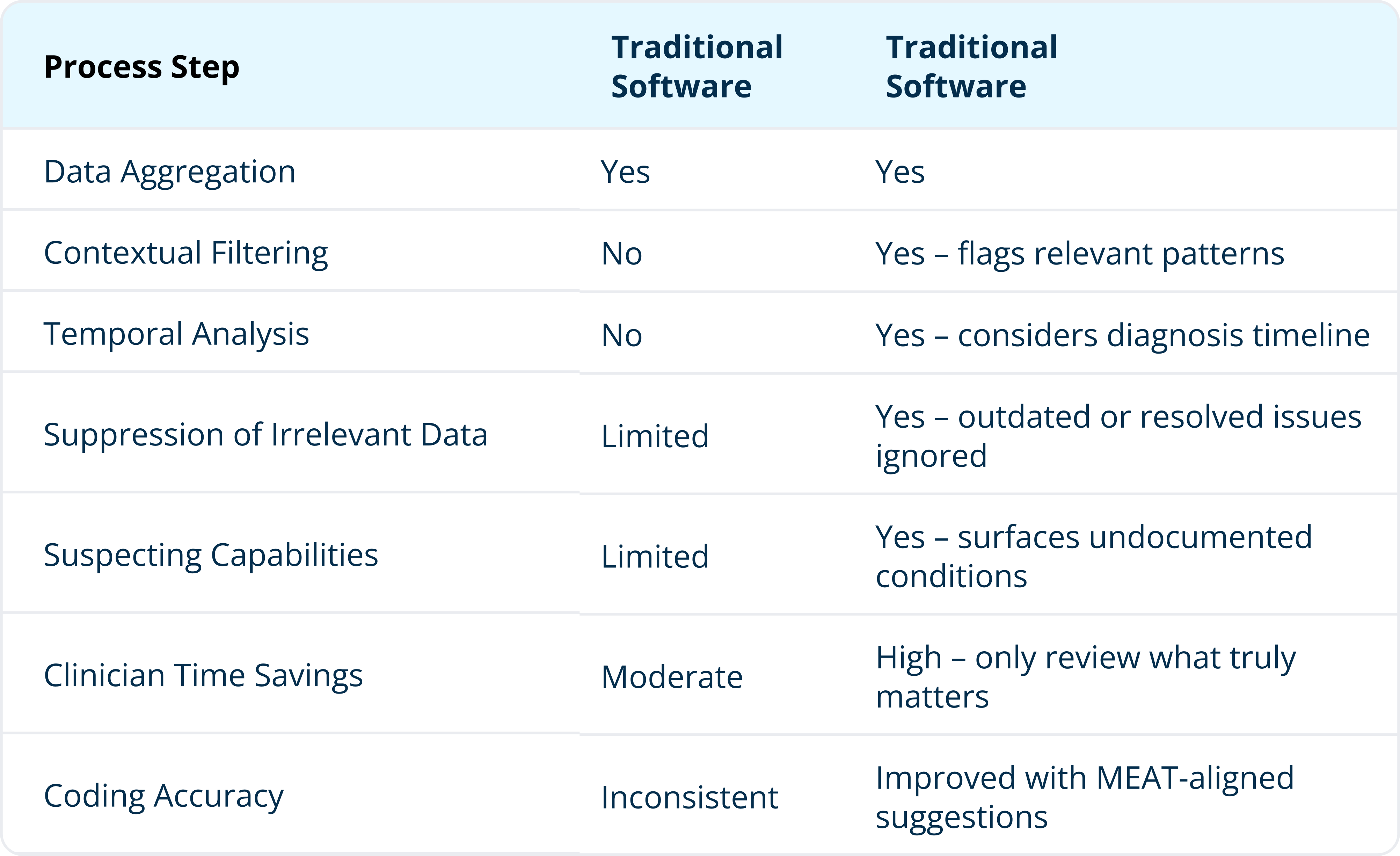
Let’s compare traditional software with AI-powered workflows:
Clinician benefits at the point of care
Ultimately, this approach isn’t just about better coding, it’s about supporting better care delivery. When clinicians are equipped with high-confidence, AI-curated summaries that highlight true coding opportunities, they can:
Make faster, more accurate documentation decisions
Spend less time on chart review
Maintain compliance with less stress
Focus more on clinical judgment, less on paperwork
In a value-based care world, this translates directly into stronger performance on quality and financial metrics.
AI-powered HCC coding is no longer optional
As risk adjustment becomes more complex and clinicians face greater demands on their time, relying on outdated chart review methods is no longer sustainable. The combination of aggregated and filtered data, processed intelligently by AI, represents a turning point in how healthcare organizations approach HCC coding.
This isn’t just about automation. It’s about turning noise into insight, supporting documentation accuracy, and protecting clinical time.
That’s where platforms like DoctusTech come in.
Built specifically for the challenges of HCC coding in value-based care, DoctusTech uses AI to aggregate multi-source data, intelligently filter it for clinical relevance, and present it in a way that actually helps clinicians, not burdens them. The platform identifies undocumented conditions, suppresses irrelevant clutter, and aligns with MEAT documentation standards, all while integrating seamlessly into daily workflows.
With DoctusTech, your team gets:
Actionable summaries, not just raw data
Point-of-care support without workflow disruption
Improved coding accuracy through compliant suggestions
Less burden on clinicians, more focus on patient care
In a world where every documented diagnosis affects care delivery, compliance, and reimbursement, AI-powered HCC coding with aggregated and filtered data isn’t just a tech upgrade, it’s a strategic advantage.
If your organization is ready to simplify HCC workflows and strengthen risk adjustment performance, DoctusTech is ready to help.
Discover how AI can transform your coding accuracy and support your clinical team, without adding more to their plate. Schedule a demo today.
You’ve invested in a targeted HCC coding refresher course to improve accuracy, boost RAF scores, or support clinicians. Maybe it was a brief CME module, a full-day workshop, or an in-app coding education tool. Now what?
Too often, coding retraining efforts are launched without a clear plan to evaluate impact. But in a value-based care environment where risk adjustment accuracy directly affects revenue, compliance, and care quality, knowing whether your refresher worked is not optional, it’s essential.
In this article, we’ll walk through how to assess the effectiveness of an HCC coding targeted refresher. We’ll cover:
What success looks like (and how to define it upfront)
The most telling KPIs to track post-retraining
How to structure a pre- and post analysis
Signs your refresher didn’t work, and what to do next
But before you dive into metrics or charts, take a step back: What were you hoping to change with this targeted refresher?
Define what “success” means for your organization
Before diving into dashboards or reviewing MEAT compliance, zoom out: what problem did you want this targeted HCC coding refresher course to solve?
Some organizations retrain clinicians on HCC coding because:
RAF scores were declining without a clear cause
Certain chronic conditions were consistently under-coded
New clinicians weren’t coding at the same level as their peers
The refresher may have aimed to:
Improve MEAT-compliant documentation
Reduce dropped or unspecified codes
Increase visibility of high-impact HCCs like diabetes with complications or depression
Boost provider confidence at the point of care
Tip: Revisit your original “why” for doing the refresher. That goal should guide your metrics and evaluation method.
Now, let’s explore more immediate metrics you can track: coding completeness, documentation quality, suspected HCCs reviewed, and how often coders or auditors are flagging issues. These will help you monitor changes in real time.
Choose the right metrics (beyond RAF alone)
It’s tempting to look only at changes in RAF scores, but RAF is a lagging indicator. Many other metrics will show change faster and more clearly. Consider tracking:
✅ HCC capture rate
Are clinicians documenting more unique HCCs per patient compared to pre-training?
Did the number of chronic HCCs increase to be in line with expected prevalence?
✅ MEAT compliance rate
What percentage of notes show full MEAT criteria (Monitor, Evaluate, Assess, Treat)?
Are clinicians adding clear supporting language for HCCs?
✅ Diagnosis specificity
Did unspecified codes (e.g., E11.9 or F32.9) decrease?
Are more diagnoses being coded with full detail, including all necessary companion codes? E.g., type 2 diabetes with kidney complications should be coded as E11.22and paired with a corresponding CKD stage code, such as N18.4 for stage 4 CKD.
✅ Audit pass rate
Has the rate of successful internal or external coding audits improved since retraining?
Are fewer diagnoses being rejected due to insufficient documentation?
✅ Clinician engagement
Did documentation behavior change in high-risk groups (e.g., new hires or low performers)?
Are more clinicians completing documentation on time or using point-of-care coding tools?
You must remember that these indicators might be a north star, but beyond the metrics, if you want to know if the refresher made a difference, it’s also useful to compare clinician performance before and after the training period.
Run a before-and-after analysis for the HCC coding refresher course
To truly know if your targeted refresher worked, you need a controlled comparison. Here’s how to set that up:
Step 1: Define your time periods
Choose a reasonable “before” window (e.g., 3–6 months pre-retraining) and an “after” window (e.g., 3 months post-retraining, with a 2-week buffer if needed).
Step 2: Segment by clinician group
Not all providers may have participated equally. Segment your data by:
Clinicians who completed the HCC coding refresher course vs. those who didn’t
By region or clinical specialty to account for differences in patient populations or expected coding.
By performance tier (low vs. high coding accuracy)
Step 3: Compare changes over time
Track the delta in metrics like:
Average HCCs per patient
Percent of charts with full MEAT documentation
Drop in unspecified or rejected codes
Step 4: Normalize for visit volume
Make sure changes aren’t due to simple increases or decreases in patient volume. Normalize metrics per 1,000 visits or per clinician FTE if needed.
In general, not all improvements show up in volume. Sometimes the real gains are in the quality of how things are written.
Look at the progress note quality, not just quantity
Let’s say your average RAF score hasn’t budged. That doesn’t mean your HCC coding refresher course failed.
Dig into note-level quality. Are clinicians:
Linking conditions to treatment plans?
Documenting chronic conditions, even if not the visit reason?
Using templated language but customizing for each patient?
Let’s look at this hypothetical example on what to compare pre- vs. post-refresher:
These kinds of improvements show behavioral change that can lead to long-term ROI, even if payment models haven’t caught up yet. But take into account that, if the refresher felt irrelevant, time-consuming, or confusing, it likely didn’t stick.
Use qualitative feedback from clinicians
Numbers matter, but so does narrative. Talk to the clinicians who went through the targeted refresher.
Ask:
Has it changed how they approach documentation?
Do they feel more confident identifying chronic conditions?
What barriers still prevent full MEAT documentation?
Is there clarity on which HCCs changed under V28?
These insights can reveal:
Where the training stuck
Where it needs reinforcement
Whether tools and workflows are supporting the knowledge
Clinician feedback helps you adapt future refreshers to feel less like “retraining” and more like ongoing support, it gives you direction. Their insights reveal where the training clicked, where it felt out of touch, and what still isn’t translating to daily practice. But don’t stop there. The real value comes when you turn that feedback into action.
Identify gaps and opportunities
If your analysis shows little to no improvement, don’t throw out the whole refresher. Ask:
Was the format right? (Live session vs. app-based? Self-paced vs. coached?)
Did all clinicians actually complete it?
Were the examples relevant to their specialty?
Was it too broad or too detailed?
Did it include V28-specific updates or real case examples?
In many cases, the issue isn’t the content, it’s retention and application.
Consider:
A second-phase refresher with new cases
Embedding reminders or nudges in the EHR
Highlighting small wins (e.g., showing how one note change raised a RAF score)
Even if this round wasn’t perfect, every effort gives you clues for what to do next.
Pinpointing what didn’t work is just the beginning. Once you understand where are the gaps (format, relevance, or retention) you can start designing smarter refreshers. But even the most engaging training won’t stick without the proper infrastructure. Next, we’ll look at the tools that help clinicians turn learning into lasting behavior change at the point of care.
Use tools that support post-training behavior change
Even the best targeted refresher can fall flat if clinicians don’t have time or tools to apply what they learned.
After retraining, it helps to:
Offer a point-of-care assist platform that flags missed diagnoses or vague codes
Run automated chart reviews to identify trends in MEAT compliance
Share monthly feedback reports with each provider, showing their coding patterns
These tools reinforce learning, support compliance, and reduce reliance on memory alone.
Of course, tools alone don’t create lasting change, but they do make it easier. When post-training support is embedded into daily workflows, it reduces friction and reinforces the right behaviors over time. Now that you’ve set the stage with education, feedback, and supportive systems, it’s time to zoom out and ask the bigger question: What does meaningful improvement in HCC coding look like, and how do you sustain it?
Final thoughts: An HCC coding refresher course is about more than just education
HCC coding improvement isn’t just about information, it’s about integration. A one-time targeted refresher can only go so far. But when it’s paired with behavioral nudges, aligned workflows, and consistent feedback loops, it becomes a real lever for lasting change.
So, how do you know your HCC coding targeted refresher made a difference? You track the numbers. You listen to clinicians. You dig into the notes. And you stay committed to continuous improvement.
This is where DoctusTech makes a difference. Through its comprehensive insights and data metrics, DoctusTech helps organizations track and analyze coding patterns, measure improvements, and identify areas for further support. With access to actionable data, healthcare teams can make informed decisions that drive both compliance and quality outcomes.
Because in the end, accurate HCC coding isn’t just a compliance checkbox. It’s a proxy for strong documentation, coordinated care, and better outcomes for the patients who need it most. And with DoctusTech’s data-driven approach, organizations are equipped to continuously optimize their processes and achieve sustainable success.
In value-based care (VBC), accurate risk adjustment is more than just a compliance checkbox—it’s the foundation for proper reimbursement, better population health management, and meaningful patient care. But each year, many chronic conditions go undocumented, leading to missed revenue and underrepresented patient risk scores. The issue? Poor HCC recapture.
Let’s explore why this happens and how HCC recapture with AI support is revolutionizing the way healthcare organizations approach documentation, recapturing, and compliance.
Why HCC recapture falls apart
The reasons for poor HCC recapture are deeply tied to the organization’s level of sophistication and resources. For example, in practices with limited infrastructure, clinicians are often solely responsible for identifying and re-documenting HCCs—sometimes in real time during the patient visit—without additional support.
Let’s imagine a scenario: a primary care physician is reviewing a patient’s chart during an annual wellness visit. If the patient’s chronic conditions are clearly listed in the problem list and thoroughly documented in the past, the provider may be able to recapture some of those HCCs. But even then, the clock is ticking.
They will prioritize an acute issue like elevated blood pressure in the limited time they have, skipping over less acute but still relevant diagnoses like diabetes or morbid obesity.
This leads to partial documentation. Worse, if last year’s documentation used a nonspecific diagnosis (e.g., “depression” instead of “major depressive disorder”), that HCC could be lost completely, along with a significant chunk of the RAF (Risk Adjustment Factor) score and associated revenue.
Even the most diligent clinicians can miss crucial diagnoses—not because they lack knowledge, but because the workflow isn’t built to support accurate and complete recapture. Let’s break down where traditional workflows make it even harder to get this right.
For example:
A provider may document “depression” multiple times, not realizing that CMS requires specificity (like “major depressive disorder”) for accurate risk capture.
A patient’s “heart failure” may be addressed during a visit. Still, if the encounter is documented solely under hypertension —a related condition that isn’t an HCC— the heart failure can go unrecaptured, despite being part of the clinical management.
All of this adds up to a system that puts too much pressure on clinicians and leaves too much room for error. The intention is there, but accurate HCC recapture becomes a hit-or-miss process without the right tools and support.
So, how do organizations try to catch what’s been missed? Let’s take a look at how manual chart reviews typically approach recapture.
How manual chart reviews typically handle recaptures
In many organizations, HCC identification is still handled manually, and while this method can catch missed diagnoses, it comes with significant limitations.
There are generally two approaches to manual chart reviews.
In one, coders check completed notes after the visit and advise clinicians on which ICD-10 codes need further specificity to support accurate HCC documentation.
In another, coders flag missed codes and offer clinical suggestions for future encounters. For example: “Based on this documentation, consider evaluating for [condition] at the next visit.” Both approaches can be valuable, but they rely on retrospective review.
And that’s where the problem begins.
Manual reviews are typically conducted after the note is signed, often 48 hours or more after the encounter. Due to this delay and the need to prioritize resource allocation, most organizations opt for targeted reviews, focusing only on specific visit types, such as annual wellness visits or charts flagged by payers. That means a large volume of documentation goes unchecked, leaving many conditions uncoded.
Even when organizations attempt broader reviews, staffing becomes a bottleneck, as it requires a large team of coders, either in-house or contracted, which drives up costs and slows down workflows. Most teams don’t have the bandwidth to do this consistently.
When documentation isn’t reviewed in time—or if it’s never reviewed at all—opportunities for accurate risk capture are missed. In some cases, entire panels of patients go under-coded for extended periods, leading to significant revenue loss and compliance risk. A provider with a large panel could potentially go an entire year without properly documenting HCCs.
Even if the gap is identified, it will require dedicated chart review sessions to clean up the data. Even then, if it is identified months later, some notes might fall outside the permissible correction window, meaning the lost revenue cannot be recovered.
This kind of scenario isn’t rare. And in today’s value-based care environment, where timely, accurate recapturing directly affects both compliance and reimbursement, that’s no longer good enough.
Some organizations try to balance costs by outsourcing coding reviews, focusing only on annual wellness visits, or high-risk patients. But even then, many gaps go unnoticed until it’s too late.
That’s the fundamental issue with manual recapture: even with experienced coders and targeted strategies, it’s still a race against time, capacity, and documentation gaps. And when the process relies on people catching mistakes after the fact, it’s nearly impossible to scale, let alone catch everything.
But that’s precisely where AI changes the game.
Transforming HCC Recapture with AI: A Game Changer for VBC Organizations
Artificial intelligence fundamentally shifts the approach to HCC documentation. Unlike static, rules-based systems, AI analyzes language, patterns, and relationships across patient records. Here’s how HCC recapture with AI redefines the game:
1. Text interpretation, not just data matching
AI can understand free-text notes, detect nuanced language around diagnoses, and flag relevant conditions—even when the conditions have not been coded or listed in structured fields.
For example, if a patient has multiple mentions of fatigue, shortness of breath, and previous heart studies, AI can connect these elements and recommend evaluation for a likely heart failure diagnosis —even if the condition hasn’t been explicitly listed.
This level of insight is nearly impossible with hardcoded rules, which can’t account for the complexity and variation of clinical language.
2. Documentation feedback
DoctusTech’s AI Coding Agent reads progress notes in real time and delivers actionable documentation feedback (for supported EMRs), and it checks 100% of charts for compliance, helping teams:
Recapture all previously documented HCCs.
Ensure documentation meets MEAT criteria.
Identify which conditions are compliant vs. at risk of audit failure.
By flagging errors, the AI agent boosts coder productivity up to 3x, supports compliance, and reduces RADV audit exposure.
3. Workflow-friendly support
AI doesn’t have to be disruptive. When integrated thoughtfully, it acts as a smart assistant:
Pre-visit: Surfaces suspected conditions for recapture
Point-of-care: Highlights relevant lab results, history, or prior notes tied to a flagged condition
Post-visit: Alerts providers to incomplete or non-specific documentation, with suggestions for improvement
Clinicians stay in control. AI simply directs their attention to the most relevant information—reducing the cognitive load without dictating care.
By shifting from reactive reviews to real-time, intelligent support, AI doesn’t just catch more—it empowers teams to document better from the start. But accurate documentation isn’t just about what gets flagged. It’s also about how well that documentation holds up under scrutiny.
That’s where MEAT criteria come in—and why they play a critical role in both recapture and compliance.
The role of MEAT in recapture and compliance
Recapture isn’t just about checking a box. CMS requires documentation to show that a provider is actively managing a chronic condition. That’s where MEAT criteria come in:
AI can analyze the clinician’s note and determine if each component is present for a given diagnosis. If one is missing, it flags the documentation as non-compliant.
This not only protects against audits, but it also ensures that the diagnosis is medically justified and relevant to the patient’s ongoing care.
MEAT isn’t just a compliance checkbox—it’s an excellent standard for credible, defensible HCC coding. And when it’s missing, the consequences go beyond documentation errors.
By holding documentation to MEAT standards, organizations strengthen both compliance and care quality. But ensuring every note meets those standards—consistently and efficiently—is a challenge no one should tackle alone. That’s where AI steps in, not to replace clinicians or coders, but to work alongside them.
Let’s examine how AI can become a trusted partner for coders, scribes, and clinicians.
AI as a partner for coders, scribes, and clinicians
In an ideal system, AI tools act as intelligent assistants—not replacements—for coding teams that include clinicians, coders, and scribes. When it comes to HCC recapture, the goal is to create a seamless partnership where AI enhances accuracy and efficiency without overwhelming workflows.
For clinicians, AI should:
Flag relevant HCCs in real-time during the visit, prompting for specificity and completeness in documentation.
Surface relevant past documentation (e.g., specialist notes, diagnostic results) to support diagnosis without manual digging.
Act as a post-visit auditor, ensuring documentation meets coding requirements and identifying any missed opportunities.
For coders, AI should:
Triage cases based on complexity or risk of error, so coders can focus on the charts that need human review.
Reduce time spent reviewing accurate charts, improving overall efficiency.
Identify documentation discrepancies (e.g., incorrect use of active vs. historical conditions) that need human judgment.
For scribes, AI should:
Provide real-time prompts during documentation to ensure critical details are captured at the point of care.
Suggest structured language that aligns with coding and compliance standards—especially for HCC-relevant conditions.
Reduce the burden of manual chart navigation by pulling in key historical data or labs relevant to the visit.
Ultimately, AI should streamline—not disrupt—the workflows of clinicians, coders, and scribes. While it may introduce new tools or steps, it also removes bottlenecks, minimizes chart review fatigue, and improves the accuracy of HCC recapture. When done right, AI becomes a quiet but powerful ally in delivering compliant, high-quality documentation.
What to ask before choosing an AI vendor
If you’re evaluating an AI tool for HCC coding, one of the most important questions to ask is: “Is this system compliant with the most current CMS guidelines?” That means staying up to date with both ICD-10-CM updates and HCC model revisions—both of which are essential for accurate risk adjustment and compliance.
To evaluate a vendor’s system, here’s what to look for:
Ask the vendor:
When was the latest update for their ICD-10-CM and HCC model?
CMS typically releases updates in April and October each year.
If the system is still using ICD-10 data from more than 6–12 months ago, it may already be outdated.
Pro tip
Check a publicly available ICD-10 lookup tool (like the CDC’s), and verify that the Fiscal Year (FY) matches the current release.
For example, the FY2025 ICD-10-CM update includes April 1, 2025 Addenda—so that should be reflected in any up-to-date AI tool.
Check how the AI handles newer codes:
Choose a condition with recent coding changes (like Parkinson’s disease, which moved from a single code to subcategories like G20.A1, G20.B1, etc.).
Test the system: Input one of these newer codes. If the tool doesn’t recognize it, it’s likely not using the most current database.
If you’re unsure:
Go toCMS.gov and navigate to the ICD-10-CM and HCC model updates.
Cross-check the AI system’s output with the most recent agenda or code list to make sure it’s aligned.
Bottom line: A good AI vendor should be able to clearly explain their update schedule, provide transparency into the source of their coding logic, and respond to regulatory changes in real time. If they can’t? That’s a red flag.
But choosing the right vendor is just the beginning. When AI is thoughtfully integrated, it elevates every role—from clinician to coder—making HCC recapture more accurate, efficient, and sustainable. But the real impact goes beyond workflow improvements or audit protection.
Final thoughts: HCC Recapture with AI Isn’t Just Financial
The cost of poor HCC recapture isn’t just financial. It can delay diagnoses, skew patient risk profiles, and lead to failed audits. But the good news is that tools for HCC recapture with AI are no longer a futuristic dream. They’re here now—and they’re working.
Whether your organization is just starting or scaling a risk adjustment program, AI can offer support at every stage. From suspecting to MEAT compliance, it’s not about replacing clinicians—it’s about giving them back time, confidence, and accuracy.
And in value-based care, those three things are everything.
With AI-enhanced tools like DoctusTech, organizations can:
Improve RAF accuracy
Streamline clinician workflows
Increase MEAT compliance
Reduce audit risk
Capture the full complexity of their patient population
The Centers for Medicare & Medicaid Services (CMS) just issued a serious wake-up call to all Medicare Advantage (MA) plans: Starting now, every eligible MA contract will be audited annually, and CMS is rapidly closing the books on a backlog of Risk Adjustment Data Validation (RADV) audits stretching from 2018 to 2024.
This change marks a sharp pivot from a previously slow and selective audit approach to an aggressive, full-scope enforcement strategy. So, what’s driving this shift? And what exactly are “unsupported diagnoses,” the root cause of billions in overpayments?
Let’s break it all down.
What changed? A new era of RADV enforcement
For years, CMS lagged in RADV audits. The last significant recovery of MA overpayments came from audits on 2007 data. Meanwhile, federal estimates suggest MA plans may be overbilling the government by $17–$43 billion each year.
All MA contracts will be audited every year going forward.
Audits from 2018–2024 will be completed by early 2026.
The coding team is expanding from 40 to 2,000 staff.
Each audit will now include 35–200 charts per plan, depending on size.
Technology and AI will help flag suspicious/unsupported diagnoses in submitted claims.
The goal? To recover overpayments and hold plans accountable for the accuracy of the diagnoses they submit.
Why are unsupported diagnoses the target?
If you’re reading this, you probably already know that MA plans are reimbursed based on their members’ RAF scores, which are calculated using the Hierarchical Condition Categories (HCC) model, and that the plans get reimbursed more money to provide care for their sicker patients (i.e., those that have more conditions or more severe conditions).
But here’s the catch: Those diagnoses must be clinically documented and relevant to the patient’s care. If a diagnosis is not supported by medical documentation, it’s considered “unsupported”—and therefore ineligible for payment.
That’s why RADV audits zero in on one thing: Are the diagnoses you’re getting paid for actually supported in the chart?
It’s not enough for a condition to exist, it has to be documented with clinical relevance and intent to treat.
But in practice, that’s where things get confusing. Many unsupported diagnoses aren’t the result of fraud; they’re just the result of gaps in everyday workflows that go unchecked.
Let’s look at 4 common ways unsupported diagnoses show up in charts and how they can put your plan at risk.
4 Common use cases (and misuses) of unsupported diagnoses
Let’s explore where unsupported diagnoses appear and how they impact value-based care programs.
Many EHRs allow auto-populating diagnoses from prior visits. While this speeds up documentation, it often leads to chronic or resolved conditions being pulled forward without evaluation or treatment, making them unsupported.
Example: A patient’s chart still lists “Major depressive disorder, moderate, recurrent episode” in the assessment and plan section of the note, but there’s no assessment, treatment, or mention in today’s note. That HCC should not be added to today’s note or submitted.
2. Historical diagnoses without ongoing impact
Diagnoses must be active during the encounter. Resolved conditions without current relevance can’t justify payment unless specified and supported.
Example: A patient had prostate cancer treated 5 years ago and is now cancer-free. If the patient is not on adjuvant therapy, then the active cancer diagnosis is unsupported and should be switched to history of prostate cancer.
3. Coding from lab values or imaging alone
Coders sometimes extract diagnoses from labs or imaging reports. However, a diagnosis needs to be made and documented by an eligible provider —typically MDs, DOs, NPs, or PAs—in a face-to-face visit, not inferred from a value. Diagnoses from scribes, MAs, or unlicensed staff aren’t valid.
Example: An eGFR of 55 appears in labs, but if the provider doesn’t document CKD stage 3a in the note, it’s not valid for risk adjustment.
4. Conditions without evaluation, assessment, or plan
Even if a condition is listed in the note, it’s unsupported if it isn’t evaluated or addressed. The recommended standard is the MEAT criteria (Monitoring, Evaluation, Assessment, Treatment).
Example: “Heart failure” is on the diagnosis list, but there’s no mention of symptoms, exam findings, or medication adjustments. That’s an audit risk.
What’s at stake?
CMS is not just validating diagnoses—they’re using audit results to extrapolate overpayments across entire plans. That means a few unsupported diagnoses in a 100-record sample could result in millions in repayment demands.
Plans that haven’t taken RADV seriously will be playing catch-up fast. The cost of non-compliance is no longer theoretical—it’s actionable.
How can you be prepared?
If you’re in population health, risk adjustment, or care delivery leadership, now is the time to:
1. Retrain providers on MEAT documentation
Help them understand which documentation is compliant for HCC coding and which isn’t.
2. Audit high-impact diagnoses internally.
Use retrospective chart audits to flag unsupported codes before CMS does.
3. Invest in Clinical Documentation Improvement (CDI)
CDI teams can help bridge gaps between documentation and coding accuracy.
4. Scrutinize vendor-coded charts
Not all external coders understand the nuance of HCC rules. Spot check their work.
5. Embrace RADV readiness as a continuous process.
With yearly audits now guaranteed, RADV prep isn’t a one-time event. It’s an operating requirement.
6. Leverage AI tools that do the heavy lifting.
AI-powered platforms like DoctusTech can transform your RADV readiness by checking 100% of charts in real time, ensuring HCCs are properly supported, and more.
Final thoughts: This is about accountability
CMS is sending a clear message: If you want to participate in a program that rewards managing patient risk, your documentation must prove it.
Unsupported diagnoses erode trust in the MA program and jeopardize funding meant for high-risk care. On the other hand, accurate documentation builds a sustainable model that rewards true clinical complexity and improves outcomes.
RADV audits aren’t just about clawbacks. They’re about accountability.
And for MA plans committed to integrity and quality care, that’s an opportunity, not a threat.
At DoctusTech, we help provider organizations and health plans improve HCC coding accuracy without adding an administrative burden to clinical teams.
With our mobile learning app, providers get brief, case-based training that fits into their day, reinforcing how to document and code diagnoses per CMS’s expectations. Our platform helps:
Reinforce MEAT documentation standards using real-world scenarios
Reduce unsupported diagnoses through more innovative education, not more paperwork
Improve RAF accuracy while staying compliant with V28 and RADV rules
It’s not just about coding education. It’s about empowering providers to get it right the first time, which protects your organization from overpayment risk and helps ensure patients receive the care they need.
Want to see how it works? Schedule a demo and see how DoctusTech helps you stay ahead of CMS’s RADV expansion.
In an era where efficiency and accuracy in medical documentation are paramount, automated chart reviews with AI are revolutionizing how healthcare professionals handle patient data. Traditional chart reviews, often time-consuming and limited in scope, are now being enhanced with AI-driven tools that streamline the process, reduce human errors, and improve compliance with medical regulations.
This article explores how AI-powered chart reviews work, their benefits over manual reviews, their challenges and misconceptions, and how they can enhance clinician workflows.
The Traditional vs the AI-Powered Approach to Chart Reviews
Historically, chart reviews have relied on manual audits performed by medical professionals. These reviews involve selectively analyzing a small sample of patient records to assess compliance, coding accuracy, and documentation completeness. However, manual reviews present significant limitations:
Limited Scope: Reviewers can only assess a fraction of patient charts due to time constraints.
Human Error: Even experienced professionals may overlook patterns or misinterpret documentation.
Time and Resource Intensive: Reviewing large volumes of charts requires significant manpower and time.
With AI-powered chart reviews, technology can analyze entire datasets of patient records in real time. Unlike human auditors who can only evaluate limited samples, AI tools can process vast amounts of medical data instantly, identifying patterns, inconsistencies, and missing documentation with unparalleled accuracy. This is How AI-Powered Chart Reviews Differ from Traditional Methods:
Comprehensive Analysis: AI scans every patient record rather than relying on a small, random sample.
Error Reduction: AI models detect inconsistencies and missing documentation with greater precision.
Efficiency: Automating reviews allows for continuous monitoring, ensuring compliance with evolving medical regulations.
Pattern Recognition: AI can identify trends in documentation, such as common coding errors or missing clinical indicators.
AI vs. Standard Software Tools in Chart Reviews
While traditional software programs can assist with documentation, they typically function using rule-based searches, limiting their flexibility. Unlike traditional rule-based programs, Chart Reviews with AI can interpret context and adapt to different documentation styles, making it a more effective tool for identifying compliance gaps.
For instance, a basic software program may simply flag whether a condition is mentioned in a patient’s chart, whereas AI can assess whether the condition is sufficiently documented based on clinical guidelines. This contextual awareness makes AI superior to simple searches, reducing false positives and improving accuracy.
One of the biggest challenges with standard software tools is their reliance on keyword searches. A simple program might flag every mention of “heart failure” in a patient’s records, but it won’t distinguish between “ruled out heart failure” and an actual diagnosis. AI, however, is being trained to understand nuanced medical language, including whether a clinician is documenting a confirmed condition, considering it as a possibility, or ruling it out entirely. Unlike traditional systems that operate with rigid, rule-based searches, AI has the potential to evaluate whether a condition is documented in compliance with MEAT (Monitor, Evaluate, Assess, and Treat) criteria.
Beyond improving accuracy, AI-driven tools also enhance clinician efficiency by integrating seamlessly into existing workflows:
Pre-Visit Planning: AI highlights relevant patient history, chronic conditions, and potential compliance risks before a consultation, helping clinicians prepare more effectively.
Real-Time Feedback: Clinicians receive instant alerts if documentation is incomplete or non-compliant, reducing the risk of audit penalties.
Post-Visit Reviews: AI reviews recent consultations to ensure coding accuracy and compliance with regulatory requirements, helping maintain accurate and complete documentation.
Reducing Administrative Burden: By automating documentation checks, AI allows clinicians to spend less time on paperwork and more time on patient care.
Despite these advantages, AI still requires refinement. Clinicians document information in varying ways, which can confuse AI models. For example, determining whether a condition is being actively monitored or simply mentioned can be challenging due to differences in writing styles, abbreviations, and phrasing. AI-powered tools must continuously learn from edge cases to improve their accuracy, reducing false positives and negatives.
Addressing Compliance and Regulatory Concerns
Chart Reviews with AI play a critical role in ensuring compliance with regulations such as CMS (Centers for Medicare & Medicaid Services) guidelines. By analyzing medical records against predefined compliance criteria, AI can detect documentation gaps before they become audit issues. This proactive approach minimizes the risk of penalties and ensures that healthcare providers maintain accurate patient records.
However, AI is not yet capable of fully replacing human coders. Regulations and coding guidelines frequently change, requiring ongoing updates to AI models. While AI can flag documentation errors and suggest corrections, human oversight remains essential for addressing complex cases and interpreting nuanced medical data.
However, AI is not a perfect solution, and its role is often misunderstood. Despite the promise of AI in chart reviews, there are several misconceptions that need to be addressed:
1.AI Will Replace Human Coders: While AI significantly reduces the workload of medical coders, human oversight is still required for complex cases and regulatory updates.
2.AI is 100% Accurate: AI-driven tools require continuous refinement to improve accuracy and minimize false positives.
3.AI Works Without Human Input: AI systems rely on predefined parameters and training data, meaning they still need human supervision and continuous learning.
Beyond these misconceptions, AI adoption in medical coding faces real challenges.
Challenges and Limitations of Chart Reviews with AI
Although Chart Reviews with AI have the potential to greatly enhance accuracy and efficiency, it depends on large volumes of high-quality data. However, healthcare documentation can vary significantly across clinicians, specialties, and institutions, which presents several challenges when AI analyzes medical records. Here are some of the common challenges AI faces in interpreting medical documentation:
Understanding Variability in Clinical Documentation: Clinicians document diagnoses differently, making it difficult for AI to interpret all variations accurately. Unlike traditional software that simply checks for documentation presence, AI must determine whether a condition meets compliance criteria, such as the MEAT framework. This involves distinguishing between phrases like “monitoring heart failure” and “heart failure considered and ruled out.”
False Positives and False Negatives: Because clinical language is often inconsistent, AI may flag conditions incorrectly. For example, if a clinician writes “patient screened for diabetes, results negative,” a keyword-based system might incorrectly categorize this as a documented diagnosis. AI models must continuously refine their understanding to avoid such misinterpretations.
Complex Sentence Structures: Clinicians often phrase evaluative statements in unique ways, making it difficult for AI to determine whether a condition is worsening, stable, or improving. Unlike humans, AI struggles with ambiguous language and varying documentation styles, requiring ongoing training to handle edge cases.
User Adoption: Clinicians may be hesitant to rely on AI-driven tools, especially if they are not well integrated into existing workflows. If AI frequently misflags conditions or requires excessive manual corrections, trust in the technology diminishes.
Changing Regulatory Standards: AI systems must be continuously updated to align with evolving medical coding regulations. A model that works well today may need adjustments tomorrow as guidelines shift.
By tackling common misconceptions and challenges, healthcare organizations can unlock the full potential of AI-driven chart reviews—improving accuracy, efficiency, and compliance—without over-relying on the technology or overlooking the value of human oversight.
As the technology evolves, AI’s ability to process vast amounts of medical data far exceeds traditional methods, and chart reviews will only become more effective at reducing administrative burden and supporting regulatory adherence.
Real-World AI Integration: DoctusTech’s PDAP
One example of AI transforming automated chart reviews is DoctusTech’s Patient Diagnosis Assist Platform (PDAP). This AI-driven tool integrates with over 70 major EMRs, allowing clinicians to streamline the redocumentation process without switching between portals or dealing with paper-based systems.
DoctusTech enhances pre-chart planning with:
Automated Chart Reviews: AI translates patient charts into accurate HCC codes in seconds, saving up to 2.5 hours per week per clinician on documentation.
Faster Progress Notes: By aggregating all relevant data directly into the EMR, clinicians can complete notes efficiently with 100% satisfaction.
Huddle Board: A feature that streamlines patient encounter management, displaying visit types, screening tests, and action items for optimized workflows.
Final Thoughts: Chart Reviews with AI for Smarter Healthcare
Chart Reviews with AI represent a transformative shift in healthcare documentation, improving accuracy, compliance, and efficiency. AI enables healthcare providers to focus on delivering high-quality patient care by improving accuracy, enhancing compliance, and reducing administrative burdens.
While challenges remain, ongoing advancements in AI technology and seamless integration into clinical workflows will ensure that AI becomes an indispensable tool in medical chart reviews. The future of healthcare documentation is here, and AI is leading the way.
Ready to see how DoctusTech can help? Schedule a demo today and discover how DoctusTech can transform your pre-charting and HCC coding processes.
Missed diagnoses can seriously impact HCC coding accuracy, leading to gaps in patient management. However, these oversights can be prevented with proactive pre-chart planning. By setting up a structured approach before the patient visit, healthcare teams can catch diagnoses early, streamline documentation, and reduce the risk of costly redocumentation errors.
Chronic conditions like diabetes or heart failure require annual redocumentation to ensure accuracy, yet time constraints and inefficient communication between providers and coding teams can result in missed opportunities for reimbursement. With the right pre-chart planning strategies, these issues can be addressed head-on, improving the bottom line and patient care.
In this article, we’ll break down 8 key pre-chart planning steps that can help your team catch missed diagnoses, optimize coding accuracy, and enhance overall care delivery.
8 Pre-Chart Planning Strategies to Catch Missed Diagnoses
Here are 8 effective pre-chart planning strategies to help healthcare teams catch and document all relevant diagnoses.
1. Establish a Structured Redocumentation Plan
A well-defined pre-chart planning strategy should include a structured timeline for reviewing and confirming previously documented conditions. Redocumenting chronic conditions such as diabetes, heart failure, or hypertension is crucial to ensure accuracy and maximize reimbursements. By setting clear expectations around when and how these conditions should be redocumented—whether during annual wellness visits, routine check-ups, or specific follow-up appointments—you create consistency across the practice.
This structured plan should include a checklist for providers, reminding them to review the patient’s medical history, confirm current diagnoses, and update any changes in the condition’s severity or treatment. It’s essential that these tasks are integrated into routine workflows to prevent them from being overlooked.
Incorporating key performance indicators (KPIs) into the redocumentation plan further strengthens its effectiveness. By tracking metrics such as HCC Recapture Rate or Suspects Review Rate, you can identify gaps in the process and take corrective action. Monitoring KPIs ensures that redocumentation is occurring consistently and with the level of accuracy needed to optimize reimbursements and minimize revenue leakage.
Implementing this plan not only ensures that all relevant conditions are redocumented but also mitigates the risk of missing important reimbursement opportunities.
2. Ensure Team Alignment with Clear Roles and Responsibilities
A successful pre-charting strategy depends on a coordinated team effort. Clearly defining roles—such as medical assistants reviewing labs, scribes preparing documentation, and coders validating accuracy—streamlines workflows and ensures accountability. Implementing task management software can help assign and track responsibilities, reducing miscommunication and ensuring each team member fulfills their role efficiently.
This structured approach helps eliminate bottlenecks and enhances documentation accuracy. A successful pre-charting strategy depends on a coordinated team effort. Clearly defining roles—such as medical assistants reviewing labs, scribes preparing documentation, and coders validating accuracy—streamlines workflows and ensures accountability.
Now, to achieve alignment, healthcare organizations should implement the following best practices:
1. Establish Clear Communication Channels: Regular meetings and collaborative platforms ensure that clinicians, coders, and support staff stay informed about updates and best practices.
2. Define Standardized Procedures: Having a clear, documented workflow for pre-chart planning helps maintain consistency across the team.
3. Use Data-Driven Dashboards: Providing real-time access to patient data, coding alerts, and redocumentation needs helps team members make informed decisions.
4. Implement Role-Based Training: Tailored training sessions ensure that each team member understands their specific contributions to the pre-charting process.
5. Encourage Continuous Feedback: Regular audits and team discussions help refine strategies and address any gaps in documentation alignment.
By fostering a structured and collaborative approach, healthcare teams can optimize pre-chart planning efforts and minimize missed diagnoses.
3. Utilize AI-Driven Software for Diagnostic Support
AI-powered tools streamline pre-charting by identifying previously documented but unrecorded conditions, flagging potential diagnoses based on lab results, and assisting in risk stratification. In fact, some tools integrate seamlessly with electronic health records (EHRs), allowing clinicians to receive automated alerts and real-time analytics during patient visits. AI can also assist coders by suggesting relevant HCC codes, reducing manual effort, and improving accuracy.
By embedding AI into the workflow, healthcare teams can enhance efficiency, reduce administrative burden, and ensure comprehensive documentation. AI-powered tools streamline pre-charting by keeping track of previously identified but undocumented conditions, flagging potential diagnoses based on lab results, and assisting in risk stratification.
Automated alerts and real-time analytics help focus clinical and coding teams on high-priority updates, reducing reliance on manual checks.
4. Review the Problem List Regularly—Right Before or After the Visit
An accurate, up-to-date problem list is essential for both quality care and compliant risk adjustment. Clinicians should review the list during routine workflows—ideally right before or immediately after the patient visit. This is the best time to remove outdated diagnoses, correct any inaccuracies, and ensure that appropriate combination codes (like diabetes with CKD) are captured.
Using EHR-integrated tools can make this process easier by flagging inconsistencies and prompting for missing chronic conditions. Consistently updating the problem list not only supports better clinical decisions but also ensures diagnoses are documented in a way that reflects true patient complexity and improves reimbursement accuracy
5. Integrate Lab and Diagnostic Data Reviews
Reviewing lab results and diagnostic tests before the patient visit can reveal undiagnosed conditions that impact risk adjustment. AI-powered analytics tools can analyze lab trends and alert clinicians about abnormal values that require follow-up. For example, an AI tool might flag a recently elevated A1C as a potential indicator of diabetes or highlight a previously low GFR result that could suggest CKD.
These insights can be integrated directly into EHR workflows, prompting providers to address flagged conditions during patient encounters, ensuring they are documented and managed appropriately. Reviewing lab results and diagnostic tests before the patient visit can reveal undiagnosed conditions that impact risk adjustment.
For example, persistent elevated A1C levels may indicate diabetes, while declining GFR levels may point to CKD. Proactively analyzing this data ensures that all clinically relevant conditions are addressed during the visit.
6. Strengthen Collaboration Between Primary Care and Specialists
Specialist reports often contain valuable diagnostic insights. These notes can help bridge documentation gaps, especially regarding less common or complex diagnoses that primary care providers may hesitate to code without additional support. Implementing structured communication pathways—such as shared EHR access, automated specialist consult summaries, or AI-driven report extraction—ensures that relevant diagnoses are easily accessible to primary care teams.
By cross-referencing these reports during pre-chart planning, healthcare teams can ensure that all relevant conditions are documented in the patient’s medical record. This approach reduces documentation silos and enhances continuity of care.
By cross-referencing these reports during pre-chart planning, healthcare teams can ensure that all relevant conditions are documented in the patient’s medical record. Structured communication between specialists and primary care teams helps capture a more complete clinical picture.
Instead of broad checklists, targeted quick-reference guides for frequently missed diagnoses improve documentation accuracy. These guides should be specialty-specific and highlight conditions commonly underreported in risk adjustment models. To improve accessibility, these guides can be integrated into EHR systems, providing real-time prompts when a provider enters related diagnoses.
AI-assisted suggestions based on historical patient data can enhance the guide’s usefulness, ensuring that high-risk conditions are consistently documented.
Instead of broad checklists, targeted quick-reference guides for frequently missed diagnoses improve documentation accuracy. These guides should be specialty-specific and highlight conditions commonly underreported in risk adjustment models.
8. Provide Continuous Training on HCC Coding
Frequent training ensures that healthcare teams stay updated on evolving risk adjustment and HCC coding guidelines. Implementing AI-based learning platforms can tailor training content based on individual clinician or coder performance, identifying specific areas that need improvement. Virtual simulation tools and real-time feedback mechanisms within EHRs can reinforce best practices, ensuring teams apply proper coding techniques consistently.
Frequent training ensures that healthcare teams stay updated on evolving risk adjustment and HCC coding guidelines. Interactive workshops, coding refresher courses, and ongoing education foster a culture of continuous improvement and compliance.
How AI Can Help with Pre-Charting
AI-powered software makes pre-chart planning and documentation a seamless part of your workflow. For example, DoctusTech’s Patient Diagnosis Assist Platform (PDAP) uses AI to help streamline the redocumentation process. Our platform integrates with over 70 major EMRs and ensures that clinicians can easily document HCC codes directly within their system, without having to switch between portals or deal with paper-based systems.
Here’s how DoctusTech can enhance pre-chart planning:
1. Improve Patient Visits Get real-time prompts based on patient charts, including questions to ask and labs to consider. This feature significantly raises chronic HCC recapture rates to 92%, helping clinicians capture all the relevant diagnoses during patient visits.
2. Automate Chart Review Our AI-driven platform translates patient charts into accurate HCC codes in seconds, saving up to 2.5 hours per week per clinician on documentation and improving coding accuracy.
3. Accelerate Progress Notes Say goodbye to third-party portals or paper-based coding. With DoctusTech, all relevant data is aggregated directly in your EMR, allowing for faster progress notes and 100% clinician satisfaction.
4. The Huddle Board This feature helps streamline patient encounter management for clinical and non-clinical staff. It offers a detailed overview, displaying patient names, visit types, screening tests, and action items, so that chart preppers, scribes, and MAs can optimize their workflows.
Investing in DoctusTech’s PDAP means empowering your team with the tools to streamline pre-charting, save time, and enhance HCC coding accuracy—all within your EMR.
Final Thoughts: Proactive Pre-Chart Planning Drives Better Outcomes
Pre-chart planning is vital for catching missed diagnoses, improving coding accuracy, and optimizing reimbursement. By implementing these 8 strategies—from structured documentation plans to software integration and team training—healthcare organizations can ensure a smoother, more efficient process for identifying and coding chronic and newly emerging conditions. Investing time in proactive planning translates to better patient care and financial stability for the practice.
Ready to see how DoctusTech can help? Schedule a demo today and discover how DoctusTech can transform your pre-charting and HCC coding processes
You’ve done training before, but documentation errors keep creeping in. Charts are missing key HCC codes, chronic conditions aren’t being redocumented, and you’re starting to wonder—will we be scrambling at the end of the year to fix all this? Sound familiar?
That’s precisely why a Risk Adjustment refresher course exists. They’re not just another box to check off; they’re a way to keep risk adjustment top of mind for your team, improve documentation habits, and make sure your team is set up for success—without a last-minute panic.
Let’s explore what makes a practical refresher course, how to structure it, and how to measure its impact.
Understanding the Role of a Risk Adjustment Refresher Course
A Risk Adjustment refresher course shouldn’t be a boring PowerPoint presentation about HCC coding. It’s a strategic touchpoint to reinforce best practices and help teams avoid common documentation pitfalls. Done right, it can mean the difference between a smooth, well-documented year and a frantic scramble to correct errors before submission deadlines.
For example, if you notice that documentation rates are lower than expected by Q1, you can run a refresher course focusing on redocumentation, workflow improvements, and CMS compliance. This way, clinicians can work toward improving their HCC coding accuracy and avoid an end-of-year crunch by maintaining consistent documentation throughout the year.
How Often Should You Run a Risk Adjustment Refresher Course?
Most teams schedule a Risk Adjustment refresher course at least once a year, but successful organizations integrate them more frequently:
Quarterly Check-Ins: These are structured sessions designed to dive into performance metrics, documentation trends, and improvement areas. Leadership teams, clinical directors, and coding specialists review redocumentation rates, audit findings, and CMS guideline adherence to ensure the organization is on track.
During Morning Huddles: These brief but focused meetings integrate risk adjustment updates into daily workflows. They highlight immediate concerns, such as specific documentation gaps, coding errors, or upcoming CMS compliance changes, ensuring real-time course correction.
On-Demand Learning: A flexible solution that benefits all organizations. Small practices appreciate its practicality, as clinicians can learn at their own pace without disrupting patient care. Large healthcare systems value its scalability, allowing multiple locations and teams to receive standardized training. One solution that fits all is the DoctusTech Learning App, preferred by 9 out of 10 clinicians.
Case-Based Discussions: Highly beneficial for specialists (e.g., cardiologists, endocrinologists) working within VBC models. Reviewing real patient cases ensures that documentation aligns with both clinical and risk adjustment requirements. In primary care, case-based discussions can be equally impactful when tailored to address specific documentation gaps, such as under-documentation of major depressive disorder.
5 Key Ingredients of an Effective Refresher Course
Let’s be honest—clinicians and coders are busy. If they don’t see the value, they won’t engage. A good refresher starts by connecting documentation back to what matters:
Better Patient Care: Ensuring conditions are properly documented leads to better treatment and follow-up.
Financial Impact: Without proper documentation, known chronic conditions won’t be reimbursed, leaving money on the table.
Compliance Risks: Missing redocumentation can mean non-compliance, audits, and clawbacks.
2. Address Common Documentation Pitfalls
If you had to pick one thing to focus on in a refresher, it should be redocumentation. Too often, chronic conditions from the previous year aren’t re-recorded, leading to missed reimbursement opportunities. Providers risk losing credit for previously diagnosed conditions without re-documentation, ultimately impacting risk scores and reimbursement accuracy.
To put this into perspective, consider the following scenario: Your team currently documents only 28% of chronic conditions annually, which means that 72% go unreported, leading to gaps in patient care and lost revenue.
So, what can you do to fix this? Here’s how to approach it:
Set Clear Goals: Aim to redocument at least 95% of chronic conditions annually.
Analyze Past Performance: Review last year’s documentation and compare it to the current year’s HCC submissions. Identify missing chronic conditions and implement structured reminders.
Reinforce Best Practices: Encourage clinicians to consistently review past diagnoses and document conditions accurately during visits where time allows. Another option is to take advantage of your scheduled check-ins, such as annual wellness exams or routine checkups, to have more opportunities to focus on comprehensive documentation.
Beyond redocumentation, there are other documentation pitfalls that refresher courses should address:
Not specifying diagnoses (e.g., using “unspecified depression” instead of “major depressive disorder, recurrent, moderate”).
Incomplete screening and lab orders, leading to missed coding opportunities.
Lack of documentation for conditions that impact risk scores, which affects reimbursements and compliance.
3. Make Workflows More Efficient
Many documentation errors happen because workflows aren’t optimized. A Risk Adjustment Refresher Course could:
Identify where documentation is breaking down.
Reinforce clinic workflows to ensure proper HCC coding at the point of care.
Highlight small workflow changes that have a significant impact (e.g., structured templates in the EMR to ensure required documentation is included).
4. Stay Aligned with CMS Guidelines & Coding Updates
CMS updates its guidelines every year, and staying ahead of these changes is critical. A refresher course should:
Summarize major updates (e.g., the addition of “Class 3 Obesity” as a new ICD-10 code).
Explain how these updates affect documentation and reimbursement.
Provide easy-to-follow guidance for clinicians on adapting to changes.
5. Use Engaging Teaching Methods
Nobody wants to sit through a dry, technical lecture. Make refresher training engaging and practical:
Case-Based Learning: Walk through real patient scenarios.
Microlearning Modules: Short, focused lessons clinicians can complete in minutes.
Quizzes & Gamification: Make learning interactive.
Customized Learning Paths: Tailor training based on common documentation gaps in your organization.
How to Measure the Impact of a Refresher Course
Training is only valuable if it leads to measurable improvements. Here’s what to track:
1. Redocumentation Rates
Metric: The percentage of previously diagnosed HCC conditions was redocumented this year.
Target: 95% or higher.
Actionable Insight: If redocumentation is low, find out why clinicians are forgetting, or use software that helps you automate this goal such as DoctusTech’s PDAP.
2. Coding Accuracy & Specificity
Metric: Reduction in unspecified diagnosis codes.
Target: More detailed diagnoses (e.g., “major depressive disorder, recurrent, moderate” instead of “unspecified depression”).
3. Number of New HCC Codes Captured
Metric: Number of new chronic conditions documented per patient visit.
Consideration: This varies—clinics new to HCC coding may capture more than established ones.
4. Compliance & Internal-Audit Performance
Metric: Percentage of charts flagged for coding inaccuracies pre- and post-training.
Insight: Documentation errors should decrease over time if refresher courses are practical.
These are basic KPIs to monitor before and after your refresher course to check if it works and identify areas for improvement. However, if you want to go deeper into metrics and you’re just starting a Risk Adjustment initiative, we recommend the article 4 Essential Risk Adjustment KPIs for Your First 90 Days.
When to Implement Additional Retraining
Even with regular refresher courses, some teams may need extra help. Consider retraining when:
Redocumentation rates drop below expected levels.
Certain conditions are underreported compared to regional benchmarks.
Audits reveal frequent coding mistakes or unspecified codes.
A great refresher course isn’t just about reviewing rules—it’s about making risk adjustment easier, more efficient, and more effective. By keeping training engaging, aligning it with real-world workflows, and tracking meaningful metrics, organizations can improve compliance, maximize reimbursements, and ultimately deliver better patient care.
A Risk Adjustment Refresher Course doesn’t have to be a chore. When done right, they become a powerful tool for making risk adjustment second nature in your organization. And with DoctusTech’s HCC coding education app, staying on top of your training has never been easier. Delivered weekly right to your phone, our app provides individualized learning to help VBC organizations like yours increase RAF accuracy by 30%.
Risk adjustment models are standardized methodologies used to estimate the expected healthcare costs of a patient population based on clinical complexity and demographic factors. In Medicare Advantage and other value-based programs, models like CMS-HCC assign condition categories to diagnoses so plans and providers are reimbursed fairly for caring for sicker or more complex patients.
What is the primary purpose of risk adjustment in healthcare?
The primary purpose of risk adjustment is to align reimbursement with patient complexity, ensuring providers and health plans are compensated accurately for the true health risk of their populations. This protects organizations from financial underpayment, supports equitable comparisons of quality and outcomes, and discourages risk selection.
What is the difference between HEDIS and risk adjustment?
HEDIS and risk adjustment serve different but complementary roles: HEDIS measures quality and performance (e.g., screenings, outcomes, care gaps). Risk adjustment measures patient acuity and disease burden to determine payment. In short, HEDIS answers “How well was care delivered?” while risk adjustment answers “How sick was the patient?”
What is the risk adjustment factor (RAF) in healthcare?
The Risk Adjustment Factor (RAF) is a numeric score that represents a patient’s overall health risk based on documented diagnoses and demographics. Each condition adds weight to the score, and the total RAF directly influences reimbursement. Higher RAF scores reflect greater clinical complexity and higher expected costs.
How do you calculate a risk adjustment factor?
RAF is calculated by: Capturing all clinically valid diagnoses documented during the year Mapping those diagnoses to HCCs under the CMS model Adding demographic factors (age, sex, eligibility status) Summing the assigned coefficients to produce a final RAF score Accurate RAF calculation depends on complete, compliant documentation. Missing or unsupported diagnoses can materially reduce reimbursement and increase audit risk.
Real-time feedback loops in HCC coding can help clinicians correct mistakes instantly and learn from them. Traditional methods of improving coding accuracy often rely on retrospective audits, which may take weeks or months before clinicians receive insights. This delay can result in missed opportunities for accurate documentation and increased administrative burden.
By integrating real-time feedback, clinicians can receive immediate guidance, make corrections on the spot, and reinforce best practices. More importantly, it fosters a culture of continuous improvement, reducing repetitive errors and ensuring compliance with evolving coding guidelines.
Healthcare organizations can proactively support clinicians rather than rely solely on post-service audits, enabling more efficient workflows and better patient care.
That’s why this article will explore the steps, challenges, and best practices for setting up real-time feedback loops in HCC coding, ensuring they are constructive, efficient, and lead to measurable improvements.
Understanding Real-Time Feedback Loops in HCC Coding
To implement this kind of system, organizations must first establish key components:
Data Collection & Identification of Gaps
Review & Analysis of the Data
Feedback Delivery to Clinicians
Justification & Training for Improvement
Each step is critical in creating a seamless loop where clinicians receive feedback on documentation errors or omissions and adjust their practices accordingly. Whether from software, trained personnel, or a hybrid approach, you must ensure the system functions efficiently.
Step 1: Data Collection & Identifying Gaps
The foundation of real-time feedback lies in identifying where clinicians struggle. Your organization can do this in several ways:
Automated Software Solutions: AI-powered tools like the HCC Patient Diagnosis Assist Platform (PDAP) can scan clinical notes in real time to identify missing or incorrect documentation.
Manual Chart Reviews: A team of coders or clinical reviewers can analyze records to detect patterns of under-documentation.
Comparative Analysis: Gaps can be identified and addressed by comparing documentation trends across clinicians with similar patient populations.
The goal is to determine what is missing in the documentation—whether it’s a lack of specificity in diagnosis codes or failure to justify a condition. Without this step, feedback loops in HCC coding lack the necessary precision to drive meaningful change.
Step 2: Review & Analysis of Data
Once data is gathered, it needs to be analyzed to identify trends. Typical areas of concern include:
Inconsistent documentation of chronic conditions.
Failure to capture appropriate HCC categories.
Overuse of unspecified codes.
Lack of justification for diagnoses.
Software tools that integrate with electronic medical records (EMRs) can automatically highlight potential documentation errors, allowing clinicians to review and correct them in real time.
Step 3: Delivering Feedback to Clinicians
The success of this kind of initiative depends on how and when feedback is delivered. Some effective methods include:
Real-Time Software Popups: AI-driven solutions can provide instant alerts when a clinician is about to close a note, prompting them to review missing or incorrect documentation.
Personalized Dashboards: Clinicians can access their documentation performance data through an online dashboard to track their improvements over time.
Direct Interaction: A coding specialist can provide immediate feedback after reviewing a clinician’s chart in person or through a virtual message.
For example, a hybrid model can be used where trained personnel review documentation and provide real-time interventions. This personalized approach ensures that clinicians receive immediate guidance, leading to better coding habits.
Over three months, the clinic could see:
A significant increase in accurately documented conditions.
A more consistent application of HCC guidelines.
Clinicians reporting greater confidence in their coding decisions.
When applied strategically, real-time feedback loops in HCC Coding leads to measurable improvements in documentation accuracy.
Step 4: Justification & Training for Long-Term Improvement
Beyond just flagging errors, feedback should be educational. Providing clinicians with the reasoning behind documentation corrections fosters long-term retention. Effective training strategies include:
Educational Modules:Learning apps can deliver targeted training programs based on individual documentation gaps.
Microlearning Sessions: Short, interactive lessons can be embedded into daily workflows, reducing cognitive overload.
Dedicated Admin Time: Some organizations allocate specific hours for clinicians to complete training and review their coding performance.
As organizations implement real-time feedback systems, they may encounter challenges that hinder the process. Let’s explore practical strategies for overcoming these hurdles and keeping the system running smoothly.
Overcoming Challenges in Implementing Real-Time Feedback
Despite its benefits, implementing such systems comes with challenges:
1. Time Constraints
Clinicians are busy, and it can be difficult to take time away from patient care to review coding errors. A well-integrated AI system minimizes workflow disruptions by providing concise, actionable feedback within the EMR.
2. Resistance to Change
Adopting new documentation practices requires behavioral change, which is often met with resistance. To counter this:
Leadership should communicate the benefits of accurate coding.
Early adopters can be identified and trained as champions to promote best practices within their teams.
Positive reinforcement should be used, such as rewarding clinicians for improved coding habits.
3. Ensuring Feedback is Constructive and Actionable
To ensure that the real-time process is effective:
Set Clear KPIs: Knowing your aim is important; it will help you monitor metrics such as condition readdress rates and documentation completeness.
Use Comparative Data: Clinicians should see how their documentation compares to their peers.
Follow-Up with Coaching: One-on-one guidance sessions help clinicians understand the rationale behind suggested changes.
As we explore the challenges of implementing real-time feedback loops in HCC Coding, we must recognize that different roles within the healthcare team may require tailored approaches to maximize the system’s effectiveness. While clinicians benefit from immediate insights into their documentation, other team members—such as medical coders and scribes—also play a critical role in the documentation process.
Personalizing Feedback for Different Roles
Personalizing feedback for these roles ensures that all stakeholders are equipped to contribute to improved accuracy and compliance. Let’s dive into how it can be customized for medical coders and scribes to enhance their workflows and collaboration with clinicians.
While clinicians are the primary focus, feedback can also benefit:
Medical Coders: By providing real-time alerts on documentation gaps, coders can collaborate with clinicians to resolve errors before claims submission.
Scribes: Ensuring that medical scribes input the correct information from the outset reduces the need for retrospective corrections.
As we explore the importance of personalized feedback, we must consider how technology enhances this process. Let’s look at how
The Role of Technology in Real-Time Feedback
AI and machine learning are revolutionizing HCC coding by making real-time suggestions more efficient. With tools like PDAP, clinicians can receive instant documentation recommendations, and administrators can track performance metrics and identify trends.
Additionally, the integration of the DoctusTech Learning App and PDAP allows organizations to tailor training programs to their specific documentation needs.
As we’ve seen, real-time feedback loops in HCC coding transform how clinicians and administrators approach documentation. However, the true power of this technology lies in its ability to support ongoing growth and development.
Final Thoughts: Building a Sustainable Feedback Loop
Implementing real-time processes in HCC coding is not just about identifying errors—it’s about fostering a culture of continuous improvement. Organizations that successfully integrate these systems will:
Improve coding accuracy.
Enhance patient care documentation.
Ensure compliance with risk adjustment guidelines.
By leveraging AI-driven tools, structured training programs, and personalized feedback, healthcare organizations can create a sustainable model where clinicians continuously refine their documentation practices without disrupting their workflow.
With real-time feedback, the future of HCC coding is not just about correction but prevention, education, and long-term excellence in clinical documentation.
The first 90 days of implementing a risk adjustment program are critical to laying the foundation for long-term success. Whether your goal is optimizing HCC (Hierarchical Condition Category) coding, improving clinical documentation, or ensuring compliance, tracking the right Key Performance Indicators (KPIs) during this period is essential. These Risk Adjustment KPIs help measure progress, identify quick wins, and highlight improvement areas.
But why is it crucial to focus on KPIs during this initial phase? Let’s explore how tracking metrics can shape the success of your risk adjustment implementation and ensure your organization stays on the path to achieving its goals.
The Importance of Tracking Risk Adjustment KPIs Early
KPIs help establish a clear baseline for improvement, allowing organizations to measure progress and evaluate the program’s impact over time. By identifying metrics like HCC capture rates or coding accuracy, healthcare teams gain data-driven insights to prioritize efforts, focus on underperforming areas, and allocate resources effectively. This approach ensures that you can address early challenges systematically, avoiding wasted time and effort.
Monitoring progress is also critical to driving accountability and engagement across teams. Risk adjustment success depends on collaboration between clinicians, coders, and operational leaders. Tracking metrics like clinician engagement ensures that everyone is aligned and working toward shared goals. Celebrating early wins, such as improved coding practices or standardized workflows, can build momentum and morale.
Additionally, Risk Adjustment KPIs provide a roadmap for long-term success by enabling scalability and stakeholder confidence. Metrics tracked in the first 90 days help refine processes that can be replicated across clinics and regions. Demonstrating measurable progress through KPIs reassures stakeholders that the program is delivering value and encourages ongoing support.
In this way, these Risk Adjustment KPIs aren’t just short-term tools but the key to creating a sustainable, efficient, and impactful risk adjustment program.
Now that we’ve highlighted the importance of tracking KPIs early in the risk adjustment process let’s explore the specific metrics that can drive success.
4 Key Risk Adjustment KPIs to Track in Your First 90 Days
Let’s explore 4 essential KPIs for the first 90 days of risk adjustment implementation, giving you a clear roadmap to measure progress and optimize outcomes.
1. HCC Recapture Rate
Recapture Rate is the rate at which providers document (code) recurring (or chronic) HCC diagnoses annually. Compare your rates with industry benchmarks to identify outliers and gaps. A standard goal is an 85% recapture rate.
Why It Matters: Accurate and yearly documentation of HCCs ensures that reimbursement aligns with patient needs. Without it, chronic conditions may go unaccounted for, leading to gaps in care and inadequate funding. For clinicians, success in the HCC model means consistently monitoring and managing chronic conditions to prevent avoidable hospitalizations.
Quick Tip: Keep the active problem list updated to ensure chronic conditions are accurately tracked while preventing acute conditions from cluttering clinician focus. Implement clinical workflows that address chronic conditions during yearly visits, and use software like PDAP to identify chronic conditions that haven’t been documented yet this year. With PDAP, you can increase your Recapture rates by up to 95%.
2. Suspect review Rate
When clinicians evaluate or treat a patient’s symptoms, they may encounter flagged conditions that require review. The Suspect Review Rate is a percentage that represents how often providers look at these flagged conditions—whether they confirm them, rule them out, or leave them unresolved. The formula for calculating this rate is:
We’ll also explore the concepts of Suspects Applied and Suspects Disconfirmed. These metrics play a role in evaluating suspected conditions and contribute to the overall Review Rate.
Why It Matters: In the HCC model, symptoms alone don’t contribute to reimbursement. So, clinicians must document the underlying condition causing the symptoms, whether they or a specialist are treating it. A high review rate ensures that these conditions are accurately captured, reducing missed diagnoses and improving the completeness of patient documentation. Quick Tip: Use AI-powered suspecting tools to identify potential conditions that need follow-up automatically. These tools will highlight when results are returned and flag instances where symptoms might be underdocumented, helping ensure the underlying condition is captured correctly.
3. New Suspected Diagnoses
These metrics are raw numbers that only provide real value when analyzed alongside the Suspect Review Rate. Suspects Applied refers to the conditions clinicians have confirmed as valid, turning them into actual diagnoses, and Suspects Disconfirmed represents the conditions that were ruled out or determined to be inaccurate. To calculate these metrics, you need a software solution ensuring a clear view of clinicians engaging with suspected conditions.
Why It Matters: A high Review Rate but low Applied Suspects suggests clinicians are rejecting most suspects. This could signal one of three issues:
Knowledge Gap – Clinicians may not fully understand the condition or suspecting criteria.
Solution: Provide targeted education on suspect criteria and clinical guidelines to improve confidence in applying diagnoses.
Workflow Gap – Clinicians struggle to access necessary patient data at the point of care.
Solution: Deploy AI tools that surface relevant clinical data in real time, streamlining the review process.
Time Constraints – Clinicians may not have enough time to properly review suspects.
Solution: Re-evaluate workflows to ensure clinicians can review flagged conditions during Annual Wellness Visits (AWVs) or other key touchpoints.
On the other hand, a low Review Rate but high Applied Suspects indicates that while clinicians accept most suspects, they are reviewing too few cases. This may point to workflow inefficiencies, bottlenecks, or system issues preventing broader engagement
Quick Tip: Regularly review suspect acceptance and rejection patterns to identify trust gaps or workflow bottlenecks. If clinicians frequently disconfirm suspects, refine the criteria. If review rates are low, investigate process inefficiencies or system limitations.
4. Suspects Addressed
You need software to help you monitor this KPI, but tracking potential conditions while they are being worked up avoids conditions being lost in referrals or pending testing. Not every suspected diagnosis turns into an actual condition, but suspected conditions need to be worked up, i.e., you can turn suspects into diagnoses (or rule them out). This KPI tracks how many have been reviewed and resolved.
Why It Matters: It ensures providers follow up on potential diagnoses and document HCCs compliantly, preventing missed codes. Addressing suspects promptly helps avoid overlooked diagnoses, ensuring accurate risk scores while maintaining proper documentation practices
Quick Tip: Leverage software to automate workflows that assign suspected conditions to the right provider, streamlining the review process and ensuring faster resolution.
How Technology Helps You Track These KPIs
Tracking these KPIs manually is like navigating a maze without a map—time-consuming, frustrating, and prone to errors. That’s where technology comes in. With the right tools, clinicians can focus on patient care while ensuring accurate documentation, optimized risk scores, and maximized reimbursements. This is where a dashboard with all these metrics comes in handy—and DoctusTech has already built it for you.
PDAP is an HCC coding software with AI-powered features designed to streamline workflows, boost RAF accuracy, and enhance clinician engagement—all while ensuring compliance. But what makes it a game-changer?
A Smarter Way to Track KPIs – The PDAP Dashboard provides real-time visibility into all the critical metrics we just discussed—Suspect Review Rate, Recapture Rates, New Suspected & Hidden Diagnoses, and more. No more guesswork—just clear, actionable insights.
Less Time on Documentation, More Time for Patients – With AI-powered automation, PDAP saves clinicians up to 2.5 hours per week by streamlining chart reviews, surfacing the right diagnoses, and eliminating redundant workflows.
Real-Time Alerts for Compliance & Accuracy – PDAP ensures that no diagnosis falls through the cracks. It cross-references clinical data, flags non-compliant notes, and integrates seamlessly with 70+ EMRs, ensuring every recapture is timely and accurate.
Proven Results in Just 6 Months – Organizations using PDAP have seen a 92% Chronic HCC Recapture Rate, a 90% clinician engagement rate, and dramatically improved risk adjustment accuracy.
Instead of juggling spreadsheets and manual processes, let PDAP do the heavy lifting. With real-time insights and automated workflows, providers can seamlessly close documentation gaps, ensure RAF accuracy, and improve patient outcomes without extra administrative burden.
Final Thoughts: Building a Foundation for Long-Term Success
Implementing a risk adjustment program is a journey, but tracking the right KPIs during the first 90 days provides a roadmap for success. From coding accuracy and clinician engagement to compliance and financial impact, these metrics help identify challenges, validate strategies, and highlight areas needing optimization.
Remember, success lies in achieving KPIs and creating a culture of continuous improvement. By focusing on data-driven insights and fostering collaboration among clinicians, coders, and operational leaders, your organization can maximize the value of its risk adjustment program. Curious about how PDAP can transform your workflow? Let’s talk!
What are risk adjustment models in healthcare?
Risk adjustment models are standardized methodologies used to estimate the expected healthcare costs of a patient population based on clinical complexity and demographic factors. In Medicare Advantage and other value-based programs, models like CMS-HCC assign condition categories to diagnoses so plans and providers are reimbursed fairly for caring for sicker or more complex patients.
What is the primary purpose of risk adjustment in healthcare?
The primary purpose of risk adjustment is to align reimbursement with patient complexity, ensuring providers and health plans are compensated accurately for the true health risk of their populations. This protects organizations from financial underpayment, supports equitable comparisons of quality and outcomes, and discourages risk selection.
What is the difference between HEDIS and risk adjustment?
HEDIS and risk adjustment serve different but complementary roles: HEDIS measures quality and performance (e.g., screenings, outcomes, care gaps). Risk adjustment measures patient acuity and disease burden to determine payment. In short, HEDIS answers “How well was care delivered?” while risk adjustment answers “How sick was the patient?”
What is the risk adjustment factor (RAF) in healthcare?
The Risk Adjustment Factor (RAF) is a numeric score that represents a patient’s overall health risk based on documented diagnoses and demographics. Each condition adds weight to the score, and the total RAF directly influences reimbursement. Higher RAF scores reflect greater clinical complexity and higher expected costs.
How do you calculate a risk adjustment factor?
RAF is calculated by: Capturing all clinically valid diagnoses documented during the year Mapping those diagnoses to HCCs under the CMS model Adding demographic factors (age, sex, eligibility status) Summing the assigned coefficients to produce a final RAF score Accurate RAF calculation depends on complete, compliant documentation. Missing or unsupported diagnoses can materially reduce reimbursement and increase audit risk.
A successful risk adjustment program doesn’t happen by chance—it requires a structured, strategic approach. The first 30 days are critical for establishing a strong foundation, aligning key stakeholders, and setting the stage for long-term success.
Laying the groundwork early helps organizations sidestep common pitfalls, streamline operations, and seamlessly transition to an optimized risk adjustment strategy. By following a clear, proactive roadmap, teams can tackle challenges head-on and set achievable goals for continuous improvement.
This guide breaks down the essential steps to maximize impact in the crucial first month—helping you drive accuracy, compliance, and financial performance from day one.
Why the First 30 Days Matter
A well-structured action plan in the first 30 days is critical to ensure that risk adjustment efforts are practical and sustainable. This period allows organizations to establish a clear direction, identify potential challenges, and implement solutions before inefficiencies become entrenched.
Without a defined roadmap, healthcare providers may struggle with inconsistent coding practices, lack of clinician engagement, and missed opportunities for accurate documentation. Organizations can ensure better financial outcomes, compliance, and patient care by setting clear objectives and taking deliberate actions.
The next step is breaking down the 30-day process into manageable phases.
Week-by-Week Overview
A week-by-week approach ensures that each critical component, from data analysis to training and evaluation, is tackled systematically, maximizing efficiency and long-term success.
Week 1: Data Analysis & Identifying Gaps
The first week focuses on understanding existing coding practices, identifying discrepancies, and pinpointing outliers. By conducting a thorough data analysis, organizations can establish benchmarks and determine the most pressing areas for improvement.
1. Assess Current Coding Practices
Conduct a data analysis to understand existing coding trends.
Compare diagnosis prevalence to regional or national prevalence rates in a comparable population.
Identify variations in coding accuracy among different clinics and providers.2. Recognize Key Outliers
Determine which providers or clinics have significantly different coding rates.
Investigate whether outliers are due to documentation gaps, lack of training, or operational limitations (e.g., missing diagnostic tools).
Address immediate discrepancies to ensure standardization.
2. Review HCC Code Prioritization
Identify high-impact conditions that are underreported.
Develop a priority list of prevalent conditions that can be easily diagnosed, documented and treated.
Quick Tip: For a deeper understanding of the official guidelines and risk adjustment methodology, organizations can refer to theCenters for Medicare & Medicaid Services (CMS), which provides an authoritative resource on HCC coding and the CMS risk adjustment model. This can guide your efforts in aligning coding practices with national standards and ensuring accuracy in reporting.
Week 2: Establishing Education & Training Plans
The second week is dedicated to developing a structured training program tailored to different roles. This includes defining training objectives, choosing effective teaching formats, and ensuring leadership buy-in to drive engagement and adherence to coding best practices.
3. Define Training Needs
Identify knowledge gaps in clinical and coding teams.
Develop educational content tailored to different roles (e.g., clinicians vs. coders).
Establish training goals that align with compliance and accuracy improvement.
4. Choose an Effective Training Format
Decide between one-on-one coaching, workshops, or digital learning platforms.
Consider a hybrid approach if resources allow.
Ensure the format aligns with organizational culture and clinician workflow.
5. Gain Leadership Buy-in
Engage medical directors and clinical leadership in decision-making.
Address potential resistance by explaining the benefits of improved coding accuracy.
Standardize controversial HCC coding decisions to avoid inconsistencies across providers.
Quick Tip: Training is most effective when teams access interactive, on-demand learning tools. Organizations can refer to the DoctusTech Learning App to provide clinicians and coders with engaging, self-paced education to master HCC coding and risk adjustment best practices, all while fitting seamlessly into busy schedules.
Week 3: Implementation & Operational Adjustments
Organizations begin standardizing screening processes in the third week and refining documentation workflows. This phase ensures that newly implemented practices are seamlessly integrated into day-to-day operations.
6. Standardize Screening
Implement standardized screening protocols for common HCCs.
Ensure your organization follows a uniform approach in conducting tests such as PHQ-9 for depression or spirometry for COPD.
Remove operational bottlenecks by ensuring necessary tools and resources are available.
7. Establish Documentation Standards
Provide clear guidelines on what constitutes an acceptable diagnosis for HCC coding.
Train clinicians on evaluative statements and documentation best practices.
Address compliance concerns by emphasizing correct coding procedures to
prevent overcoding.
Quick tip: To align with best practices, organizations can reference theCMS Data Principles and Operating Norms, which provide key guidelines on data governance, accuracy, and integration. Establishing standardized workflows based on these principles helps improve documentation quality, streamline coding processes, and enhance compliance across teams.
Week 4: Evaluation & Refinement
The final week focuses on assessing the effectiveness of the implemented strategies. Organizations can refine their approach and make necessary adjustments to sustain improvements over time by gathering feedback, monitoring performance, and leveraging technology.
8. Implement a Real-Time Feedback Loop
Develop a system for clinicians to receive feedback on coding accuracy.
Utilize coding support tools such as AI-driven suggestions or workflow automation.
Encourage the use of structured templates for more straightforward documentation.
Ensure clinicians have access to up-to-date coding resources and guidelines.
Quick Tip: To stay compliant and avoid documentation discrepancies, healthcare organizations can use DoctusTech’s PDAP, an AI-powered tool that enhances RAF accuracy and reduces documentation time. Seamlessly integrating with 70+ EMRs, PDAP streamlines workflows, minimizes errors, and provides real-time alerts for non-compliant notes.
Final Thoughts: Setting the Stage for Long-Term Success
The first 30 days of an HCC coding initiative are critical in laying the groundwork for success. Organizations can ensure improved accuracy, compliance, and financial performance by implementing effective training, standardizing operations, and refining processes.
Also, consider that, beyond the first month, ongoing evaluation becomes essential. Tracking key metrics helps assess the impact of training on clinic revenue, ensuring that education efforts strike the right balance between effectiveness and clinical productivity. Regular performance monitoring allows organizations to measure coding improvements, identify areas needing additional support, and adjust strategies to maintain engagement and effectiveness.
A well-structured risk adjustment program not only enhances reimbursement outcomes but also improves patient care through better documentation and diagnosis practices.
We know navigating risk adjustment can feel overwhelming, but you don’t have to do it alone. DoctusTech is here to help. Schedule a demo with us today and see how we can streamline your HCC coding initiatives for long-term success.
What are risk adjustment models in healthcare?
Risk adjustment models are standardized methodologies used to estimate the expected healthcare costs of a patient population based on clinical complexity and demographic factors. In Medicare Advantage and other value-based programs, models like CMS-HCC assign condition categories to diagnoses so plans and providers are reimbursed fairly for caring for sicker or more complex patients.
What is the primary purpose of risk adjustment in healthcare?
The primary purpose of risk adjustment is to align reimbursement with patient complexity, ensuring providers and health plans are compensated accurately for the true health risk of their populations. This protects organizations from financial underpayment, supports equitable comparisons of quality and outcomes, and discourages risk selection.
What is the difference between HEDIS and risk adjustment?
HEDIS and risk adjustment serve different but complementary roles: HEDIS measures quality and performance (e.g., screenings, outcomes, care gaps). Risk adjustment measures patient acuity and disease burden to determine payment. In short, HEDIS answers “How well was care delivered?” while risk adjustment answers “How sick was the patient?”
What is the risk adjustment factor (RAF) in healthcare?
The Risk Adjustment Factor (RAF) is a numeric score that represents a patient’s overall health risk based on documented diagnoses and demographics. Each condition adds weight to the score, and the total RAF directly influences reimbursement. Higher RAF scores reflect greater clinical complexity and higher expected costs.
How do you calculate a risk adjustment factor?
RAF is calculated by: Capturing all clinically valid diagnoses documented during the year Mapping those diagnoses to HCCs under the CMS model Adding demographic factors (age, sex, eligibility status) Summing the assigned coefficients to produce a final RAF score Accurate RAF calculation depends on complete, compliant documentation. Missing or unsupported diagnoses can materially reduce reimbursement and increase audit risk.
If you’re reading this, you’re likely aware that accurate HCC coding is critical within value-based care (VBC) models. Yet, clinicians often face challenges with complex workflows that make documentation difficult.
Fortunately, emerging technologies like Artificial Intelligence (AI) offer innovative solutions to these challenges, streamlining workflows and improving coding accuracy.
This article will explore how AI can help achieve accurate HCC coding, ultimately leading to better patient care and optimized operational performance.
A Reminder: Why Accurate HCC Coding Matters
The HCC model assigns specific codes to patients’ documented health conditions, quantifying their overall health risk. These codes are used to calculate risk-adjusted factor (RAF) scores, which directly influence funding levels from the Centers for Medicare & Medicaid Services (CMS).
For VBC organizations, properly documented codes align reimbursements with the costs of managing chronic illnesses, enabling providers to deliver high-quality care. Conversely, inaccurate coding can result in underfunding, compliance risks, or penalties.
Beyond financial implications, accurate HCC coding significantly impacts patient care. It provides a comprehensive view of the patient’s health status, enabling clinicians to design personalized treatment plans that address both immediate needs and long-term risks. Proper coding also facilitates better care coordination, reducing hospital readmissions and improving overall outcomes.
Given HCC coding’s financial and clinical importance, leveraging technology to achieve accurate HCC coding has become critical for healthcare organizations working within value-based care frameworks. However, achieving this precision is not without its challenges.
Challenges in Achieving Accurate HCC Coding
Accurate HCC coding can be difficult to maintain, and time constraints are one of the biggest hurdles. Under pressure to code quickly, even the most experienced coders may miss crucial details or make errors.
The result? Documentation that doesn’t accurately reflect a patient’s health status and potentially affects care quality. On top of this, information silos across departments can create barriers, making patient data less accessible and increasing the risk of errors.
Moreover, managing complex workflows demands seamless coordination between coders and clinicians, who must ensure every relevant detail is included in a patient’s record.
Workflow inefficiencies, such as software incompatibilities and communication gaps, can compromise coding accuracy. Still, providers can save time and reduce errors by automating repetitive tasks and enhancing cross-department communication. AI offers a way to address these challenges and improve accuracy.
Four Ways AI Simplifies HCC Coding
AI solutions are key to overcoming the HCC coding challenges. Using AI can simplify complex workflows, reduce manual data review, and ensure more accurate documentation of chronic conditions for patient care.
Here are 4 ways AI can address HCC coding challenges:
1. Aggregated and Filtered Data
AI platforms can integrate data from various sources, such as EMRs, specialist claims, and lab reports, into a centralized system. Rather than merely aggregating data, these platforms filter and prioritize critical information to support accurate documentation.
By identifying relevant health details within clinicians’ notes and patient records, AI helps coders efficiently review and address documentation gaps. Sometimes, this involves correcting errors or identifying coding opportunities for clinicians to address during future patient visits.
This collaborative approach enhances the accuracy of chronic condition documentation, resulting in more precise RAF scoring and improved patient profiles.
2. Automated Chart Reviews
Manual chart reviews can be time-consuming and prone to human error, especially when coders must sift through extensive patient records to find specific details. AI-driven automation transforms this process by identifying patterns and extracting relevant information in a fraction of the time.
By automating these reviews, AI streamlines documentation, minimizes the chance of errors, and enables coders to focus their expertise on complex cases requiring nuanced human judgment. This approach leads to faster workflows, improved accuracy, and more comprehensive patient records.
3. AI-Powered Suspecting
One of the standout features of AI in HCC coding is its ability to “suspect” potential diagnoses. Using advanced algorithms, AI analyzes patient data to flag conditions that might not be explicitly diagnosed. These suspecting models identify risk factors, trends, or patterns that clinicians can review and decide if the condition warrants further evaluation.
Uncovering new and untreated conditions that affect accurate RAF scores helps complete patient profiles and enables organizations to capture the full range of risk adjustment opportunities.
4. HCC Recapture
Chronic conditions require consistent tracking and updates to ensure accuracy in coding. AI solutions equipped with HCC recapture capabilities continuously monitor patient data, automatically track relevant conditions, and update patient profiles with the latest information. This feature minimizes the need for coders to revisit records manually and ensures that no HCC codes are overlooked.
By keeping profiles up-to-date and accurate, these AI tools enhance RAF scoring while reducing administrative burdens on healthcare teams, but also play a key role in transforming how healthcare systems capture and process data.
Impact of AI-Driven HCC Coding Solutions
AI solutions are transforming healthcare by combining advanced algorithms with medical data to improve the accuracy of HCC coding. These tools enable clinicians and coders to capture chronic conditions in real time, ensuring that codes are assigned correctly and reflect the true complexity of a patient’s health status.
By automating repetitive tasks, AI enhances the efficiency of processing large volumes of patient data and ensures that every relevant condition is documented accurately. This supports long-term coding precision and allows healthcare teams to dedicate more time to patient care, reducing administrative burdens while improving compliance with value-based care models.
Ultimately, we all know that time is a precious commodity for busy clinicians. That’s where AI platforms like DoctusTech’s HCC Patient Diagnosis Assist Platform (PDAP) come in to provide comprehensive solutions that address the key challenges clinicians face in their daily workflows. Here’s how it helps:
Processes unstructured data.
Recaptures HCCs within your native charting workflow.
Automates chart reviews.
Streamlines pre-charting with automated suggestions and screening reminders.
Unifies patient data from EMRs, payer lists, and historical records.
Delivers real-time coding updates to achieve more accurate RAF scores.
Ready to streamline your HCC coding process? Discover how DoctusTech’s PDAP can save time and improve your RAF accuracy. Learn More Today.
When considering a patient’s chart, every detail matters. It’s not just about the diagnosis, it’s the whole picture – missing something could affect the quality of care your patient receives. By now, it’s clear to most HCPs that accurate Hierarchical Condition Category (HCC) coding goes beyond paperwork alone. Accurate coding helps to deliver quality care for your patients while maintaining the financial stability of your practice.
The problem? It’s all too easy to get it wrong, and even minor coding errors can have serious consequences. These mistakes might result in financial penalties, inaccurate funding, and most importantly, compromised patient care.
Let’s consider eight of the most common HCC coding errors, and how we can avoid them. But first, the basics: what exactly is HCC coding, and why is it important?
What Is HCC Coding and Why Should You Care?
Imagine the following scenario: A 65-year-old patient with diabetes, hypertension, and chronic kidney disease (stage 3a) walks into your practice. Properly documenting all relevant conditions ensures that the appropriate HCC codes are assigned, which in turn helps forecast the healthcare resources needed for this patient’s care.
When clinicians or their coders enter the patient’s conditions into their EMR system, they select the appropriate ICD-10 codes, and the system maps the corresponding HCC codes based on this documentation.
For example:
Chronic Kidney Disease (Stage 3a): Documenting this as N18.31 under ICD-10 will see the condition mapped to HCC 329.
Diabetes with Chronic Complications: Entering E11.22 for diabetes with chronic kidney disease maps to HCC 37.
Hypertension: Hypertension does not map to a specific HCC code in this instance.
Focusing on maintaining accurate patient records will ensure the appropriate HCC codes are credited, resulting in proper care and resource allocation.
Introduced by the Centers for Medicare & Medicaid Services (CMS) in 2004, HCC coding uses these codes and factors like age and gender to calculate risk. Documenting HCC codes generates a Risk Adjustment Factor (RAF) score, which helps predict healthcare costs and ensures accurate reimbursement. The higher the RAF score, the more resources should be used for the patient’s care. Essentially, these scores allow insurance companies to predict healthcare costs.
A patient with minimal health issues will typically have average healthcare costs. In contrast, a patient with multiple chronic conditions – like the 65-year-old we mentioned earlier – will require more intensive care, leading to higher costs.
We understand that HCC coding can feel like just another item on a neverending administrative checklist. But the HCC model provides a full picture of a patient’s health, ensuring they get the right care. More accurate coding means a more appropriate allocation of resources for your patient, which boosts their chances of recovery and leads to a better quality of life.
But even with the best intentions, mistakes can happen. So let’s consider the eight most common HCC coding errors, and what we can do to avoid them.
8 Common HCC Coding Errors (and How to Address Them)
By identifying the following mistakes and implementing proactive solutions like continuous HCC education, you can minimize errors and ensure your patients continue to receive the necessary care.
1) Failing to Code the Specifics
The more specific the diagnosis, the better. Failing to code with sufficient specificity can lead to missed opportunities for proper risk adjustment and reimbursement.
For example, a diabetes diagnosis can be grouped into three categories within the HCC model. Recording whether the patient has Diabetes with Chronic Complications, Diabetes with Severe Acute Complications, or Diabetes with Glycemic, Unspecified, or No Complications determines the accuracy of that patient’s health status. So the more specific you can be with your documentation, the better.
How to Address It: Use the most specific code available, conduct comprehensive reviews to capture all relevant diagnoses, and follow coding guidelines for appropriately use of combination codes. Train your team to always code to the highest level of specificity
2) Lacking Documentation
When documentation is vague or missing, coders have to guess – and that’s where errors occur. Whether it’s an unclear diagnosis or missing information on a chronic condition, incomplete documentation inevitably leads to HCC coding errors.
How to Address it: Make it a habit of documenting every condition thoroughly and specifically. Think of it as telling the whole story, not just the headline. Use templates or checklists so nothing is left out. If you’re confused about the correct codes, the CMS website is the most comprehensive resource for HCC codes.
3) Coding Chronic Conditions as Acute
Misclassifying chronic conditions as acute can lead to inaccurate risk profiles, misaligned care plans, and incorrect reimbursement. For example, for conditions such as hepatitis, acute and chronic codes reflect different levels of complexity in patient care.
Acute Hepatitis C (IB17.10) does not risk adjust, while Chronic Hepatitis C ( B18.2, HCC 27) requires ongoing management and does impact risk adjustment. This distinction highlights how even the same condition, if documented incorrectly, can significantly impact resource planning and patient care.
How to Address it:Thoroughly review the patient’s medical history to accurately differentiate between chronic and acute conditions. Identify and code chronic conditions appropriately, reflecting the patient’s long-term health status.
4) Missing Annual HCC Codes
Clinicians must code chronic conditions every year. Missing these codes can impact patient care and reimbursement – so don’t let them slip through the cracks.
As of January 1st, 2025, HCC v28 is the only active model, and there are changes you need to be aware of. For example, acute, chronic, and acute chronic heart failure have been separated into three distinct HCCs, meaning that appropriately documenting the chronicity of heart failure can significantly impact reimbursement.
Additionally, only vascular disease with rest pain now risk adjusts, and sarcoidosis of the skin has been added as a new HCC – reflecting the ongoing refinements in the model to capture more specific conditions.
How to Address it: Set up an annual review for chronic conditions so all diagnoses are up to date with the latest HCC guidelines. Think of it as a health check of your documentation.
5) Using Default Codes Unnecessarily
Unnecessarily using default codes can result in a vague or inaccurate representation of a patient’s condition, impacting care and reimbursement. Default codes should only be used when no other diagnosis is available.
For example, documenting diabetes without complication (E11.9 – Type 2 diabetes mellitus without complications) when the patient actually has diabetes with peripheral angiopathy (E11.51 – Type 2 diabetes mellitus with diabetic peripheral angiopathy without gangrene) can lead to underrepresentation of the patient’s health status.
Similarly, conditions like heart failure or chronic kidney disease should be properly documented to reflect their chronic nature and stage, ensuring the correct HCC is applied. This can significantly affect care management and financial reimbursement.
How to Address it: Only use default codes when you have to, and ensure the documentation supports it. Always look for the most specific code that reflects the patient’s condition, and perform regular audits.
6) Over- or Undercoding
Overcoding (sometimes called upcoding) can exaggerate a patient’s condition, and undercoding can undersell it. Both can have severe consequences including failed audits, financial penalties, and inaccurate care plans.
Overcoding may occur if a clinician accidentally documents diabetes with hyperosmolarity (E11.00), which maps to HCC 36: Diabetes with Severe Acute Complications, instead of diabetes with hyperglycemia (E11.65), which maps to HCC 38: Diabetes with No Complications. This would result in overestimating the severity of the patient’s condition, and lead to higher reimbursement than is appropriate.
An example of undercoding would be documenting major depressive disorder, single episode, mild, (F32.0), which does not map to an HCC, instead of major depressive disorder, single episode, moderate (F32.1), which maps to HCC 155. This would underrepresent the severity of the patient’s condition, and result in insufficient care planning and reimbursement.
How to Address it: Perform regular audits to catch and correct over- or undercoding, provide feedback to coders to prevent it from becoming habitual, and ensure documented codes reflect the patient’s condition without exaggeration or omission.
7) Outdated Coding Practices
Guidelines change, and what worked last year may not work this year. Keeping up with coding best practices can seem overwhelming, but it’s necessary for continued compliance and accuracy. For example, updates to HCC coding have seen N18.3 Chronic Kidney Disease become invalid, and be replaced by more specific codes such as N18.30 (CKD Unspecified), N18.31 (CKD Stage 3a), and N18.32 (CKD Stage 3b).
If you’re using outdated codes, it can lead to compliance issues, denied claims, or underpayment. Staying up to date with the latest codes – such as those added for obesity class 1, 2, or 3 – is essential to ensure accurate documentation and proper reimbursement.
How to Address It: You can address this common HCC coding error by regularly reviewing coding guidelines from authoritative sources like CMS, conducting routine audits to catch and correct any coding errors, and keeping your team updated with ongoing training sessions on the latest industry changes.
8) Failing to Capture Patient Histories, and Overlooking Secondary Diagnoses
Patient histories and secondary diagnoses play a vital role in accurate HCC coding. Omitting significant historical conditions or missing additional diagnoses can result in incomplete coding and misrepresent the patient’s overall health status.
For example, a patient with Type 2 Diabetes with Chronic Complications (HCC 37) and Chronic Kidney Disease Stage 4 (HCC 327) must have both conditions documented accurately. Instead of simply stating, ‘patient has diabetes,’ the documentation should read, ‘patient has Type 2 diabetes mellitus with chronic kidney disease stage 4, with ongoing treatment for both conditions,’ to capture the full complexity of the patient’s health.
Additionally, it’s essential to document status codes that still impact risk adjustment. For instance, if a patient has Type 2 Diabetes with Chronic Complications but has a history of a kidney transplant, documenting the status of the transplant ensures that the risk adjustment reflects the more complex medical situation, rather than the underlying condition alone.
Proper documentation of current AND historical conditions is essential for accurate coding and reimbursement.
How to Address It: Conduct thorough record reviews to capture all relevant diagnoses, including secondary conditions and significant patient histories. Ensure the coding reflects the patient’s complete health profile – not just the primary diagnosis.
Using Technology to Address Common HCC Coding Errors
Addressing the most common HCC coding errors requires care, diligence, and a rigorous, repeatable process. But having the right tools and support in place can also ensure that these common errors never happen again.
DoctusTech offers tools to support the HCC coding process – both by integrating directly into major EMRs to ensure documentation specificity and reduce coder dependency, and by providing HCC training that fits seamlessly into HCPs’ workflows. This combination of technologies improves overall efficiency, enhances compliance with the latest guidelines, and keeps clinical and non-clinical teams up to date without time-consuming traditional training methods.
Instead of sitting through long lectures or deciphering coder feedback, users get five minutes of app-based, asynchronous learning that fits seamlessly into their workflows. The result? A 30% increase in RAF accuracy, and 90% engagement from clinicians. And at the point of care, our HCC Patient Diagnosis Assist Platform integrates directly with more than 70 major EMRs, automating chart reviews and ensuring documentation integrity.
If you’re looking to reduce common HCC coding errors like those listed above, schedule a demo with DoctusTech today.
By 2025, the transition from HCC V24 to V28 will be complete. CMS has already begun a phased transition to the new model, but as we move into Q3, time is running out to prepare for 100% adoption. So what can organizations do to be ready for HCC V28? How can they remain compliant, ensure they’re correctly reimbursed, and that they continue to deliver exceptional patient outcomes under the new model? This short guide explains the essential next steps.
STEP 1: Understand the changes
Preparing for HCC V28 means teams must first understand the changes, and how they will affect their organizations. The following is a brief overview of the major differences between V24 and V28, but ongoing HCC coding education is critical if clinical and non-clinical staff are to understand their responsibilities in the new model.
Demographic rates. Demographic factors including sex, age, disability status and dual eligibility status are weighted differently in HCC V28. In the new model, average rates will significantly decrease across most categories.
HCC numbers. The total number of HCCs has increased in V28 – from 86 in V24 to 115 in the new model – while the total number of codes has fallen from 9,797 to 7,770.
HCC groupings. CMS divides HCCs into 26 different condition ‘groupings’, and these groupings have changed significantly in V28. HCCs are coded, grouped and assigned differently – and staff will have to familiarize themselves with those changes.
RAF modifiers. RAF modifiers including the Disease Interaction modifier and the Payment HCC Count modifier have also undergone changes between V24 and V28. The majority of interaction categories have seen their values reduced in the new model – with a couple of notable exceptions – while most Payment HCC Count modifiers have increased.
Raw RAF adjustments. CMS’ backend RAF adjustment (the Normalization Factor) has been reduced in HCC V28, adjusting from 1.127 to 1.045.
This is just a topline summary of the changes between V24 and V28. For a deeper dive, check out our four-part series: Transitioning to HCC V28.
STEP 2: Assess reimbursement amounts
The aforementioned changes will affect how each patient’s RAF score is calculated, and consequently, the amount organizations can expect to be reimbursed for their care.
In HCC V28, RAF scores are likely to be a little lower than in the previous model – except for patients with multiple HCCs. However, every patient is different, and of course a number of factors influence how their RAF scores are calculated.
While organizations can expect to receive slightly lower reimbursement amounts in V28, this won’t necessarily be true in every case. Medicare Advantage Organizations should calculate each patients’ adjusted RAF value to accurately determine reimbursement in the new model, and allow for reliable financial planning.
STEP 3: Ensure documentation accuracy
In HCC V28, many established HCC groupings, codes, and diagnoses have changed. New codes have been added, many old codes have been removed, and others have been combined or reclassified. In short, there’s a lot for clinical and non-clinical staff to re-learn.
Maintaining documentation accuracy with a new set of rules and variables will prove a significant challenge for many organizations. Here are two approaches to maintain and improve documentation accuracy in HCC V28:
Continuous training and education
It’s widely accepted that HCC coding education is important to bring clinical and non-clinical staff up to speed with the documentation requirements of the CMS risk-adjustment model. However, traditional training methods result in knowledge retention rates of just 30% or less. With the new model taking effect, staff require continuous HCC coding education via a method that both engages them, and ensures lasting knowledge retention.
DoctusTech uses app-based learning to engage clinicians at 90%, with clinical vignettes and weekly questions offering up to 75% knowledge retention. Our app is up-to-date with HCC V28, and we even offer dedicated programs to help staff get to grips with the new model
Automated chart review
Automation can make it easier for clinicians to capture more accurate HCCs at the point of care. DoctusTech’s fully-integrated EMR workflow solution is an easier way for clinicians to accurately document HCCs on every patient, in their EMR of choice. Artificial intelligence allows us to automate the chart review process – helping clinicians translate patient charts into accurate HCCs in seconds.
If you’re concerned about the transition to HCC V28 and want to ensure continued compliance and documentation accuracy, DoctusTech can help. Schedule a demo today and find out how we can help your team prepare for V28.
Research compliance in the CMS risk-adjustment model and you might come away with more questions than answers. There are few rigid guidelines or clear regulations, leaving Medicare Advantage Organizations (MAOs) in a state of some uncertainty. One thing they can be sure of, however, is that they’ll inevitably face a RADV audit. This blog post explores how to prepare for a RADV audit, the potential consequences of noncompliance, what auditors are looking for, and more.
What are RADV audits?
The acronym ‘RADV’ stands for risk adjustment data validation – which hints at the purpose behind these audits. In effect, CMS wants to ensure that documentation is accurate and reliable, that it reflects the diagnosis and management of a patient’s condition, and, therefore, that reimbursement is appropriate to the patient’s estimated cost of care.
Here’s how CMS defines the RADV program:
“The Medicare Advantage Risk Adjustment Data Validation (RADV) program is CMS’ primary way to address improper overpayments to Medicare Advantage Organizations (MAOs). During a RADV audit, CMS confirms that any diagnoses submitted by an MAO for risk adjustment are supported in the enrollee’s medical record.” – CMS
CMS states that they’re looking for ‘risk adjustment discrepancies’ that lead to payment errors – in essence, whether MAOs have been overpaid.
Why are RADV audits important?
RADV audits are important for the same reason that accurate HCC coding is important. The CMS risk-adjustment model only works if MAOs document risk-adjusting conditions appropriately – allowing CMS to accurately calculate each patient’s estimated cost of care, and reimburse providers appropriately. RADV audits help ensure this process is working as it should.
From an MAO’s perspective, RADV audits help to reveal overpayment errorsdue to incorrectly-recaptured acute codes, incorrect initial encounter codes, and exclusion codes coded together.
The risk of non-compliance
Complying with CMS’ regulatory requirements will help organizations receive accurate reimbursement, and ensure positive patient outcomes through the correct allocation of resources. Non-compliant organizations, however, risk owing CMS up to three times the overpayment, plus a fine of $11,000 per violation. And as these examples show, fines can really add up:
The documentation accurately reflects the diagnosis
“The true north is: ‘are the diagnosis and management appropriate’?’ That’s what compliance means, and that’s what auditors are looking for,” explains DoctusTech CEO Dr. Farshid Kazi.
But beyond that, the specifics remain frustratingly unclear. “All we can really be sure of are things people have been penalized for previously,” says DoctusTech’s Director of Quality Dr. Adam Steele. “While there are audit standards online and in CMS’ training book, these standards aren’t necessarily the same things we see organizations get penalized for.”
This leaves MAOs with little choice but to prioritize specific diagnoses and thorough documentation, accurate HCC coding, and the appropriate care and management of patients’ conditions.
How to prepare for a RADV audit
While hard-and-fast compliance regulations may be thin on the ground, following these best practices can help organizations remain compliant and prepare for a RADV audit.
Train and educate staff
Provide ongoing HCC education for coders, CDSs, scribes, and clinical staff on documentation and coding best practices.
Educate staff on the importance of compliance with RADV audit requirements.
Conduct internal reviews
Perform thorough chart reviews to ensure diagnoses submitted for risk adjustment are supported by the appropriate documentation.
Hold regular internal audits to identify discrepancies in coding and documentation.
Ensure data integrity and accuracy
Ensure ICD-10 codes are accurately assigned based on documented clinical conditions.
Confirm that any data submitted to CMS matches patients’ medical records.
Develop a response plan
Assemble a dedicated audit response team with clearly defined roles and responsibilities.
Establish a protocol for responding to audit requests, including timelines and communication strategies.
Hold mock audits
Conduct mock RADV audits to identify potential issues and improve your response processes.
Use feedback from mock audits to make necessary adjustments in documentation and coding practices.
Use technology
Technology can be used to help organizations prepare for RADV audits through effective HCC coding education and retroactive document review.
If your organization needs help ensuring ongoing compliance and preparing for RADV audits, DoctusTech can help. Book a demo today.
When we talk about optimizing health system performance in the value-based care (VBC) model, it’s common to refer to the quadruple aim: improved patient outcomes, improved patient experiences, improved provider experiences, and reduced costs. And the best way to determine whether or not the VBC model is delivering on these aims is to talk to those who work on the frontlines. So, we asked some VBC thought leaders to share their experiences of how the value-based care model delivers on the promise of the quadruple aim.
Improved provider experiences
A decade ago, a paper published in the Annals of Family Medicine by Thomas Bodenheimer, MD and Christine Sinsky, MD, recommended that the long-established triple aim be expanded to include “the goal of improving the work life of health care providers, including clinicians and staff.” At a time when clinician burnout levels sit at around 63%, this latest aim feels more important than ever.
Dr. Gabriel Waterman of SCAN Health Plan explains how he sees the difference between working in a traditional fee-for-service model versus a value-based one, in terms of the provider experience:
“The reason I don’t work in fee-for-service is because I didn’t want to be measured by how many RVUs (relative value units) I had produced, or how many patients I’d seen that day. I knew that wouldn’t feel meaningful – and many clinicians who work in that sort of environment don’t even have access to outcomes data.”
“In value-based care, it’s all about the outcomes – and that’s just so much more rewarding for me as a clinician.”
When the success of a health system is no longer measured by patient volumes, it creates space and frees up resources to dedicate to improved patient care. Dr. Rayny Ramirez of Community Medical Group tells us of just such an experience:
“I remember visiting another clinic, and I saw this senior walking in. No shoes, poorly dressed… just in a bad way.One of the medical assistants showed up, and returned 10 minutes later with shoes, clothes, food…. She just went and bought it with the funds available based on how the company operated. They even arranged for the person to sleep at a hotel for the next couple of nights.”
“These are things you cannot even imagine in fee-for-service.”
Value-based care organizations won’t necessarily prioritize lower costs if they come at the expense of true ‘value’, expressed by the equation:
As Dr. Ramirez explains: “It’s all relative to how you measure the value of VBC.In my previous stewardship,we were able to improve or extend life by an average of five years in seniors with a certain number of conditions.Potentially the costs are higher, but what’s the cost of living five more years?”
But in many cases, cost and quality DO go hand-in-hand. Dr. Waterman picks up the baton, explaining how Medicare hospital-at-home programs can help to reduce costs and improve both the provider and patient experiences:
“Even if it costs $1,000 to send a clinician to the home, do remote telemetry, and give them IV antibiotics, it’s still a lot cheaper than providing that care in the hospital… Again, as a clinician, it’s so rewarding if you’re able to say: ‘you really need IV antibiotics, but we can do this at home instead of in the hospital’.”
“That improves the patient experience and offers satisfaction as a provider.”
Finally, the last goal of the quadruple aim is arguably the most important – and to many, where the success of value-based care will be judged. It’s also where some of the most incredible, impactful stories can be found. Inspira Health’s Krystyna Sienkiewicz shares an experience from her early days with the Inspira team:
“We had probably three people on the team, and we were doing things like transitional care management – so calling patients after they were discharged from an inpatient stay to get them to follow up with their PCP. We also covered some preventive metrics during those calls, and identified several patients that had not had their colorectal cancer screening. It was flagged for our nurses, they went over it, and they convinced the patients to do a fecal occult blood test – something they could do in the privacy of their own homes.”
“There were three patients who were identified with colorectal cancer, and they had no idea that they even had it. They were able to get the treatment that they needed and are now cancer-free.”
“That was a direct result of what we were doing from a value-based care perspective.”
Value-based care organizations like those represented by our three experts strive every day to deliver on the four tenets of the quadruple aim. But the documentation complexity inherent in the CMS risk-adjustment model can create additional challenges for providers. Fortunately, DoctusTech’s HCC training app provides an easier way for clinicians to learn the intricacies of HCC coding – offering up to 90% engagement and 75% knowledge retention. And at the point of care, our integrated platform works seamlessly with 70+ major EMRs to help clinicians raise chronic HCC recapture rates up to 92%.
If you’d like to make it improve documentation accuracy and make it easier for your clinicians to deliver exceptional patient care in the VBC model, book a demo with DoctusTech today.
Clinicians and other medical staff find it hard to care about HCC coding. Here’s why they should.
Selling clinicians on the value-based care (VBC) model should be straightforward. In theory, it promises more time with patients per encounter – with a greater focus on patient outcomes when compared with the ‘numbers game’ of fee-for-service medicine. For many, VBC captures why they became doctors in the first place. But for some, the documentation requirements associated with the value-based care model stand in the way.
“The documentation is intimidating,” agrees the Chief Clinical Officer of a leading at-risk physician group. “And it wasn’t something that providers learned in medical school.” The ‘intimidating documentation’ around HCC coding is highly off-putting to providers. They don’t care about it, they don’t want to learn it, and they’d rather be spending time with patients. So why does accurate HCC coding matter, and how can we make clinicians care about it?
The problem
Physician burnout remains a major issue, and it’s clear that the accumulation of non-clinical tasks is a significant contributing factor. As an example, a recent study from the American Journal of Medicine reports that primary care physicians spend an average of two hours interacting with an EMR for every hour of patient contact – that’s 4.5 hours each day in the clinic, with an additional 90 minutes at home every evening. This quote from the same report puts the problem into context:
“I am no longer a physician but the data manager, data entry clerk and steno girl… I became a doctor to take care of patients. I have become the typist.” American Journal of Medicine
With physician burnout rates reportedly as high as 63%, it’s hardly surprising such attitudes persist. In the value-based care model, learning the intricacies of risk adjustment and maintaining accurate documentation represents another time-consuming task for clinicians. That’s why it’s so crucial that they understand and appreciate the value of accurate HCC coding.
Accurate HCC coding and reimbursement
“In addition to helping predict healthcare resource utilization, RAF scores are used to risk-adjust quality and cost metrics. By accounting for differences in patient complexity, quality and cost performance can be more appropriately measured.” – American Academy of Family Physicians
The first and most obvious point to make here is that accurate HCC coding has a direct influence on reimbursement. The risk-adjustment model depends on all risk-adjusting conditions being coded accurately – ensuring each patient has a risk score that suitably reflects their likely cost of care. Therefore, accurate coding ensures that healthcare services are appropriately reimbursed for the level of care provided to patients. In a nutshell, clinicians and other medical staff should care about accurate HCC coding because it ensures they get paid.
Inaccurate coding, meanwhile, can lead to under- or overpayment – either of which can be highly damaging to an organization’s financial stability.
Accurate HCC coding and compliance
While HCC compliance regulations can seem vague or confusing, the most common causes of audit failure include the following:
Under-documented chronic conditions
Incorrectly-recaptured acute codes
Incorrect initial encounter codes
Exclusion codes coded together
Inclusion codes missed
Accurate HCC coding, therefore, is a matter of regulatory necessity if organizations are to avoid penalties and other legal repercussions. While compliance isn’t necessarily the most powerful motivator for reluctant clinicians, it is an important reminder that accurate HCC documentation is non-negotiable for VBC organizations.
Accurate HCC coding and patient care
“Accurate diagnosis coding can help your team identify high-risk patients and give them the right care at the right time.” – American Academy of Family Physicians
This final point is likely the one that will resonate most powerfully with clinicians and other clinic and hospital staff. At its heart, the value-based care system is about reducing costs and increasing the quality of patient care.
As a part of that, accurate HCC coding helps:
Identify patients at greater risk of certain conditions or complications
Implement preventative screenings and lifestyle interventions
Minimize hospitalizations and readmissions
Ensure patients have access to the appropriate resources for their needs
Improve patient understanding and management of chronic conditions
Improve care coordination
Ensure all relevant providers have access to accurate, up-to-date information on patients’ health status
Improve quality reporting and identify areas for improvement
Accurate HCC coding is an unglamorous but essential aspect of value-based reimbursement – helping to support the fundamental promise of value-based care to improve patient experiences and enhance patient outcomes.
Improving engagement, getting buy-in
“Physician engagement can make or break a hospital’s HCC-capture strategy.” HFMA
It’s clear that accurate HCC coding is vital to the success of accountable care organizations and other VBC providers. But to code accurately, clinicians and other staff must first undergo HCC coding education. The trouble is, traditional methods of HCC training no longer work. Knowledge retention rates for ‘tired and tested’ techniques such as lectures, written materials, and demonstrations range from between 5% and 30% – which is to say nothing of the critical matter of clinician engagement.
Here at DoctusTech, we employ a revolutionary app-based learning method using a mix of multiple-choice questions and clinical vignettes. This active learning approach generates knowledge retention rates as high as 75%, and better yet, clinicians love it. Our research shows that the DoctusTech app is the preferred method of HCC education for 9 out of 10 clinicians, with an engagement rate of 90%.
If you’re struggling to get your clinical staff to care about accurate HCC coding, it’s time you tried the DoctusTech app. Schedule a demo today.
We asked VBC thought leaders to share their experiences of fee-for-service and value-based reimbursement models.
While value-based payment models are on the rise in the U.S, primary care practices still receive the majority of their payments via fee-for service. In 2022, 70% of primary care physicians reported receiving fee-for-service payments, versus just 46% for value-based payments. Although many health systems are now transitioning to the value-based care model, this transition can’t happen overnight – meaning some combination of both value-based and fee-for-service models is inevitable. In this article, we’re going to explore so-called blended payments in value-based care, and ask whether organizations should persist with them long-term.
Are value-based care and fee-for-service incompatible?
Value-based care and fee-for-service are often considered to be polar opposite reimbursement models. While the fee-for-service model sees providers receive payment for each service they deliver – regardless of the quality of care or patient outcomes – value-based medicine follows the equation of ‘value = quality ÷ cost’. That means, under the VBC reimbursement model, providers are rewarded for delivering high-quality care and positive patient outcomes – while effectively managing costs.
In the highly-politicized U.S healthcare landscape, it’s possible to see value-based care and fee-for-service medicine as philosophically incompatible. “The difference is the basic premise of having a transactional relationship with a healthcare provider, versus putting the responsibility of the outcome of that relationship on the healthcare provider,” says Dr. Rayny Ramirez, CEO, Community Medical Group. “At the clinical level, doctors can care less about financials and cost. Doctors just want to be doctors.”
Blended payment: a marriage of inconvenience
The transition to value-based healthcare slowed during the turmoil imposed by the COVID-19 pandemic, but this was never a rapid process to begin with. Medical Economics describes how the industry has “inched toward” value-based healthcare over the last decade “on an incremental basis”. This slow shift has left many organizations in a kind of limbo, forced to operate blended payment models comprising both value-based and fee-for-service payments. Although a marriage of convenience, these blended payment models could potentially explain recent criticism of VBC success rates, says the Chief Clinical Officer of a leading at-risk physician group who prefers to remain anonymous.
“I wonder if they’re trying to do both,” she tells us. “I wonder if they’re trying to do this treadmill of fee-for-service and – ‘oh yeah, I have to slow down to see my VBC patient’. It’s impossible.”
“I always equate it [blended payment] to a cross-training sneaker: it’s not good for running, it’s not good for playing tennis. If you want to run, you wear a running shoe, and if you want to play tennis, you wear a tennis shoe.”
Both of our experts have experienced the blended payment method first hand, and both have questions about its efficacy as a long-term solution.
“I’ve been in an organization that’s fee-for-service, I’ve been in an organization that is value-based, and I’ve been in an organization that is both at the same time – or trying to be both at the same time – which is kind of crazy,” says Dr. Ramirez.
“It is really hard to do both well,” the CCO agrees. “And I think that’s why some providers don’t necessarily see the value in value-based care – because they just see the documentation requirements and preventative care checklists, and say ‘this is harder medicine’. They’re not looking at the outcomes.”
Reaping the benefits
Both of our interviewees extol the virtues of working for dedicated value-based care organizations over the blended model. “I love our health center because we’re just a running shoe!” the CCO laughs. “I think certain providers say their VBC programs haven’t been successful because they’re living with one foot in each world.”
Dr. Ramirez agrees. “It’s all relative to how you measure the value of VBC,” he tells us. “In my previous stewardship – with a different organization that provided care for senior patients – we were able to improve or extend life by an average five years in seniors with a certain number of conditions. Potentially the costs are higher, but what’s the price of living five more years?”
Both parties are realistic regarding the challenge of transitioning to value-based care. “I’m not going to pretend that there aren’t more rigorous documentation requirements in value-based care,” the CCO says. “The documentation is intimidating. And it wasn’t something that providers learned in medical school… If you’re used to commercial documentation, you might be like, ‘this is a burden’.”
Accurate documentation starts with education. Clinicians, MAs, coders and other staff must buy into the increased burden of documentation necessitated by the switch to value-based care, before learning the many intricacies of risk adjustment and HCC coding. The DoctusTech HCC coding education app applies active learning theory to engage clinicians at 90%, and encourage lasting behavior change with 75% knowledge retention. It’s the preferred method of HCC education for 9/10 clinicians – ensuring users not only retain the valuable information they’re taught, but that they’re motivated to keep learning for the long term.
If you need help managing the transition to value-based care, get in touch and arrange a demo of the DoctusTech app today.
Healthcare is a dynamic and complex industry, constantly evolving to provide the best possible care to patients. In this ever-changing landscape, accurate Hierarchical Condition Category (HCC) coding and risk adjustment in the value-based care healthcare model play a crucial role in ensuring quality care, managing patient populations, and optimizing revenue. Here are 7 strategies to improve HCC coding and risk adjustment accuracy in your VBC organization.
1. Streamlined clinical workflows
Streamlined clinical workflows reduce administrative burdens and free up healthcare providers to focus on patient care. Efficient workflows can also aid in capturing HCC codes more effectively. Organizations should evaluate and optimize their workflows to ensure that providers have the time and resources necessary for accurate coding.
2. Regular coding audits and feedback
Regular coding audits are essential for identifying errors and areas for improvement. They help organizations ensure compliance with coding guidelines and enhance accuracy. Feedback from audits can guide coders and providers in refining their coding practices. These audits can be conducted regularly, and the findings should be used constructively to improve the coding process.
3. Data analysis
Data analysis is an invaluable tool in risk adjustment. By analyzing patient data, organizations can identify gaps in coding and areas for improvement. Data-driven insights can help pinpoint under-documented conditions, ensuring that all relevant HCCs are captured. This analysis also helps organizations gain a deeper understanding of their patient populations.
4. Comprehensive provider education
Healthcare providers are at the frontline of patient care, and their understanding of the importance of accurate HCC coding is paramount. Comprehensive education programs ensure that healthcare professionals are well-informed about the significance of documenting chronic conditions accurately. By equipping providers with the knowledge and tools they need, organizations can improve coding at the source.
One of the leading HCC coding education providers in this space is DoctusTech. It’s an app that clinicians can use to learn and stay updated about HCC coding. Book a demo to earn how DoctusTech helps healthcare providers train clinicians.
5. Proper documentation training
Training healthcare professionals in the nuances of proper documentation is vital. These training programs help providers understand the specific details required for accurate HCC coding. Coding specialists or educators can play a significant role in delivering this training, ensuring that providers are well-equipped to document patient conditions comprehensively.
6. Advanced EHR and documentation tools
Electronic Health Records (EHRs) have become integral to healthcare documentation. Implementing advanced documentation tools within EHR systems can prompt providers to capture relevant HCCs during patient encounters. These tools can offer real-time suggestions and guidelines, aiding providers in accurate coding.
One of the revolutionary tech solutions for improving HCC code capture is DoctusTech. It makes it easy for clinicians to accurately document HCC codes for every patient within their own EMR. DoctusTech HCC 360 streamlines EMR workflows by combining all external data sources and presenting information to clinicians as they write their progress notes. It can integrate with all major EMRs with minimal hassle. Book a demo here to learn more about this product.
7. Collaboration and communication
Effective communication and collaboration between coders, providers, and administrative staff are vital for HCC coding accuracy. Open channels of communication allow providers to seek clarification or guidance on coding, and coders to provide feedback or request additional information when necessary. This collaborative approach fosters a culture of accuracy and ensures that everyone is working together towards the common goal of improved coding.
In conclusion, accurate HCC coding and risk adjustment are essential for healthcare organizations to deliver quality care while optimizing revenue. These seven strategies – comprehensive provider education, advanced EHR tools, streamlined workflows, regular coding audits, proper documentation training, data analysis, and collaboration – collectively form a robust framework for enhancing coding accuracy. By implementing these strategies, healthcare organizations can meet the challenges of the evolving healthcare landscape while improving patient care and financial outcomes.
As the healthcare industry continues to evolve, following these 7 strategies to improve HCC coding accuracy. By investing in accurate HCC coding and risk adjustment, healthcare organizations can ensure that they are well-prepared to provide the best care to their patients while achieving financial sustainability in an increasingly complex healthcare ecosystem.
To improve your HCC coding accuracy with the DoctusTech app.
The CMS, or Centers for Medicare & Medicaid Services, developed the HCC Risk Adjustment Model to determine Medicare Advantage (MA) plan payments, based on the expected healthcare costs of plan enrolees. HCC stands for Hierarchical Condition Categories, which are groups of medical conditions that share similar expected costs of treatment.
Since its inception in 2004, the CMS HCC Risk Adjustment Model assigns each MA enrolee a risk score based on their demographic information – such as age and gender – their medical conditions, and the severity of those conditions. The risk score is calculated by first assigning HCCs to each enrolee based on their medical diagnoses, then applying a weight to each HCC based on the expected cost of treatment. These weights are then added up to determine the enrolees’ overall risk score.
The CMS HCC Risk Adjustment Model is designed to account for differences in the health status and expected costs of care among MA enrolees, and to ensure that MA plans are adequately compensated for the medical needs of their enrolees. The risk adjustment methodology is used to adjust payments made to MA plans based on the enrolee’s risk score, with higher risk scores resulting in higher payments to the MA plan.
The CMS HCC Risk Adjustment Model is updated annually to reflect changes in the prevalence and costs of medical conditions, as well as changes in the coding and classification systems used to identify medical diagnoses.
What is a RAF score?
The Risk Adjustment Factor (RAF) score is a measure used to adjust the payment for healthcare services based on the health status and expected medical costs of the patient. The RAF score is typically used in the context of Medicare Advantage (MA) plans, which are a type of health insurance offered by private companies that contract with Medicare to provide Medicare benefits to eligible individuals.
The RAF score is calculated using a formula that takes into account the patient’s demographic information, such as age and gender, as well as their medical conditions and the severity of those conditions. The formula assigns a weight to each medical condition based on its expected cost of treatment. The weights are then added up to determine the patient’s overall RAF score.
So a patient has a RAF of 1.5 may have a 0.6 from demographics, a 0.3 for diabetes, and 0.6 from COPD.
The RAF score is used to adjust the payment made by Medicare to the MA plan for each patient. Patients with higher RAF scores are considered more expensive to treat, and the MA plan will receive a higher payment to cover the expected costs of care. This helps to ensure that MA plans are adequately compensated for the medical needs of their patients, and that patients with more complex health conditions receive appropriate care.
How do HCCs relate to it?
Each year, Medicare calculates an amount of money that will be paid per member per month (PMPM). This same base rate is paid out for every patient, regardless of what services were done. This base rate is then multiplied by the patient’s RAF score so that more money is payed out to take care of patients with a high RAF (sicker patients) than those with a low RAF (healthier patients).
If a CMS patient has a high RAF, they he/she is expected to get extensive medical care, clinicians who enrol these are reimbursed more than those who have low RAFs. The additional reimbursement amounts for patients who qualify will not be paid to organizations that do not properly or completely document HCC codes as incorrectly documented codes do not add to the RAF score.
Risk adjustment models are standardized methodologies used to estimate the expected healthcare costs of a patient population based on clinical complexity and demographic factors. In Medicare Advantage and other value-based programs, models like CMS-HCC assign condition categories to diagnoses so plans and providers are reimbursed fairly for caring for sicker or more complex patients.
What is the primary purpose of risk adjustment in healthcare?
The primary purpose of risk adjustment is to align reimbursement with patient complexity, ensuring providers and health plans are compensated accurately for the true health risk of their populations. This protects organizations from financial underpayment, supports equitable comparisons of quality and outcomes, and discourages risk selection.
What is the difference between HEDIS and risk adjustment?
HEDIS and risk adjustment serve different but complementary roles: HEDIS measures quality and performance (e.g., screenings, outcomes, care gaps). Risk adjustment measures patient acuity and disease burden to determine payment. In short, HEDIS answers “How well was care delivered?” while risk adjustment answers “How sick was the patient?”
What is the risk adjustment factor (RAF) in healthcare?
The Risk Adjustment Factor (RAF) is a numeric score that represents a patient’s overall health risk based on documented diagnoses and demographics. Each condition adds weight to the score, and the total RAF directly influences reimbursement. Higher RAF scores reflect greater clinical complexity and higher expected costs.
How do you calculate a risk adjustment factor?
RAF is calculated by: Capturing all clinically valid diagnoses documented during the year Mapping those diagnoses to HCCs under the CMS model Adding demographic factors (age, sex, eligibility status) Summing the assigned coefficients to produce a final RAF score Accurate RAF calculation depends on complete, compliant documentation. Missing or unsupported diagnoses can materially reduce reimbursement and increase audit risk.
‘HCC coding’ is shorthand for the Hierarchical Condition Category (HCC) coding system used to identify and classify medical conditions for the purpose of risk adjustment. This system is used to calculate a risk score for each MA enrolee, which acts as a measure of their expected healthcare costs based on their medical conditions and demographic information. The risk score is used to adjust payments made to MA plans, with higher risk scores resulting in higher payments. Accurate HCC coding is essential for ensuring that MA plans are adequately compensated for the medical needs of their enrolees, and for providing appropriate care to patients with complex medical conditions. Accurate HCC coding is essential for the success of the value-based care system, so explore these five key reasons why HCC coding is important for medical practices.
Accurate risk adjustment
HCC coding is used to calculate a risk score for each patient, based on their health status and expected healthcare costs. This score is used to adjust payments made to healthcare providers, so accurate HCC coding is crucial to ensure that providers are fairly compensated for the care they provide.
Improved quality of care
By accurately identifying and documenting all of a patient’s medical conditions, HCC coding helps to ensure that providers have a complete picture of the patient’s health status. This can help providers deliver more personalized, effective care.
Regulatory compliance
HCC coding is subject to regulatory guidelines and requirements. Accurate and complete HCC coding helps healthcare providers to comply with these regulations and avoid potential penalties or legal issues.
Resource optimization
HCC coding can help healthcare organizations optimize their resources by identifying patients who are at high risk of costly medical events. By targeting these patients with preventive care and disease management programs, healthcare providers can help to reduce healthcare costs and improve patient outcomes.
Increased revenue
Accurate HCC coding can help healthcare providers maximize their revenue by ensuring they receive appropriate payments for the care they provide. By identifying all relevant medical conditions and coding them appropriately, providers can ensure they aren’t underpaid for the services they render.
Incorporating HCC coding into a medical practice is essential for documentation accuracy, workflow efficiency, and regulatory compliance. It helps reduce errors and omissions, improve billing and reimbursement rates, and provide more detailed reporting. By incorporating accurate HCC coding, medical practices can ensure they continue to deliver the highest quality of care to their patients.
The DoctusTech app is the easiest, most effective way for clinicians to learn HCC coding – with a 90% clinician engagement rate. The DoctusTech app lets you train whenever and wherever you want, and benchmark yourself against your peers to track learning and performance.
Book a free demonstration here and start training today.
Healthcare providers and payers use the HCC coding system to identify the seriousness and severity of a patient’s medical condition. The main purpose of coding is to ensure that a patient receives good medical care and resources. If it is not performed correctly, then there will be some potential risks associated with HCC coding. Improper, incorrect, wrong, or incomplete coding could classify a patient as less sick, which could lead to inadequate care, improper payments to healthcare providers, or audits and fines and penalties paid to Medicare. Here are four key steps that healthcare providers and coders can implement to improve HCC documentation and reduce risk:
1 – Stay updated on coding guidelines
There are certain guidelines on HCC coding which can change or evolve over a period of time. It is important to stay updated with the latest guidelines, changes, and revisions. This can be achieved through regular training sessions or staying informed by reviewing resources such as CMS websites or other industry-related publications.
2 – Error-free documentation
Accurate and complete documentation is vital for HCC coding, as it properly identifies a patient’s condition and provides all the information that is needed by the patient and healthcare providers. In the end, all the relevant diagnoses, procedures, and treatments should accurately reflect the patient’s conditions in the coding document.
3 – Regular audits
Conducting regular audits is crucial to identifying potential errors and correcting them, and to avoid penalties, so that patients get the proper treatment. Regular audits can be implemented by internal staff or by third-party auditors. This includes a review of accuracy, documentation, and compliance requirements.
4 – Leveraging the technology
There are numerous online tools available which can help in HCC coding, these include coding software, EHR systems, and other electronic tools. These instruments can facilitate coding, lessen errors, and help in maintaining the consistency among different coders and providers.
Potential risks can be avoided by staying updated on current coding guidelines, changes, and compliance requirements. This will help to improve the quality, reliability, and accuracy of HCC coding. It is an important factor that reflects a patient’s health status and ensures he/she receives proper care and resources.
To know more about the list of HCC codes, you can also read our blog on “What Is HCC Coding ?“
Medicare risk adjustment factor score accuracy is an important measure of the quality of care provided by healthcare providers. By understanding and applying proven strategies to improve RAF score accuracy, healthcare organizations can demonstrate their commitment to quality care and improve overall patient outcomes. In this article, we’ll look at 10 proven ways to increase your Medicare risk adjustment factor score accuracy. These strategies include optimizing patient care processes, leveraging data-driven insights, investing in technology, and building strong relationships with patients, care teams, and payors. With the right approach, healthcare providers can improve their Medicare risk adjustment factor score accuracy and create more value for their organization.
Optimize Patient Care Processes
To improve your risk adjustment factor score accuracy, start with the basics by optimizing patient care processes. This includes reducing unnecessary tests and procedures, improving adherence to treatment protocols, and managing patient expectations around outcomes. For example, make sure patients follow treatment plans for conditions like diabetes and heart disease. These conditions require ongoing care and self-management. Poorly managed conditions can lead to complications and costly readmissions. Best practices include clearly communicating expectations to patients and providing them with tools and resources to help them manage their condition. This can also help to improve your readmission rates. Hospitals with lower readmission rates have higher risk adjustment factor score accuracy
Leverage Data-Driven Insights
To drive better outcomes, healthcare providers must have a clear understanding of what’s working and what isn’t. Use data to identify areas for improvement and then create action plans to address them. For example, review readmission data to identify the root causes of readmissions. Then use this information to create interventions or best practices to help improve patient outcomes. Find ways to collaborate with other organizations in your area. This can help you gain access to a wider range of data and insights. Find opportunities for partnerships with other healthcare providers. These partnerships can help you gain access to patient information and clinical data that can inform your decision-making and help you improve care.
Invest in Technology
New technologies are transforming how healthcare providers deliver care and how patients manage their health. Investing in these technologies can help healthcare providers improve outcomes and reduce waste. This can also help to improve your risk adjustment factor score accuracy by reducing readmissions and freeing up staff time to spend with patients. Find ways to implement technology throughout the patient journey. Start with areas where it can have the biggest impact. For example, use wearable devices to monitor patient vital signs and provide real-time feedback to care teams. This can help to reduce unnecessary readmissions by providing earlier alerts when patients are showing signs of deterioration. Find creative ways to use technology to improve patient satisfaction. Initiatives like digital check-in and virtual visits can help to reduce wait times, improve patient experiences, and reduce the overall cost of care.
Build Relationships with Patients, Care Teams, and Payers
Strong relationships with patients and care teams can help healthcare organizations achieve better results. This includes improving the relationship between physicians and patients. Relationships are also important with payers. Engage with your payer community and educate them about your clinical performance. Be transparent about your results and work to improve them over time. For example, work with payers to improve billing and coding practices. This can help to reduce your risk adjustment factor score accuracy by improving your Medicare reimbursements. Find ways to better engage patients with chronic conditions. This includes providing patients with tools and resources to help them manage their conditions. It also includes providing them with regular feedback on their progress.
Improve Patient Outcomes
These strategies can help to improve patient outcomes, which will also help to improve your risk adjustment factor score accuracy. For example, help patients adhere to their medication regimens by using effective strategies like regular check-in calls or SMS reminders. Find ways to optimize the use of specialists. This includes diagnostic imaging services and intensive care unit visits. Find ways to reduce patient wait times. This includes reducing the time spent in the emergency department and the time spent in the hospital. It can also include reducing the wait times for physician appointments. Find ways to increase patient safety. Adverse patient events are an important measure of the quality of care. By finding ways to reduce the number of adverse patient events, you can improve your risk adjustment factor score accuracy by as much as 8%.
Use Quality Improvement Tools
Find ways to incorporate quality improvement tools into your operational processes. This can include adopting a standardized process for managing patient care. It can also include adopting a standardized process for measuring and improving patient outcomes. Use tools like the 9 Wards method. This is an evidence-based method for improving patient safety by reducing the number of adverse events. It can be used in any healthcare setting. Find creative ways to use simulation and role-playing exercises to identify and work to improve system-wide issues. This can help to improve communication between different departments and improve the consistency of care across your organization.
Increase Physician Engagement
Strong physician engagement can help improve patient outcomes and clinical outcomes. It can also help to reduce readmissions. For example, make sure physicians are following their patients. This includes timely follow-ups and regular communication with patients after they have left the hospital. Find creative ways to build stronger relationships with physicians by incorporating them into decision-making processes and involving them in your organizational improvement efforts. Find ways to recognize and celebrate physicians for their clinical achievements. This can help to improve physician engagement and boost morale.
With the Doctus Tech App, clinicians can greatly improve their risk adjustment factor (RAF) score accuracy. This app provides a comprehensive suite of tools and resources that give clinicians the ability to better manage their patient data for more accurate risk adjustment. By leveraging the features of this app, clinicians can customize their approach to risk adjustment in order to optimize their score and make sure they are adequately reimbursed. Furthermore, this app is designed to be user-friendly and easy to use, making it a great resource for those looking to maximize their RAF score accuracy without having to be familiar with the complexities of risk adjustment processes.
What are risk adjustment models in healthcare?
Risk adjustment models are standardized methodologies used to estimate the expected healthcare costs of a patient population based on clinical complexity and demographic factors. In Medicare Advantage and other value-based programs, models like CMS-HCC assign condition categories to diagnoses so plans and providers are reimbursed fairly for caring for sicker or more complex patients.
What is the primary purpose of risk adjustment in healthcare?
The primary purpose of risk adjustment is to align reimbursement with patient complexity, ensuring providers and health plans are compensated accurately for the true health risk of their populations. This protects organizations from financial underpayment, supports equitable comparisons of quality and outcomes, and discourages risk selection.
What is the difference between HEDIS and risk adjustment?
HEDIS and risk adjustment serve different but complementary roles: HEDIS measures quality and performance (e.g., screenings, outcomes, care gaps). Risk adjustment measures patient acuity and disease burden to determine payment. In short, HEDIS answers “How well was care delivered?” while risk adjustment answers “How sick was the patient?”
What is the risk adjustment factor (RAF) in healthcare?
The Risk Adjustment Factor (RAF) is a numeric score that represents a patient’s overall health risk based on documented diagnoses and demographics. Each condition adds weight to the score, and the total RAF directly influences reimbursement. Higher RAF scores reflect greater clinical complexity and higher expected costs.
How do you calculate a risk adjustment factor?
RAF is calculated by: Capturing all clinically valid diagnoses documented during the year Mapping those diagnoses to HCCs under the CMS model Adding demographic factors (age, sex, eligibility status) Summing the assigned coefficients to produce a final RAF score Accurate RAF calculation depends on complete, compliant documentation. Missing or unsupported diagnoses can materially reduce reimbursement and increase audit risk.
HCC (Hierarchical condition category) coding is a complex and ever-changing field, and training clinicians in the traditional seminar format can cause significant pain points for healthcare providers and administrators. Here are just a few examples of the pain points that result from HCC coding education seminars:
Inaccurate or incomplete information: Traditional seminars often result in low retention, which leaves you with clinicians who may not provide accurate or complete documentation when coding for HCCs, which can lead to coding errors and non-compliance with CMS.
Difficulty applying the information: The seminars cannot provide hands-on training or clinical vignettes, which makes it difficult for attendees to apply the information they’ve learned in their own practice.
Lack of understanding of the most current guidelines: The seminars may not be up-to-date with the most recent guidelines and definition, which can lead to confusion and non-compliance.
Lack of ongoing education and support: The seminars cannot offer ongoing education or support, which makes it difficult for attendees to stay current with new information or retention.
Time and money wasted: Poor education seminars can be a waste of time and money – both for clinicians who attend them as well as the organizations that sponsor them.
Decrease in Reimbursements: Ineffective HCC coding education often leads to an increase in missed diagnoses and a decrease in revenue.
Audits and penalties: Bad HCC coding education often results in bad HCC coding, which can lead to an increased risk of audits and penalties from CMS.
Decrease in patient care: Bad HCC coding education can lead to an overall decrease in patient care, as providers may not be able to accurately diagnose and treat patients due to coding errors.
It is time for physician groups, hospitals and hospital systems to reevaluate the outdated methods of training clinicians on HCC coding and consider alternative options. While traditional HCC coding education seminars have been the norm for many years, they can be time-consuming, unengaging, and disruptive to the clinician’s daily workflow. Additionally, they simply are not as effective as other methods of training, which can lead to inaccuracies in coding and lost revenue for the practice.
Instead of relying solely on traditional HCC coding education seminars, physician groups should consider implementing a blended learning approach that combines different methods of training such as:
Online training modules: These can be accessed by clinicians at any time and can be tailored to their specific needs and experience level.
Self-paced learning: This allows clinicians to learn at their own pace and on their own schedule, reducing the disruption to their workflow.
One-to-one coaching: This can be done by pairing experienced coders with less experienced clinicians to provide real-world training and hands-on experience.
Using software such as the DoctusTech HCC coding education platform provides active education that helps clinicians engage with coding best practices, tests to run, things to look for, and ways to diagnose for risk in a Value-Based Care arrangement, helping to reduce the risk of audit penalties and fines.
Incorporating a blended learning approach can make training more efficient, effective, and engaging for clinicians, which can ultimately lead to improved coding accuracy, increased revenue for the practice, and reduced clinician burnout.
It’s also important to note that, even with the implementation of a blended learning approach, it’s important to have a mechanism in place to keep the clinicians accountable, so administrators know when and for whom a little extra one-to-one coaching and chart review could be beneficial.
Want to see the DoctusTech app in action? Schedule a demonstration today.
Every VBC patient has a Risk Adjustment Factor (RAF) score, and the score follows the patient. The more medically complex diagnoses render a higher RAF score. The higher the score, the more resources required to care for that patient; therefore, Medicare pays more to care for that patient. No matter where the diagnoses and HCC codes originate, RAF scores follow the patient back to the group that has taken on risk for that patient. So if your patient sees a cardiologist and is diagnosed with afib, that will impact your capitated reimbursement from CMS. And that will also impact the care required to keep that patient healthy and out of avoidable hospitalizations.
Although there are 80+ HCC codes, Medicare has created 8 special groups of HCCs with similar diagnoses of differing severity: cancer, diabetes, COPD, renal disease, substance use disorder, cardiorespiratory failure, psychiatric disorders and pressure ulcers. HCC codes that belong to one of these groups may be overridden by a different HCC in the same group higher up the hierarchy.
For example HCCs 8-12 all involve cancer, from solid breast tumors to leukemia. If a patient has a cancer in HCC 8 and a cancer from HCC 11, the more serious category (HCC 8) will be the only one that is reimbursed. Also worth noting, lower numbered HCCs trump higher numbers in their group, and have a greater impact on RAF scores.
Medical complexity diagnosed & documented determines Reimbursement
CMS uses RAF scores to render capitated payments
As illustrated above, HCCs contribute to RAF through a somewhat complex relationship, but the key is accurate documentation of all patient conditions and treating the patient for the complexity that has been diagnosed. Each patient has a RAF score that typically falls within the range of 0.6 to 1.2. When looking at a risk contract, CMS reimburses for each patient according to their RAF score, adjusted for age, sex and regionally based on costs of care.
So the overall average RAF within a contract determines the overall reimbursement for that population. The payments are termed capitated (from the Latin word for head) as it is paid “per head” rather than per-action, or CPT codes submitted in a FFS arrangement. Often, revenue is looked at in a per-member per-month average (PMPM), where the total population RAF and the total PMPM capitated payments are reviewed to determine how well a contract aligns with regional averages, numbers per clinic, or per doctor’s panel.
A CMS Medicare Advantage audit is a process used by the Centers for Medicare and Medicaid Services (CMS) to ensure that Medicare Advantage (MA) plans, also known as Medicare Part C, are complying with regulations and standards set by the CMS. The process includes several stages, including notification of the audit, preparation, on-site review, audit findings, and potential repayment or appeals.
Here’s a general overview of what to expect during a CMS audit:
Notification of Audit: The provider will be notified by the CMS of the audit, and will be given a specific timeframe in which to prepare for the audit.
Preparation: The provider should review their billing and medical records to ensure they are accurate and in compliance with government regulations. They should also review the CMS audit protocol and gather any supporting documentation that may be needed during the audit.
On-site Audit: A CMS representative will conduct an on-site audit of the provider’s billing and medical records. The audit may last several days, and the provider should be prepared to answer any questions and provide any necessary documentation.
Audit Findings: After the audit, the CMS representative will provide a report of their findings. If any errors or discrepancies are found, the provider will be given an opportunity to correct them.
Payment Recoupment: If the audit finds that the provider has overbilled the government, they may be required to repay the overbilled amount.
Appeals: If the provider disagrees with the audit findings, they have the right to appeal the decision.
It is important to note that the CMS audit process can be stressful and time-consuming, but by following the guidelines and providing accurate and complete information, providers can minimize their risk of overpayment recoupment and negative findings.
It’s always a good idea to be proactive and conduct regular internal reviews and compliance audits to identify and correct any errors or non-compliance issues before an official CMS audit takes place.
In summary, a CMS audit is a process used by the government to ensure that healthcare providers and suppliers are complying with Medicare and Medicaid regulations. During an audit, a CMS representative will review a provider’s billing and medical records to ensure they are accurate and in compliance with government regulations. Providers should be prepared to answer any questions and provide any necessary documentation.
As a healthcare provider, it’s essential to understand the importance of accurate HCC (Hierarchical Condition Category) coding. HCC codes are used to classify patient conditions, which determines Medicare Advantage payments. Inaccurate HCC coding can have serious consequences for both your practice and your patients.
Inaccurate HCC Coding Impacts Revenue
One of the most significant risks of inaccurate HCC coding is financial loss. When codes are not reported correctly, the capitated payments for your patient care will be lower than they should be. This can have a significant impact on the bottom line of your practice, and it can be difficult to recover lost revenue. Furthermore, practices may also be subject to audits or investigations if it is found that they have submitted inaccurate codes. These can be costly and time-consuming, and often result in fines and penalties.
Inaccurate HCC Coding Impacts Patient Care
Inaccurate HCC coding can also negatively impact the care that your patients receive. The codes are used to identify patients who have complex health conditions, and when codes are not reported accurately, these patients may not receive the additional resources they need. This can result in poorer health outcomes and increased healthcare costs down the line.
Inaccurate HCC Coding Impacts Compliance
Another major risk of inaccurate HCC coding is compliance. If your healthcare providers are not be aware of the latest coding guidelines and regulations, that can lead to coding errors. Inaccurate coding can result in compliance violations and non-compliance with laws and regulations can result in penalties and legal issues.
Inaccurate HCC Coding Is Not Mandatory
In order to mitigate these risks, it’s essential that healthcare providers are trained and stay up-to-date with HCC coding guidelines and regulations. Your organization already invests in education and training for your staff, and you likely use coders and coding software that can help identify coding errors and ensure compliance. But this is not enough.
Fix Inaccurate HCC Coding With DoctusTech
The DoctusTech HCC coding education app is not only the best way to train clinicians, it is also the only way to measure your clinicians’ HCC coding knowledge while they learn. Training in our app helps providers to ensure that they are accurately diagnosing coding patient conditions and maximizing reimbursement.
Mitigate The Impacts Of Inaccurate HCC Coding
Accurate HCC coding is vital for the financial success of your practice, and for ensuring that your patients receive the care they need. Investing in training that really works and using technology tools to help you stay compliant can help you to mitigate the risks of inaccurate HCC coding.
Learn more about the DoctusTech app trains clinicians on more than which code to pick – it teaches them what to look for, what to test, and how to document for RISK in a Value-Based Care arrangement, to ensure that every HCC category is captured and every patient receives care for every condition. And because it is in an app, clinicians can do their training whenever and wherever, in just five minutes a week. And admins have total visibility into clinician engagement, learning progress, retention and growth, so your team will know which clinicians need a little extra coaching.
Stop Missing Diagnoses and HCC Categories
Do you want to stop missing HCC codes, categories and diagnoses? Schedule a demonstration of the DoctusTech app and start on the path to success in VBC. Schedule your demonstration here.
Diagnosing for risk in VBC is the unsung hero fixing healthcare behind the scenes. In this blog, we dig into diagnosing for medical complexity & documenting with ICD-10 codes.
Diagnosing for medical complexity
Physician diagnoses patients with all medical conditions.
One shift when transitioning to Value-Based Care is the need to diagnose very specifically for complexity, rather than simply diagnosing a disease. In the old Fee-For-Service (FFS) model, it would be reasonable to diagnose simply diabetes mellitus. In a VBC model, it would serve the patient better to diagnose with a high degree of specificity—type 2 diabetes mellitus with neuropathy—to fully capture the complexity and severity of the disease, ensuring that all conditions are documented and the plan of care is executed accordingly.
“Medical complexity” is another way to say “How hard is it going to be to keep this patient out of the hospital?”
For patients with very mild chronic conditions, it is often easier to manage their symptoms, keep them on their meds, and keep them healthy; thus, not requiring intensive medical resources. Comparatively, patients with very complex diseases can be very resource-intensive, and require a great deal of time, attention, services, and oversight to manage their chronic conditions and maintain their health. Therefore, these patients with more complex disease states are reimbursed at a higher rate, to allow for more intense and expensive care.
Documenting with ICD-10 Codes
Diagnoses are documented with the appropriate ICD-10 codes
ICD-10 codes are still the backbone of medical diagnoses, and typically the only codes used in a VBC arrangement. So the diagnosis coding that was learned in FFS arrangements is still at play, just with a slightly different focus – especially, when diagnosing chronic conditions.
Hierarchical Condition Categories are a subset of ICD-10 codes, therefore not all ICD-10 codes map to HCC codes. Each risk-adjusting diagnosis will alter the patient’s risk profile, with the more serious conditions increasing RAF score more than less serious. But some HCCs supersede others when they are within the same category. For example, E11.9 – diabetes without complication will add 0.11 to the patient’s risk score, but E11.22 – diabetes with chronic kidney disease will add 0.33. As the codes are hierarchical by category, the highest diabetes score will be the one passed along to the patient’s total RAF – not both.
Risk follows the patient, not the provider
The risk score of a patient is tied to the patient themselves, not the provider. Diagnoses submitted to medicare by any clinician anywhere will add to the patient’s risk profile. Each patient has just one PCP assigned to them when they join a managed care plan, and that PCP will receive payment for that patient’s care, as they are the one taking on risk.
Here is the cheat sheet you’re looking for: DOWNLOAD
ICD-10 codes are hard. Knowing which codes to use for Risk Adjustment in your Value-Based Care is even harder. And even the best available clinician training rarely yields lasting behavior change. Your team needs a resource in your pocket, but a cheat sheet isn’t the best available.
A cheat sheet for ICD-10 codes can include a list of the codes and their descriptions, as well as common scenarios and the corresponding codes that should be used.
Having a cheat sheet can also help you quickly look up any unfamiliar codes so that you can make sure you are using the correct ones. Some cheat sheets may even include helpful tips on how to use the codes, which can be very useful for those who are just learning about ICD-10 coding.
So, if you are dealing with ICD-10 codes, having a cheat sheet can be a great way to stay organized and make sure you are using the correct codes.
Is it a cheat sheet if it helps provide better care to patients?
Absolutely not! First of all, it can help streamline the process of coding diagnoses and treatments. By having an easily accessible reference guide for ICD-10 codes, healthcare providers and coders can quickly look up the correct codes for their documentation. This saves time and can help ensure that all pertinent information is accurately and properly coded.
Secondly, an ICD-10 code cheat sheet can help to improve accuracy in medical coding. Medical coding is a complex process, and mistakes can be costly. An ICD-10 code cheat sheet can provide coders with a quick reference to ensure that they are using the correct codes for diagnoses and treatments. This can help reduce errors and improve patient care by ensuring that all relevant information is accurately and properly coded.
Finally, an ICD-10 code cheat sheet can help ensure that all necessary information is documented in a timely manner. By having a handy reference guide for ICD-10 codes, healthcare providers and coders can ensure that all necessary information is recorded quickly and accurately. This can help speed up the process of providing care to patients and ensure that their records are up to date.
In summary, an ICD-10 code cheat sheet can be a valuable tool for providing better care to patients. It can help streamline the process of coding diagnoses and treatments, improve accuracy in medical coding, and ensure that all necessary information is documented in a timely manner.
Why are so many clinicians searching for a cheat sheet?
ICD-10 codes are extremely complex and can be difficult to keep track of, and everyone wants to make their jobs easier and accurate. Clinicians too are often looking for quick and easy ways to access the codes they need quickly and easily. A ICD-10 code cheat sheet is a great way to do this.
For example, there may be codes related to infectious diseases, cardiovascular diseases, etc. This cheat sheet allows clinicians to quickly find the code they need without having to search through a long list of codes.
The other advantage of a ICD-10 code cheat sheet is that it can be used to check for accuracy. If a clinician suspects that a code might not be correct, they can quickly refer to the cheat sheet to double-check the code before submitting it for billing purposes. This helps ensure that the code is accurate and helps avoid any issues with billing.
Get your ICD-10 code cheat sheet now!
Here are two simple resources that you can use to quickly and efficiently locate and select the most appropriate ICD-10 code when diagnosing chronic conditions for patients in a risk arrangement.
The DoctusTech HCC Quick Guide: A simple PDF with the HCC codes for the most frequently diagnosed conditions.
The DoctusTech App – the best code finding lookup tool for VBC, complete with insights on connected conditions and proper documentation requirements.
As a healthcare provider, you know the importance of accurately and consistently documenting diagnoses, but not just to align revenue – there is a far greater reason for specific, accurate HCC coding: patient care. One thing that is often overlooked when calculating RAF scores is the simple fact that Risk Adjustment Factor is the simplest way to track a patient’s critical health: how difficult will it be to keep this patient alive?
If you consider the RAF as an indicator of the life of your patient, and your patient population, then properly diagnosing, documenting, and calculating RAF makes a lot more sense. This simple number tells a complex story, and it is vital to the health and lives of your patients – which is why proper HCC documentation is critical, and having instant access to the right HCC code is of utmost importance.
One way that many clinicians have traditionally done this is by using HCC (Hierarchical Condition Category) coding cheat sheets. These sheets provide a list of diagnoses and the corresponding HCC codes, making it easy for clinicians to find the right code for a particular diagnosis.
While HCC coding cheat sheets can be useful in the short term, relying on them too heavily can lead to problems in the long run. Here are a few reasons why you may want to consider weaning your clinicians off of HCC coding cheat sheets:
Cheat sheets can be outdated: HCC codes change frequently, and cheat sheets may not always be updated to reflect the most current codes. This can lead to incorrect coding, which can result in denied claims or underpayment.
Cheat sheets can promote a lack of understanding: Clinicians who rely heavily on cheat sheets may not take the time to fully understand how HCC coding works. This can lead to errors in coding and a lack of confidence in their coding abilities.
Cheat sheets can be a crutch: It’s important for clinicians to be able to code diagnoses accurately without relying on cheat sheets. This requires a strong understanding of HCC coding and the ability to think critically about how to code different diagnoses.
So, how can you wean your clinicians off of HCC coding cheat sheets? Here are a few suggestions:
Provide enhanced training: Consider offering HCC coding training to your clinicians to help them understand the coding process and develop their coding skills. This can be done through in-person training sessions or online courses.
Encourage critical thinking: Encourage your clinicians to think critically about how to code diagnoses and to use resources like official coding guidelines and the ICD-10 manual to help them determine the correct codes.
Use coding software: Many electronic health record (EHR) systems have built-in coding tools that can help clinicians determine the correct codes for diagnoses. Encourage your clinicians to use these tools to help them become more confident and accurate in their coding.
By taking these steps, you can help your clinicians develop strong coding skills and break their reliance on HCC coding cheat sheets. This will lead to more accurate coding, better reimbursement, and improved patient care.
The relationship between medical complexity, documentation, risk, innovation, and revenue is actually far more simple than it sounds.
We are often asked very broad questions about how all of the moving pieces of VBC work together. How does highly specific and accurate diagnosing with HCC codes relate to patient care? Do HCC codes help patients, or is coding just to generate revenue? How do you avoid under-coding, or over-coding, and harden your charts for an audit? What is the role of the clinician, when there are also coders? How do you educate clinicians on HCC coding, when they barely engage in the seminars? How should clinicians view HCC coding and RAF scores as a component of patient care?
There are a lot of questions. So in this series of blogs, we are going to lay out a robust and thorough explanation of each piece of the VBC puzzle, share how they relate and impact each other, and by the end, you will have a thorough understanding of both the VBC space and your role in it.
First, a word about risk. Upside risk, downside risk, two-sided risk, quality scores, stars… there are only really a few things you need to know about risk.
In Value-Based Care, when you take on risk for a patient population you are making a wager.
Your organization wagers that they can both run a business and keep a patient population healthy for a predetermined dollar amount, set by CMS. If you are caring for a very sick patient population, you will need more resources. And the wager is that your organization can provide effective care within the budget. This incentivizes a care team to keep patients healthy, rather than only treating them when they get very sick.
The organization that takes on risk is reimbursed in a capitated payment model, paid per-member, per-month (PMPM), based on the Risk Adjustment Factor (RAF) of your patient population the year before. That score is the sum of all RAF scores from the patients in your VBC contract. The RAF score of each patient is the sum of all the diagnosed chronic conditions, documented with Hierarchical Condition Category codes (HCC codes) that risk adjust. CMS payment models typically pay for conditions diagnosed the previous year.
Over the next few weeks, we are going to dig deeper into four central concepts in Value-Based Care, with special attention paid to how each piece impacts patient care.
– Diagnosing for risk in VBC
– The basics of RAF and how it is calculated.
– How RAF and Revenue drive Patient Care and Innovation
– RAF, Revenue, Audits and the DOJ
To our VBC clinicians, thank you for the work you’re doing to move patient outcomes to the forefront of healthcare. Thank you for truly caring for your patients – and for your patients with all the required learning, coding and documentation. It matters, you matter, and your healthy patients will thank you.
To our VBC admins, operators and physician executives, your management of all the moving parts and pieces is critical to achieving the pivotal shift from fee-for service to a value-based model. Thank you for your commitment to patient-centric care and clinician satisfaction. Without you at the helm, the system would never change.
We get it, HCC coding is hard: choosing the right HCC is nuanced, and can seem subjective. But when you see a patient, you are probably not reaching for a cheat sheet on how to diagnose this patient, right? How is it that HCC coding sent you searching for a cheat sheet?
And learning another new thing is hard, especially when the connection between caring for your patients and coding for VBC can seem tenuous at best. (It’s not, we promise.)
It is possible that the training you have received around HCC coding was not great. Learning HCC coding for VBC in a seminar is almost impossible – and the last several years of zoom seminars has exacerbated an already bad situation. Do you get emails with certain codes to focus on – the “Code of the Month Club” or the like? Do you occasionally get one-on-one coaching and chart reviews, but it is infrequent and perhaps does not match your learning style?
Knowing which code to use when diagnosing is nuanced, and the rules around HCC coding are very strict. Practicing medicine is an art, but the hard edges of HCC coding compliance and rigorous documentation are a very strict science. Less art, more math. And nobody went to medical school because they love math. And most of all, when you are moving fast to get to your patients, the last thing you want to do is dig for a code that is only meaningful for the billing department, and has very little bearing on how you treat your patients.
Strategies on how to diagnose and document for VBC are not clear. It can seem like you are practicing coding and not medicine. But there is a deep truth in HCC coding that is often not communicated in training: diagnosing for risk is one of the most important steps in caring for your patients.
Diagnosing for risk is a vital step in caring for your patients, and it has nothing to do with revenue. When CMS determines the guidelines around risk, a very simple metric is often overlooked: risk is just another way to say “how likely is it that this disease will kill my patient?” Risk Scores, Risk Adjustment Factors, the hierarchies within Hierarchical Condition Category coding – these are all just means of determining how dangerous and serious a condition is, and that should help you prioritize and treat your patients better, with better outcomes. And, to put it simply, better survival rates for your patients.
HCC coding for Risk is just a data-centric approach to prioritizing care for your patients. Better care for the individual patient, because you captured every relevant diagnosis code, documented and planned care around those diagnoses. Better care for your entire panel, because you know the weighted risk of each patient, and can prioritize accordingly. And better care for your organization, because resources are available to provide care where it is needed most.
But again, coding and documentation are daunting, and can seem insurmountable – hence, the need for a cheat sheet.
But what if we told you that there was hope for this situation? A brighter day is coming.
Somewhere on your team, somebody is evaluating the DoctusTech HCC Coding education app, which was designed by doctors to help you master diagnosing for VBC in a fun and engaging app. And after the initial evaluation, it only takes about 5 minutes a week to achieve full HCC coding mastery. And the best part is that it’s not only NOT BORING, it’s actually engaging, competitive, and please verify this – FUN.
If nobody on your team is evaluating the DoctusTech app, somebody’s got to do it. If that’s you, great – download it here, and book some time with our team to see it in action. If there’s somebody you think should be evaluating the DT app, please share it with them, they will thank you.
Values-based healthcare reimbursement has been adopted more quickly in some healthcare sectors than in others.
According to the LAN’s latest APM Measurement report, 40.9% of US healthcare payments—representing over 238 million Americans and more than 80% of the covered population—were generated through value-based reimbursement programs last year. Population-based payments and downside risk agreements were included in these programs, in addition to upside risk agreements.
In addition, almost one fifth (19.8%) of all healthcare payments made last year were in some way tied to value or quality of care while still being based in fee-for-service. The remaining 39.3% of payments were strictly fee-for-service.
Despite the fact that the healthcare industry has adopted value-based reimbursement, adoption is often glacially slow. But values-based reimbursement has been adopted quicker in some segments of the healthcare system.
Where progress is occurring.
According to the APM Measurement report, Medicare and Medicare Advantage are leading the charge in value-based reimbursement – no surprise there.
Just 15.0% of traditional Medicare payments and 38.0% of Medicare Advantage payments were fee-for-service in 2020, down from 2019 data showing 14.1% of traditional Medicare payments and 46.0% of Medicare Advantage payments being fee-for-service.
In both programs, the proportion of value-based reimbursement in two-sided risk alternative payment models continue to increase year over year. In traditional Medicare, 24.2% of payments were part of some two-sided risk model, compared to 20.2% in 2019. In Medicare Advantage, the percentage of payments in two-sided risk models increased from 28.6% in 2019 to 29.3% in 2020.
Insight: Medicare Full Risk grew by 20% between 2019 and 2020.
Medicare Advantage Full Risk grew only 3% in the same period.
Despite fee-for-service payments making up 59.0% of Medicaid payments in 2019, value-based reimbursement adoption increased from 10.6% to 14.5% in 2020.
According to the report, private payers covered 62% of the lives represented in the LAN’s data, but only 10.8% of payments made in 2020 were from two-sided risk models, while over half (51.5%) were from fee-for-service.
In addition, a higher proportion of payments to providers from private payers (11.1%) in 2019 was tied to two-sided risk models. Furthermore, 53.5% of payments were fee-for-service, as shown in the report.
How to accelerate value-based payment and risk
Industry experts at the 2021 LAN Summit concur that a lag in value-based reimbursement adoption is shown by the results of the 2020 APM Measurement report. However, there is speculation that risk-based models will be adopted more rapidly over the next few years.
According to the report, 87% of respondents believe that alternative payment model activity will increase; none of them believe it will decrease. In addition, the majority agreed that adoption would lead to higher quality, more accessible care, as well as improved care coordination.
Despite the payors’ perspectives, provider willingness to take financial liability, their capability to implement models, and their interest and willingness are still the greatest barriers to value-based payment adoption.
An “exponential” increase in the level of cooperation between payers and providers has occurred, and more providers are bringing to us the idea of entering into risk arrangements, Shrank said. Because of the outbreak, he thinks more people will be open to working in risk arrangements.
However, payers still must offer the right incentives to incentivize providers to participate in value-based reimbursement and eventual downside risk.
Fred Schulte, Kaiser Health News and Holly Hacker Republished with permission
Newly released federal audits reveal widespread overcharges and other errors in payments to Medicare Advantage health plans for seniors, with some plans overbilling the government more than $1,000 per patient a year on average.
Audits — Hidden Until Now — Reveal Millions in Medicare Advantage Overcharges
Summaries of the 90 audits, which examined billings from 2011 through 2013 and are the most recent reviews completed, were obtained exclusively by KHN through a three-year Freedom of Information Act lawsuit, which was settled in late September.
The government’s audits uncovered about $12 million in net overpayments for the care of 18,090 patients sampled, though the actual losses to taxpayers are likely much higher. Medicare Advantage, a fast-growing alternative to original Medicare, is run primarily by major insurance companies.
Officials at the Centers for Medicare & Medicaid Services have said they intend to extrapolate the payment error rates from those samples across the total membership of each plan — and recoup an estimated $650 million as a result.
But after nearly a decade, that has yet to happen. CMS was set to unveil a final extrapolation rule Nov. 1 but put that decision off until February.
Ted Doolittle, a former deputy director of CMS’ Center for Program Integrity, which oversees Medicare’s efforts to fight fraud and billing abuse, said the agency has failed to hold Medicare Advantage plans accountable. “I think CMS fell down on the job on this,” said Doolittle, now the health care advocate for the state of Connecticut.
Doolittle said CMS appears to be “carrying water” for the insurance industry, which is “making money hand over fist” off Medicare Advantage. “From the outside, it seems pretty smelly,” he said.
In an email response to written questions posed by KHN, Dara Corrigan, a CMS deputy administrator, said the agency hasn’t told health plans how much they owe because the calculations “have not been finalized.”
Corrigan declined to say when the agency would finish its work. “We have a fiduciary and statutory duty to address improper payments in all of our programs,” she said.
The 90 audits are the only ones CMS has completed over the past decade, a time when Medicare Advantage has grown explosively. Enrollment in the plans more than doubled during that period, passing 28 million in 2022, at a cost to the government of $427 billion.
Seventy-one of the 90 audits uncovered net overpayments, which topped $1,000 per patient on average in 23 audits, according to the government’s records. Humana, one of the largest Medicare Advantage sponsors, had overpayments exceeding that $1,000 average in 10 of 11 audits, according to the records.
CMS paid the remaining plans too little on average, anywhere from $8 to $773 per patient.
Auditors flag overpayments when a patient’s records fail to document that the person had the medical condition the government paid the health plan to treat, or if medical reviewers judge the illness is less severe than claimed.
That happened on average for just over 20% of medical conditions examined over the three-year period; rates of unconfirmed diseases were higher in some plans.
As Medicare Advantage’s popularity among seniors has grown, CMS has fought to keep its audit procedures, and the mounting losses to the government, largely under wraps.
That approach has frustrated both the industry, which has blasted the audit process as “fatally flawed” and hopes to torpedo it, and Medicare advocates, who worry some insurers are getting away with ripping off the government.
“At the end of the day, it’s taxpayer dollars that were spent,” said David Lipschutz, a senior policy attorney with the Center for Medicare Advocacy. “The public deserves more information about that.”
At least three parties, including KHN, have sued CMS under the Freedom of Information Act to shake loose details about the overpayment audits, which CMS calls Risk Adjustment Data Validation, or RADV.
In one case, CMS charged a law firm an advance search fee of $120,000 and then provided next to nothing in return, according to court filings. The law firm filed suit last year, and the case is pending in federal court in Washington, D.C.
KHN sued CMS in September 2019 after the agency failed to respond to a FOIA request for the audits. Under the settlement, CMS agreed to hand over the audit summaries and other documents and pay $63,000 in legal fees to Davis Wright Tremaine, the law firm that represented KHN. CMS did not admit to wrongfully withholding the records.
High Coders
Most of the audited plans fell into what CMS calls a “high coding intensity group.” That means they were among the most aggressive in seeking extra payments for patients they claimed were sicker than average. The government pays the health plans using a formula called a “risk score” that is supposed to render higher rates for sicker patients and lower ones for healthier ones.
But often medical records supplied by the health plans failed to support those claims. Unsupported conditions ranged from diabetes to congestive heart failure.
Overall, average overpayments to health plans ranged from a low of $10 to a high of $5,888 per patient collected by Touchstone Health HMO, a New York health plan whose contract was terminated “by mutual consent” in 2015, according to CMS records.
Most of the audited health plans had 10,000 members or more, which sharply boosts the overpayment amount when the rates are extrapolated.
In all, the plans received $22.5 million in overpayments, though these were offset by underpayments of $10.5 million.
Auditors scrutinize 30 contracts a year, a small sample of about 1,000 Medicare Advantage contracts nationwide.
UnitedHealthcare and Humana, the two biggest Medicare Advantage insurers, accounted for 26 of the 90 contract audits over the three years.
Eight audits of UnitedHealthcare plans found overpayments, while seven others found the government had underpaid.
UnitedHealthcare spokesperson Heather Soule said the company welcomes “the program oversight that RADV audits provide.” But she said the audit process needs to compare Medicare Advantage to original Medicare to provide a “complete picture” of overpayments. “Three years ago we made a recommendation to CMS suggesting that they conduct RADV audits on every plan, every year,” Soule said.
Humana’s 11 audits with overpayments included plans in Florida and Puerto Rico that CMS had audited twice in three years.
The Florida Humana plan also was the target of an unrelated audit in April 2021 by the Health and Human Services inspector general. That audit, which covered billings in 2015, concluded Humana improperly collected nearly $200 million that year by overstating how sick some patients were. Officials have yet to recoup any of that money, either.
In an email, Humana spokesperson Jahna Lindsay-Jones called the CMS audit findings “preliminary” and noted they were based on a sampling of years-old claims.
“While we continue to have substantive concerns with how CMS audits are conducted, Humana remains committed to working closely with regulators to improve the Medicare Advantage program in ways that increase seniors’ access to high-quality, lower cost care,” she wrote.
Billing Showdown
Results of the 90 audits, though years old, mirror more recent findings of a slew of other government reports and whistleblower lawsuits alleging that Medicare Advantage plans routinely have inflated patient risk scores to overcharge the government by billions of dollars.
Brian Murphy, an expert in medical record documentation, said collectively the reviews show that the problem is “absolutely endemic” in the industry.
Auditors are finding the same inflated charges “over and over again,” he said, adding: “I don’t think there is enough oversight.”
When it comes to getting money back from the health plans, extrapolation is the big sticking point.
Although extrapolation is routinely used as a tool in most Medicare audits, CMS officials have never applied it to Medicare Advantage audits because of fierce opposition from the insurance industry.
“While this data is more than a decade old, more recent research demonstrates Medicare Advantage’s affordability and responsible stewardship of Medicare dollars,” said Mary Beth Donahue, president of the Better Medicare Alliance, a group that advocates for Medicare Advantage. She said the industry “delivers better care and better outcomes” for patients.
But critics argue that CMS audits only a tiny percentage of Medicare Advantage contracts nationwide and should do more to protect tax dollars.
Doolittle, the former CMS official, said the agency needs to “start keeping up with the times and doing these audits on an annual basis and extrapolating the results.”
But Kathy Poppitt, a Texas health care attorney, questioned the fairness of demanding huge refunds from insurers so many years later. “The health plans are going to fight tooth and nail and not make this easy for CMS,” she said.
KHN (Kaiser Health News) is a national newsroom that produces in-depth journalism about health issues. Together with Policy Analysis and Polling, KHN is one of the three major operating programs at KFF (Kaiser Family Foundation). KFF is an endowed nonprofit organization providing information on health issues to the nation.
Republished with permission from KHN
KHN (Kaiser Health News) is a national newsroom that produces in-depth journalism about health issues. Together with Policy Analysis and Polling, KHN is one of the three major operating programs at KFF (Kaiser Family Foundation). KFF is an endowed nonprofit organization providing information on health issues to the nation.
With the flu season ramping at unprecedented rates, and a new surge of RSV coming when COVID-19 numbers are rising again, the topic of a healthcare surge emergency is back in the headlines. What the New York Times is calling a “Tripledemic” is threatening to overwhelm providers and hospitals yet again. During the peak of the pandemic, hospitals experienced a surge in demand for physical resources and personnel that lasted nearly two years. And just when things started to adjust back to some recognizable norms, the question is again on everyone’s mind: “How do we tackle a surge?”
According to Shereef Elnahal, MD, president and CEO of University Hospital and former Commissioner of New Jersey’s Department of Health, hospitals and health systems often lose money during their peak seasons. Supply shortages are largely due to the fact that most hospitals use a fee-for-service payment model.
Hospitals that charge on a fee-for-service basis are paid based on the volume of patients they treat, not the quality of patient outcomes. Because of this, hospitals usually operate at full capacity in order to reap the greatest rewards. When patient volumes rise during peak seasons, however, hospitals have little margin for error.
According to static payment rates for inpatient care, hospitals may struggle with seasonal demand. In order to keep up with surges, health systems may have to hire more staff or order more supplies, which leads to increased expenses despite no increase in revenue.
During flu season, primary care physicians often augment their workforce by up to 30 percent and still face financial challenges and capacity limitations. Across all healthcare facilities, staffing shortages have become worse as a result of the COVID-19 pandemic, which increased the need for healthcare professionals.
Rather than relying on simply adding more headcount, health systems needa model that can easily adjust healthcare delivery to fit any situation, including increased patient capacity and pandemic surges. Creating a value-based payment model may give health systems more flexibility when dealing with demand surges.
According to the quality of care, providers are compensated using value-based payment models, not the quantity. This approach may inspire health systems to improve staffing procedures. In contrast to dividing physicians’ time in a way that will lead to the highest number of completed services, health systems might focus on patient needs and health outcomes in order to address them.
Physicians using a value-based model are less likely to refer patients to specialty care facilities if those referrals are not medically beneficial.
Because of Maryland’s value-based all-payer model, which reimburses hospitals using global budgets for inpatient episodes of care, hospitals in the state were able to manage the influx of patients during the pandemic far better than neighboring states with different models.
A study from JAMA Network Open noted that the all-payer model also decreased surgical spending and surgical complications. Providers can save resources and supplies for busy periods if they are reimbursed based on outcomes rather than quantity of services.
Patients may be able to avoid expensive hospital stays, saving staff time and resources, if they have access to healthcare services at home. Hospitalization rates may also be lowered by using home-based primary care services.
In addition, health systems could leverage telehealth services to assess patients and determine if an in-person visit is required. According to the authors, telehealth use could improve access to care and save hospitals money.
Patients may also be able to manage their acute conditions from home using remote patient monitoring technology.
Surges can also be a contributing factor to physician burnout. That is why reducing physician workload (blog post) should be a part of hospitals’ strategy of dealing with patient surges.
The DoctusTech Mobile App is based on our successful HCC education and retention strategy, which relies on clinical vignettes customized to the clinicians’ weaknesses and strengths, which are sent to their mobile phones every week. With an engagement rate of 90%, DoctusTech App results far exceed any other learning tool, technology, or strategy.
After using the app for HCC coding education, clinician RAF accuracy is consistently increased based on the learning data.
What methods does the app use to accomplish this?
Our app gamifies the learning experience, connects clinicians with one another, allows them to compete for real prizes, and provides administrative support. In addition, the most advanced HCC code search tool in the world is available. Clinicians earn 25 CME hours every year as they learn HCC coding in a non-boring app!
Audits are no longer just for large payors, provider groups are feeling the pressure of rising compliance audits, and the playing field is complicated to negotiate. Some of this may seem unfair, but with the cost of medical fraud on the rise, the DOJ, CMS, OIG, HMS and all the other initials are not going to let up any time soon, if ever.
The DOJ sued Cigna in October, the Supreme Court refused to intervene on behalf of Molina Healthcare’s whistle-blower case, and more negative audit and antitrust cases are appearing daily.. You may be doing your best but that is no defence in an audit. The only things that matter are facts, documentation, accuracy, and pure compliance. Practicing medicine is an art, but documenting is a strict science, and anything less than precise documentation may result in poor audit outcomes and your company’s name up next in the headlines.
The DOJ is relentless, but not unpredictable. It turns out, they consistently target the same set of codes in nearly every suit. Apparently, the “low-hanging fruit” can be bucketed into four simple categories: Acute coded as chronic; Lack of clinical accuracy or supporting documentation (MEAT Criteria); and Diagnosing without changing the plan of care.
We’ve pulled together a list of “The Usual Suspects” – HCC codes that appear most frequently in DOJ audits, and married the specific codes with strategies to both find them in your EMR and avoid them in your coding. Access the most common offenders in our free report.
Back in 2004, CMS introduced HCC coding as a tool to help estimate Medicare costs. Today, HCC coding us used across Medicare Advantage plans, the Medicare Shared Savings Program, Medicaid, and private health plans – all deploying a variation of the risk adjustment model in order to quantify the upcoming cost of care for their member population, and as a mechanism of submitting that care need to CMS for payment. And yet, the question comes up more often than you may think: “What is HCC Coding?”
Even in the value-based care space, there is confusion around HCC coding, which ICD10 codes risk adjust, and how to diagnose and document accurately and specifically. So if you’re moving from fee-for-service into VBC, taking on risk for the first time, or a veteran at HCC coding for VBC, this article will clarify much of the confusion and simplify what HCC coding is, why it matters, how it is used and what the future holds for HCC and VBC.
Do Doctors Know HCC Coding?
First, clinicians typically have a good working knowledge of ICD-10 codes. And every org has their lookup functions baked into the EMR. However, not only do most ICD-10 codes not work as HCC codes, many of the traditional ways of diagnosing in the fee-for-service world are turned on their heads in VBC. So knowing or having access to ICD-10 codes is not actually that much of an advantage when learning HCC coding. In fact, in some cases, that knowledge can be a liability.
Knowing the code to document diabetes is great, but using that same basic E11.9 that you’re used to is not helpful when diagnosing in a risk model. You need to dig into the complications, the severity of the disease state, and both diagnose and document with high specificity in order to treat and afford to treat the full complications of the disease. If you under-diagnose, you will likely under-treat, and risk an avoidable hospitalization, the risks to the patient and the costs notwithstanding. So in the case of diabetes, a quick check of the toes could yield a missed diagnosis that is critical to the patient’s care as well as accurate RAF and adequate capitation.
What are HCC Codes?
Hierarchical Condition Categories – as the name implies, the categories relate to a hierarchy of of conditions, and it all works together as an efficient sort function to calculate the risk that the patient’s will be expensive. Think about it like this: A patient with mild diabetes as unlikely to end up in the ER due to their disease, so basic diabetes does not risk adjust; whereas a patient with severe diabetes with complex circulatory symptoms that have already led to amputation of one toe is at extremely high risk of ending up in the ER, and they will require a lot of personal and intense care to keep them out of the hospital. And care costs money, so risk and care are nearly synonymous. A higher risk diagnosis gets an HCC code with a higher risk adjustment score, which adds a higher multiplier to the capitation of that patient – meaning the government pays more dollars a month to maintain that disease and help that patient stay out of the hospital.
How do clinicians use HCC coding?
The primary use of HCC codes is to document new chronic condition diagnoses, and recapture chronic conditions being treated, and communicate those diagnoses to Payors and CMS in order to receive capitated payments.
How do HCC codes translate to revenue?
The payment model is obviously vastly different from the traditional fee-for-service (FFS) format where actions are performed, justified, transmitted as CPC codes and reimbursed by payors and/or CMS. In the VBC model, a patient is diagnosed with a specific chronic condition, that condition is documented and coded based on hierarchical condition categories that adjust the risk associated with keeping that patient healthy and out of the hospital. By taking on that risk, the plan or provider group is agreeing that, if given a reasonable amount of money, they will be able to maintain the health of that patient. That money directly ties back to the HCC codes documented, and is paid on a capitated model, with a certain dollar amount paid per-member per-month (PMPM). Those payments allow the overall organization to provide excellent care to the entire patient population, paying extra attention to those whose disease states have reached a complexity where significant resources are required to maintain optimal health. Whether for-profit or non-profit, the organization providing care will financially benefit from accurate diagnosis coding and aggressively proactive care.
How does HCC coding help doctors get paid?
When done correctly, practicing medicine in a Value-Based Care arrangement means more time for doctors, less administrative burden, less burnout and more time to spend per-patient. Smaller panels, and more help treating patients mean that a good doctor can provide truly life-changing care to patients without over-working or over-coding. And by practicing good medicine with proper HCC documentation, you will find your organization flourishing and your patient outcomes improving – all while actually decreasing the overall cost of healthcare. Sure, there is no such thing as a perfect system, but this is as close as we can get in today’s environment. And with an eye to continuous improvement, good coding and good care puts your organization squarely on the path.
How does HCC coding translate to patient care?
You cannot treat what you do not diagnose. And if you diagnose with an eye to changing the trajectory of the patient’s care plan, you are practicing good medicine. To diagnose without proper documentation denies the patient the care that comes from critical revenue. And to document without care is, simply put, fraud. So diagnose with high specificity and proper documentation to ensure that your clinic can afford to provide the kind and quantity of care that will keep your VBC patients out of the hospital. Better HCC coding = better care.
How long does it take to learn HCC coding?
Depending on the tools used for teaching and learning, it can be a years-long process fraught with frustration and difficulty – OR – it can be a simple weekly check-in on an app that uses modern learning methodologies to make mastery quick and easy.
How does HCC coding relate to compliance audits?
The number of compliance audits of provider groups has been steadily rising. The DOJ launches new lawsuits against both large payors and smaller provider groups with increasing penalties. And the Supreme Court has refused to step in and ease the pressure, letting whistle-blower cases proceed unchecked. Clinicians are doing their best, but that is no defense in an audit – the only thing that matters is facts, documentation, accuracy and pure compliance.
Practicing healthcare is an art, but documenting is a strict science, and anything less than accurate documentation vigorously maintained will likely result in negative audit outcomes and your group’s name landing in next month’s headlines.
CMS and DOJ have been increasingly scrutinizing payor strategies and billing patterns as it pertains to Hierarchical Condition Categories (HCCs). As more and more physician groups take on risk in the VBC models, it is imperative that physician groups do not make the same mistakes as their payor partners (intentionally or not).
Some of the most common offenses are fairly simple to avoid. But as we all know, simple does not mean easy. In fact, achieving simplicity can be far more difficult than creating complexity – which is what happens most of the time. A simple solution requires tremendous discipline.
HCC coding for acute conditions
As a rule of thumb, an acute code should not repeat 2 years in a row for a specific patient. And usually, even the first year is inaccurate. Acute heart attack is one of the most common errors penalized by CMS and the DOJ. One reason for this is misunderstanding how to document “history of heart attack” vs “heart attack.” Another version is chronic conditions that have been mis-coded as acute. There is a very short distance between upcoding and practicing good medicine.
It is sometimes appropriate to use these within the year where the acute event occurred, but the following year you must diagnose and document a different code. A third of the most common acute condition dinged by CMS is the combination of #1 & #2 – Acute Stroke and Acute Heart Attack.
Lack of clinical accuracy or supporting documentation – Medical diagnoses are complex and sometimes exist in the gray area between possibilities – but coding and compliance are hard rules. Picking the wrong code. Commonly misused diagnoses. While RADV audits are routinely looking for MEAT criteria, they’re not looking for clinical criteria or diagnostic accuracy.
Commonly misrepresented diagnoses: The exact criteria can be confusing even though the treatment can be the same for mild, moderate, and severe forms of certain diseases. Misrepresentation of the severity can result in overpayment from CMS, and legal and financial penalties – not to mention the obvious ethical concerns.
What is HCC Coding Without Plan of Care?
Now that a doctor has diagnosed a chronic condition, what is the plan to treat or manage the disease? A diagnosis that does not demonstrate a direct and deliberate impact on the plan of care is almost always incorrect at best, and in an audit, illegal. Diagnosing and documenting should function as a mechanism of providing care; documenting to document is never correct. So be on the lookout for conditions diagnosed and codes submitted that do not impact the plan of care. These are often targeted by CMS, both in OIG compliance audits and RADV audits.
How is HCC Coding improved by Education and 1-on-1 coaching?
Build a culture that connects patient care to diagnostic specificity and accuracy in coding and documentation. No doctor wants the business managers coming down from their offices, clipboard in hand, scolding about how code capture and RAF scores impact revenue. But every clinician understands the need to improve care and decrease cost. So start there – in VBC, practicing good medicine and providing better care starts at accurate diagnosis right through to rigorous documentation.
Documentation enables treatment, funds resources to provide care, ensures better health outcomes for patients and actually lessens clinician workload – when done correctly. Chart audits do not have to be brutal, they can be helpful, asking clinicians how a particular diagnosis changes the care trajectory, and helping document for maximum patient benefit. Internal meetings should focus on coding as care. And manual chart reviews should be performed by medical doctors to give timely 1-to-1 feedback. If this is done, the last error on the OIG’s list of usual suspects will go down:
How does HCC coding impact clinician workload?
It can go either way – with increased coding requirements becoming a burden, both to learn in boring seminars and to chase down in chart reviews. But with modern advanced app-based learning tools like DoctusTech, clinicians can master HCC coding in as little time as 5 minutes per week.
What is HCC coding to the OIG?
The Office of Inspector General of the Department of Health and Human Services is at the forefront of auditing healthcare fraud, and recommending action from the DOJ.
From OIG: Since its 1976 establishment, the Office of Inspector General (OIG) has been at the forefront of the Nation’s efforts to fight waste, fraud and abuse and to improving the efficiency of Medicare, Medicaid and more than 100 other Department of Health & Human Services (HHS) programs.
In today’s healthcare landscape, the OIG is finding value-based care to be a target-rich environment, with special focus placed on Medicare Advantage programs, as these allow a small action (documenting a chronic condition that does not actually exist) to multiply into a year of capitated payments to an organization. The simple act of up-coding a condition into something more complex than it should be or over-coding by documenting a chronic condition that does not exist results in thousands of dollars per year in fraudulent overpayments.
What is HCC coding to the DOJ?
While the Department of Justice is not directly concerned with healthcare, they are very concerned about medical fraud, which defrauds the government’s medicare programs, and in extension, the American people. Most often, the DOJ takes on whistleblower cases, where an individual from inside an organization shares insider information regarding acts of upcoding or overcoding that are both large and systemic. These whistleblowers stand to profit significant sums, at times earning up to 20% of the total settlement. And with the recent Sutter case settling at $90,000,000, the whistleblower could potentially take home $18 Million. The False Claims Act ensures that the federal government has a means of penalizing organizations and individuals who, through filing false claims, defraud the government. While this law has been in place since the 1800s, it is getting renewed attention as the DOJ discovers millions of dollars in false claims specifically in Medicare Advantage programs, as these allow an organization to bill CMS with very little scrutiny or oversight.
Top mis-used HCC codes
We address this in a report, feel free to request it HERE.
Also, codes most found in unlinked chart reviews, and subject to RADV audits are detailed in our white paper, found HERE.
What are the requirements for HCC coding documentation?
Generally referred to as the MEAT Criteria, here are the four things you must have to document an chronic condition with an HCC code:
M = Monitoring by ordering or referencing labs, imaging studies or other tests
E = Evaluation with a targeted part of the physical examination specific to a certain diagnosis
A = Assessment of the status, progression or severity of the diagnosis
T = Treatment with medication, surgery, lifestyle modification, or referral to a specialist.
What are the best HCC coding tools?
What apps are available for learning, search, lookup, documentation? This may be a bit of a self-promoting softball, but if you haven’t checked out the DoctusTech app by now, you really should. Make time with a member of our team to see if the DT app is right for your team. Demo DoctusTech today.
What is the best way to change physician behavior around HCC coding
Notes and insights from a study published by AJMC on how to change physician behavior. “The authors evaluated methods for implementing clinical research and guidelines, in order to change physician practice patterns, in surgical and general practice. They evaluated the effectiveness of different implementation methods.”
And as we have demonstrated through successful behavior change in physicians using our HCC coding education app, the most common solutions aren’t the most effective when it comes to ongoing positive change in physician behavior. Want to learn how to change physician behavior? Let’s dig a little deeper into a review of reviews, revealing some hard truths.
We’ve been saying for years, lectures do not work. Emails do not work. If you want to know how to change physician behavior on HCC coding, don’t take our word for it. The American Journal of Managed Care released a systematic review evaluating fourteen medical reviews in an effort to understand which interventions are most effective in changing physician behavior for the better and improving patient outcomes.
It is evident from their publication that the methods of intervention most commonly deployed in teaching doctors HCC coding are rarely able to create lasting change in physician behavior.
What is the best tool inside the EMR?
The DoctusTech Patient Data Analysis Platform (PDAP) is the premier tool for Value-Based Care, living inside the EMR and helping clinicians find and use the best HCC codes, track and manage care associated with chronic diagnoses, and learn which codes to use for which patients – all while reducing clinician workload. It helps readdress conditions diagnosed last year, significantly improving recapture rates. And it helps administrators see into the data by clinician, patient, clinic or by codes. Learn how the DoctusTech PDAP can help your patients and your doctors live happier, healthier lives. Demo DoctusTech today.
The Department of Justice has filed a new lawsuit against Cigna for overcharging the federal government by purposefully inflating how sick its Medicare Advantage members are.
Federal prosecutors previously declined to intervene in this whistleblower case, but have now seemed to change their minds about it.
The lawsuit brings up a very important point: Medicare fraud is a widespread practice. This lawsuit has just been another push by the government to crack down on insurers who exaggerate enrollees’ conditions in order to get more money from Medicare.
Over the past 2 years, the DOJ has joined separate, similar lawsuits against Medicare Advantage plans run by Kaiser Permanente and Elevance (formerly known as Anthem) and settled cases with several other similar organizations.
The lawsuit focuses on risk adjustment
The lawsuit focuses on risk adjustment – a process in Medicare that pays insurers more if patients are sicker than average. Some patients are assigned a higher ‘risk’ score’ than others due to conditions like diabetes, heart disease, etc.
Risk adjustment is a program to encourage insurers to cover people who might be considered a higher risk, even though they might be healthy. However, the current risk adjustment program also gives incentives to insurance companies and their vendors. They may prioritize coding diagnoses and bundling them together depending on your age or other factors.
The lawsuit specifically claims Cigna abused in-home assessments, where nurses and other clinicians go into a patient’s home and conduct health screenings.
The DOJ said Cigna’s home visits were designed to generate revenue for Cigna, not to provide medical care or treatment. They cited several instances in which people were diagnosed with things like rheumatoid arthritis but never received the blood tests they needed to confirm the diagnosis.
The practice of adding more conditions without verifying their accuracy is illegal. Every year, insurers have to attest to Medicare that they are following the rules and practices set by them. The overall practice is extremely profitable for Medicare Advantage insurers – potential profits could be thousands of dollars per year for just one patient.
The lawsuit by the DoJ is a cautionary tale on why it is imperative and critical for healthcare service providers to make their doctors compliant by coding accurately, documenting everything and providing proper justification.
How DoctusTech Helps Protect Against Actions Like This
HCC Coding Education in an app: DoctusTech helps train clinicians on proper VBC diagnosis requirements in a fun and engaging app. Through clinical vignettes and gamification, doctors learn quickly and accurately how to diagnose for risk, which HCC codes to use for what, and how to meet MEAT standards on all documentation. Learn how the DoctusTech app can help keep your team compliant today.
HCC Coding Implementation In Your EMR
DoctusTech Patient Data Analytics Platform: The PDAP sits inside your EMR and provides a simple pathway to capturing unique accurate diagnosis codes, recapturing appropriate past codes, and document appropriate MEAT standards were met to ensure highest data integrity and audit preparedness. To assist admins manage recapture codes across the organization, the integrated solution provides an Admin Portal that lists the recapture rates across clinic, provider, and patient level. This ensures that you have all the necessary information at your fingertips on clinics, providers, and patients as it relates to HCC coding, documentation, accuracy, and more.
Nearly 60 percent of health systems are looking to move into risk-based Medicare Advantage programmes in the coming year, according to the Healthcare Financial Management Association (HFMA) executive survey for Guidehouse Health Insights. This is a 14 percent increase from the June 2019 Guidehouse/HFMA analysis, Guidehouse said.
According to the survey of over 100 CFOs and finance and managed care executives from provider organizations, Medicare Advantage isn’t the only line of business that will take on risk in 2022.
More than half of executives (52% ) plan to increase risk-based payment or capitation in their commercial lines of business, while 49% anticipate taking on more risk or capitation through Medicare alternative payment models. In other words, health systems expect risk-based payment to both increase and diversify across business lines.
More than one-third of executives believe that risk-based payments will increase in managed Medicaid, 33 percent in direct-to-employer arrangements, and 12 percent “otherwise.”
According to Guidehouse Partner Richard Bajner, we are seeing increased interest from providers to own the premium dollar through risk-based arrangements. Large payers, on the other hand, have been investing directly in primary care assets to gain control over the flow of care and better manage services delivered to members, increasing the need for payors and providers to collaborate closely on market strategies, according to the press release.
According to Guidehouse, payviders, the value-based partnership between a payers and provider, can employ risk-based contracting between payors and providers, provider-sponsored health plans, joint ventures, and payor-new-entrant partnerships to encourage the adoption of employer-sponsored health plans.
Payvider models, however, are not suitable for all markets, the study found. Furthermore, a recent survey discovered that health systems faced substantial challenges in establishing strategic partnerships with payors, a crucial element of payvider success.
According to the survey, 50% of executives cited pursuing payor models or increased risk, capitation, or joint venture arrangements as their top external challenge. This challenge was chosen over local competition (21%), legal/trust issues with payors (10%), other (9%), new entrants/disruptors (6%), and price transparency compliance (4%).
Despite the challenges with fee-for-service, risk-based revenue has stalled.
In addition, 52 percent of executives said that vertically integrated health plans, such as UnitedHealth Group, were a major barrier to success with pay-for-performance models in their market.
According to the survey, 36% of executives see data and technology costs, integrity, reporting, and insights as their greatest internal hurdle to pursuing payvider models or increasing risk, capitation, or joint venture arrangements. Internally, health systems are having trouble with data and technology.
23 percent of those surveyed cited lack of collaborative payor/provider partners as the biggest challenge to achieving quality or cost outcomes, while 13 percent said scale, 10 percent said difficulty achieving quality or cost outcomes, and 9 percent said leadership alignment or support was the most challenging aspect (Klaphake, 2018).
Despite taking a risk-based payment approach, most health systems are still developing the required capabilities in-house. Thirty percent of executives said their organisation is collaborating with a health plan, 21 percent are outsourcing capabilities, and 7 percent are sourcing capabilities from other healthcare organisations. Around half (51 percent) believe the abilities are being developed in-house.
According to the American Journal of Managed Care (AJMC), the least effective method for continuing medical education (CME) for clinicians is distributing printed materials: emails, PDFs, flyers, email blasts, and so on. Many medical professionals believe that clinician education should be concerned with encouraging continuous development rather than simply raising consciousness. What, then, are the most effective strategies for accomplishing the goal of both informing and changing clinician behavior?
The AJMC says that the methods of intervention most commonly deployed in teaching doctors HCC coding are those same methods determined to rarely create lasting change in physician behavior (classroom lectures, emails, PDFs, flyers, email blasts). So most frequently utilized modes of learning are clearly out.
“When you’re seeing patients, you remember the questions, and you remember what you need to ask the patients.” – Dr. Villaplana-Canals, Florida, DoctusTech App User
Both the AJMC and common sense agree that active education methods and multifaceted interventions are the most effective when it comes to educating and changing physician behavior. The DoctusTech mobile app provides active education and multifaceted interventions through clinical vignettes. In other words, our app helps you achieve your desired outcomes – as a physician, or as an operator for your physicians. In fact, we provide the most effective intervention methods, demonstrated by consistently better outcomes.
How?
Learning in the app is driven by clinical vignettes, placing clinicians in a real-life patient scenario, presented with symptoms and facts, and then asked questions about diagnosis and documentation, all in an effort to alter the method of diagnosing from the fee-for-service approach most physicians were educated in to a value-based care system, in which chronic conditions are diagnosed in a very specific manner, with an eye to risk and outcomes. By including any and all information about the diagnosis that impacts risk adjustment in the diagnosis, clinicians learn to both diagnose and document those diagnoses with supporting information in the chart.
“The mobile app is wonderful, in that it’s a clinical vignette – it’s what is literally in front of their face, and it gets them thinking.” – Teresa, Director of Clinical Documentation Improvement
For clinicians, behavior change is accomplished through learning in clinical vignettes with the DoctusTech mobile app. Doctors learn more deeply and permanently about diagnostic procedures and proper documentation by sitting through a clinical vignette. The socratic method is a highly regarded teaching tool as well as being one of the most commonly used teaching strategies in medical school. The socratic approach is utilised by medical students as they learn by questioning in clinical vignettes. It is fitting, therefore, that they will gain a new store of knowledge through clinical vignettes.
“It does reinforce for us something that, although most doctors use a problem list, most of the problem lists … ended up being too long, too nonspecific, and very unwieldy to use in the clinic. The training taught me to make sure you have the linkages and causations clearly laid out.” – Dr Joseph Bateman, Medical Director, Christ Hospital, DoctusTech App User
Clinicians can justify the RAF score impact of those diagnoses by supporting them with appropriate documentation that meets the MEET criteria. When there is an audit (When, not If), their charts are proper and in order, and their patients are well cared for.
Rather than diagnosing “diabetes” a DoctusTech educated physician would instead test for complications and diagnose a specific disease condition, accurately reflecting the capitated payments for that person’s care. The behaviour change comes from switching from one ICD-10 code that doesn’t risk adjust to a more specific diagnosis, using a different ICD-10 code that does adjust the risk of that patient and accurately reflects the change in capitated payments for their care.
Book a demo today, and experience DoctusTech Mobile App’s transformative teaching techniques for yourself!
Value-Based Care is a natural movement toward the benefit of the patient with a reduction in costs by aligning all incentives in the right direction. And as providers make the shift, patients will be encouraged both by the motive behind the transition as well as the improvement in their overall health and the reduction in the costs of their care. Truly, Value-Based Care has the potential to be a significant win-win for patients and providers. And in the end, isn’t that why you spent all those years pursuing your medical training? Value-Based Care is for patients, and for the providers who care for them.
The market is now moving towards building value-based care drivers to all types of patients outside of Medicare Advantage. It’s unlikely a brand new risk model will be born for commercial patients. Therefore, all physicians will need to understand the risk adjustment models and the implications of documentation accuracy for reimbursement.
Why is HCC Coding Important for Value-Based Care?
HCC coding’s importance is less about the impact on revenue and more about the shift towards VBC models, which have consistently shown better clinical outcomes at lower costs. And Hierarchical Condition Category Coding is the language clinicians use to document the diagnoses of chronic conditions and the complications and various disease states that contribute to risk.
Why should doctors care about HCC coding?
Doctors should, first and foremost, care about patients – and they do. But as a mechanism of that care, doctors must diagnose with specificity and document with accuracy in order to provide care and the revenue that affords that care. And HCC coding is how that is done. HCC coding is the documentation foundation for most of the value-based care arrangements used today. With “value-based care” usually being equated with Medicare Advantage, in coming years we believe that VBC will be incorporated into nearly all types of financial models.
HCC coding falls under the broader term of Risk Adjustment (RA) models for prospective payment. These models are designed to determine risk scores and assign a fee according to the patient’s level of risk.
In the Medicare Advantage world, these models use certain demographic and HCC codes to assign a risk score to patients known as an RAF. The assumption is the sicker the patient, the higher the RAF, the more dollars it will take to care for this patient during any given year. Therefore the RAF score of any patient population will determine the prospective payment Medicare disburses.
This prospective payment model based on RAF does 2 things:
Aligns physician incentives. Currently, clinicians make money from taking care of sick patients. The sicker the patient, the more visits, tests, surgeries they have to do, and the more they are reimbursed. In this model, clinicians are incentivized to keep patients healthy and therefore require LESS tests and surgeries.
Spurs clinical innovation the right way. Right now, pharmaceuticals and medical hardware companies are all trying to find ways to treat diseases. The newer the drug or medical device, the more revenue they make. In this model, healthcare groups are incentivized to find new ways of preventing the disease progression from ever needing the latest drug or newest medical surgery equipment.
How can DoctusTech Help?
We provide a modern learning tool for the modern clinician, using gamification, competition, real prizes and administrative oversight to see who is engaging and who needs a little extra help. Also, our app deploys all the subtle nudges and complete with the most advanced HCC code search tool on earth.
DoctusTech helps clinicians learn HCC coding through clinical vignettes in an app that is fun and engaging. Diagnosing with the appropriate HCC code is a critical skill for modern clinicians who care for patients in a value-based care arrangement.
You cannot treat what you do not accurately diagnose, and you cannot afford to treat what you do not appropriately code. Without the correct diagnoses and accurate documentation and coding, caring for patients with complex disease will be unsuccessful, leading to increased avoidable hospitalizations and increased cost to the organization.
In an effort to strengthen its presence in the healthcare technology sector, CVS Health has announced plans to acquire Signify Health for $8 billion. CVS will be acquiring Signify from private equity firm TPG and other Signify shareholders. As a result of this acquisition, CVS will now have access to Signify’s enterprise-grade software solutions for clinical assessment, population health management, care coordination, and patient experience monitoring. Given that Signify is a provider of telemedicine services, the combination of these two companies will give CVC a greater nationwide presence. For example, CVS has 2,300 retail locations where it could place telemedicine kiosks or stations.
And remember, it was just mid-February 2022 that Signify Health announced plans to acquire Caravan Heath for $250 million with $50 million in additional payments depending on performance. This previous merger created one of the nation’s largest provider networks engaging in risk-based payment models. So with the Signify acquisition, CVS will be gaining a considerable share of the Medicare Advantage market, making them one of the biggest players in value-based care.
Why is CVS making this acquisition?
CVS Health’s acquisition of Signify Health will expand its telehealth offerings, increase its reach in the healthcare market, and support its aim to become a one-stop shop for healthcare and health insurance services. Currently, Signify works with approximately 100 health systems and approximately 1,000 physicians. CVS Health currently offers health insurance, retail pharmacy, and other nonclinical services. By bringing Signify on board, CVS Health will be able to connect Signify’s technology with its retail locations to provide customers with a one-stop shop for their healthcare services. CVS Health is also aiming to expand its product offerings to include prescription delivery and doctor’s appointments. If successful, these efforts could further shore up CVS Health’s position in the healthcare market amid an increasingly competitive environment.
What does CVS get from Signify?
With the acquisition of Signify, CVS will gain access to a variety of healthcare products and services. These include enterprise-grade clinical assessment software, population health management services, care coordination software, and patient experience monitoring solutions. The clinical assessment software helps healthcare organizations identify gaps in their care delivery process, while the population health management software enables them to understand their patients’ needs, preferences, and health goals. The care coordination software is used to enhance communication between physicians and patients, while the patient experience monitoring solutions provide real-time insights into patient-facing services.
What does Signify get from this acquisition?
As mentioned above, Signify Health is a telemedicine services provider. It uses AI-powered technology to connect patients with healthcare professionals via virtual consultation. By acquiring Signify Health, CVS Health will be able to expand its telemedicine services to an increased number of customers. CVS Health’s acquisition of Signify Health will increase its reach in the healthcare sector, allowing it to deliver cost-effective and convenient care to a larger number of patients nationwide. In particular, CVS will be able to provide patients with greater access to its pharmacy services.
What does this mean for consumers?
CVS Health’s acquisition of Signify Health could mean greater convenience and lower costs for patients. The health insurer is in the process of integrating Signify’s technology into its own platform. Once this is complete, customers will be able to connect with medical professionals via virtual consultation. These virtual consultations are expected to be offered at CVS Health retail locations or online. Currently, CVS’s customers must travel to its retail locations to access prescription medication and professional health advice. With the Signify acquisition, the health insurer hopes to allow customers to access prescription delivery, health advice, and virtual consultations from a single platform. This is expected to reduce travel costs for customers and enable them to receive quick and accurate health advice from medical professionals.
How will this benefit TPG?
TPG is a private equity firm that has been investing significantly in the healthcare sector over the past decade. Currently, TPG owns approximately a 45% stake in Signify Health. The health insurer’s acquisition of Signify will enable TPG to receive an attractive exit. This exit could come in the form of a cash payout or a partial cash-and-stock transaction. CVS Health’s acquisition of Signify Health is expected to close during the second half of 2019. Once the acquisition is complete, TPG will be able to reap the benefits of its substantial investment in Signify Health.
Final Words: Will we see more healthcare mergers?
CVS Health’s acquisition of Signify Health is the latest in a series of healthcare mergers and acquisitions. For example, in April 2019, CVS Health announced that it would be acquiring Aetna for $69 billion. As the healthcare industry becomes increasingly competitive, we can expect that more mergers and acquisitions will take place. These acquisitions may involve healthcare providers and technology companies or pharmaceutical companies and health insurers. As the healthcare industry undergoes these changes, we can expect to see new healthcare delivery models and solutions emerging. And, with mergers and acquisitions, these solutions can be brought to market faster and at a lower cost.
In December of 2021, the Mayo Clinic published an alarming report: ⅓ of physicians surveyed intended to reduce their work hours – that represents 336,000 doctors. While—and I hope you are sitting down—1 in 5 physicians intended to leave their practice altogether – 20%, or 204,000.
The cause? Burnout.
Burnout from workload, COVID-19–related anxiety/depression, and fear of contracting the disease. Now, some of those burdens have certainly eased over the past 10 months – but the prevailing concern of burnout from overwork has hardly abated.
Burnout is a widespread problem in any industry, but the stakes are even higher in healthcare with lives of patients on the line. Quality and safety of care is our top priority and errors or lack of awareness can lead to terrible consequences.
With burnout on the rise and VBC/HCC knowledge requirements continuing to grow, it can feel like there is an impossible riptide in front of today’s clinicians. And with healthcare relentlessly marching in the direction of Value-Based Care, it’s no wonder why new clinicians have a difficult time onboarding. Requiring providers to add HCC coding to their already complex workflow is not only vital to improve the industry, it is increasingly mandated by CMS.
The DoctusTech HCC Coding App is designed with a sole purpose in mind: to reduce clinician workload, and make it easier for them to diagnose, and ultimately, take care of their patients.
The Socratic method, clinical vignettes, and question and answer sessions are the most effective methods for capturing long-term knowledge. This is how doctors were taught in the first place, and this is the best way to do it. With DoctusTech, they can learn HCC coding in the same manner—from other doctors using clinical vignettes—on their own time, requiring only an average of five minutes per week.
The DoctusTech Mobile App is based on our successful HCC education and retention strategy, which relies on clinical vignettes customized to the clinicians’ weaknesses and strengths, which are sent to their mobile phones every week. With an engagement rate of 90%, DoctusTech App results far exceed any other learning tool, technology, or strategy.
After using the app for HCC coding education, clinician RAF accuracy is consistently increased based on the learning data.
What methods does the app use to accomplish this?
Our app gamifies the learning experience, connects clinicians with one another, allows them to compete for real prizes, and provides administrative support. In addition, the most advanced HCC code search tool in the world is available. Clinicians earn 25 CME hours every year as they learn HCC coding in a non-boring app!
If HCC Coding and Physician Burnout are at all on your radar, we’d love to share a solution to both. Better solutions are out there – and they outperform seminars and code-of-the-month email blasts for engagement and results. And they free up your coaches to focus on the 20% that need it the most.
HCC coding accurately estimates future healthcare costs while improving patient care. But like any other tool, it’s only effective if the people who use it master it.
Without comprehensive education, even the most advanced coding tools can fall short. That’s where DoctusTech comes in, providing the support and resources to help your organization implement HCC coding education effectively.
In this article, we will share how you can use our learning app to deploy HCC coding education across your organization.
Empowering Your Team with HCC Coding Education
At DoctusTech, we are always eager to assist healthcare organizations in boosting HCC training programs. Our unique approach, which focuses on solving the three shortcomings of risk adjustment—the data gap, the workflow gap, and the knowledge gap—is critical and sets us apart from other solutions.
Most available solutions address only the data or workflow gaps. However, if your clinicians don’t have the right knowledge, you won’t obtain the outcomes you desire, no matter what you do to resolve the data and workflow issues. We strongly believe that if you resolve HCC coding knowledge challenges, you will also fix your data and workflow issues along the way.
The DoctusTech Mobile App is designed based on our successful HCC education and retention strategy, which relies on clinical vignettes customized to the clinicians’ strengths and weaknesses, sent to their mobile phones weekly. With a 90% engagement rate, the DoctusTech App’s results far surpass any other learning tool, technology, or strategy.
According to the learning data, we consistently increase RAF accuracy after they start using the app for HCC coding education.
How Does DoctusTech Mobile App Achieve This?
Clinicians can use our app to gamify their learning experience, engage with their peers, compete for real prizes, and receive administrative support. Our app also comes with the most sophisticated HCC code search tool available. In addition, clinicians earn 25 CME hours every year as they learn HCC coding in a non-boring app!
Also, our app offers weekly, personalized training that provides valuable insights about the clinicians’ progress.
This data-driven approach helps identify knowledge gaps, enabling more focused coaching for continuous improvement and ensuring your team is always growing and learning.
Clinical Vignettes – The secret sauce!
Most doctors who have just graduated from medical school or residency programs know little to nothing about coding for risk adjustment and value-based care. In the past, these clinicians were forced to sit in seminars and learn the correct codes to diagnose and document them properly.
Every other important medical fact is learned in clinical vignettes, so clinicians have difficulty retaining and applying information learned in boring seminars or email blasts. Simply put, incorporating new HCC codes into daily practice is hard – which is why the DoctusTech HCC coding education app is so vital.
Doctors prefer to learn using the Socratic method, clinical vignettes, and question-and-answer sessions because it is the most effective way to capture long-term knowledge gain. This is how doctors are educated, and this is the best way.
DoctusTech enables them to learn HCC coding in the same manner—from other doctors, using clinical vignettes on their own time, requiring only an average of five minutes per week.
Get in touch to learn more about how DoctusTech helps!
DOJ jumps into yet another False Claims Act lawsuit, this time regarding the Cigna Medicare Advantage Fraud Case. The Department of Justice has joined a False Claims Act lawsuit against Cigna Corp. that alleges the health insurance provider exaggerated the illnesses of its Medicare members in order to receive higher payouts from the federal government.
Cigna Medicare Advantage, a subsidiary of Cigna, was sued in New York federal court in 2017 for defrauding the federal government of $1.4 billion by providing incorrect diagnostic codes from 2012 to 2019. According to the complaint, Cigna defrauded the federal government by providing incorrect diagnostic codes based on health conditions that patients did not have or that were not found in any medical records.
Earlier this month, the court granted the Justice Department’s motion to intervene in the case in particular regarding allegations that Cigna billed Medicare for risk-adjusted payments based on diagnoses that did not include testing, imaging, or other necessary clinical steps.
Cigna Medicare Advantage Fraud Case: a failure to document.
According to the Department of Justice, no Medicare Advantage patients received any treatment for these conditions during home visits or from any other health care provider during 2018. The DOJ initially decided not to join the case in February 2020, but reserved the right to do so. They have until September 30 to file their own case or enter their own complaint. The federal government intervenes less than 25% of whistleblower cases. DOJ joined Medicare Advantage fraud lawsuits against insurance firms UnitedHealth Group and Anthem in 2017 and 2020, respectively, on the same grounds.
According to the Centers for Medicare and Medicaid Services, improper payments from these plans amounted to $16.2 billion in 2020, or 6.8% of all Medicare Advantage.
“I don’t care if the RAF goes up or down, I only care if it’s accurate.”
Dr. Farshid Kazi, Co-Founder, DoctusTech
If an organization is caught over-coding, up-coing, diagnosing conditions that either do not exist or are not supported in the chart, the cost of these errors can be very high. Audits are no longer just for health plans, provider groups like Sutter, Kaiser (and many others) have also been audited by the DOJ and hit with heavy fines.
On the other side of the board are many plans and provider groups that are struggling to diagnose and accurately document chronic conditions that truly do exist and risk adjust, leading to poor performance in VBC contracts and clinician burn-out.
RAF accuracy is achieved through a perfect balance of accurate diagnosis and accurate documentation.
What is Risk Adjustment Factor Scoring
Risk adjustment factors are used to estimate the expected outcome for a patient based on a number of different factors. One important factor is the patient’s age; other factors include socioeconomic status and comorbidities such as chronic illnesses or conditions. Each of these can be scored to give a single risk adjustment factor score.
We teach clinicians how to think about chronic conditions, improve diagnosis at the point of care, and help documentation and HCC coding – all in a lovable mobile app. And not only do clinicians learn how and what to code, the app is also the most powerful HCC code finder in the palm of your hand. Look up the code through a variety of intuitive queries, by tests that might indicate a diagnosis, and by related conditions – complete with complexities and branch-points to help drill down into greater specificity.
While we cannot share sensitive client data, we can confidently state that a 30% increase in RAF accuracy is well within the normal range for our clients.
DoctusTech Helps by Boosting Clinician Knowledge and Changing Behavior Just by Engaging With a Lovable Mobile App
The app uses the classic learning technique we all grew to know and love in med school: the Socratic method. By posing questions within a clinical vignette, clinicians learn—and remember—how to diagnose, code and document for risk adjustment. By increasing the fund of knowledge around diagnosing chronic conditions, the app improves unique code capture and documentation, boosting RAF accuracy over a very short period of time. After the initial self-assessment, clinicians are only asked to spend about five minutes per week engaged on the app, and behavior change outpaces traditional HCC teaching techniques by a significant margin.
DoctusTech HCC Integrated Platform
Instead of clinicians having to go to various external data sources to gather information, DoctusTech’s HCC integrated platform, HCC 360, consolidates all data sources and presents them to clinicians while they are writing progress notes. Here’s how you can achieve greater RAF accuracy with DoctusTech:
Improve Patient Visits: Based on your patient’s chart, get real-time prompts for questions to ask or labs to consider.
Automate Chart Review: Translate your patient’s chart into HCC code using our A.I. in seconds, based on evidence-based medicine.
Faster Progress Notes: You won’t have to wade through third party portals or paper suspect codes anymore; we bring all sources into your EMR to simplify your life.
As healthcare continues to evolve, it is crucial that providers get educated and improve their skills in using HCC codes. DoctusTech is a revolutionary new way to improve the accuracy of HCC coding by making sure you know exactly how to code each condition. Our simple mobile app that engages clinicians in an easy guided learning experience while they file HCC coding notes. After only five minutes of training, clinicians can quickly and accurately code their own charts and boost the accuracy of their efforts.
Amazon has announced plans to buy OneMedical for $3B. OneMedical is a brick and mortar plus digital healthcare marketplace that operates in several major U.S. markets. The acquisition is Amazon’s latest move in the healthcare sector, and analysts say it could be a sign of bigger things to come. This is not Amazon’s first foray into the healthcare market, but after the Haven experiment closed down, the company has kept a relatively low profile while it tests new business models. In June, Amazon was among several investors that participated in a $35 million funding round for Zscaler, an Austin-based cybersecurity firm that offers an edge security service for cloud networks and internet-facing applications and services. A few months earlier in March, news broke that Amazon had hired former pharmaceutical executive Bernard Jegou as its new vice president of e-commerce strategy and new business development.
And in a very public failure back in 2017, Amazon partnered with Berkshire Hathaway and JPMorgan Chase to form an independent healthcare company called Haven, which it quietly scuttled mid-pandemic, February, 2021. Read on to learn more about how this acquisition could indicate continued interest from Amazon in the healthcare space — or if it is just another pivot from one of its many subsidiaries.
What is OneMedical?
OneMedical is a primary care practice and digital healthcare marketplace that uses technology to reduce healthcare costs and increase convenience for patients. The company has built a network of more than 500,000 doctors and has partnered with health insurance providers across the country to serve more than 3 million members. OneMedical offers a range of services, including access to an online portal for patients and a concierge service for their members. OneMedical’s network of doctors comes from a variety of specialties, including general practice, pediatrics, OB/GYN, and family medicine. OneMedical also offers telemedicine services, including video visits with doctor consultations and prescription refills.
Why might Amazon be buying OneMedical?
While Amazon has not released any details about why it is acquiring OneMedical, analysts say this acquisition may be a sign that the company has larger ambitions in the healthcare sector. Amazon has a track record of acquiring companies in sectors where it sees potential for disruption and then gradually building out its business there. This could be a way for Amazon to expand its e-commerce business into health insurance. It could also be a sign that Amazon wants to become a one-stop shop for healthcare services. Amazon has been experimenting with new business models in the healthcare space for several years now. The partnership with Berkshire Hathaway and JPMorgan Chase formed an independent health company called Haven began with promise, but was quietly closed a few short years later. And in June, news broke that Amazon had participated in a $35 million funding round for Zscaler, an Austin-based cybersecurity firm whose edge security service could help internet-facing applications and services like those that run on Amazon’s AWS platform.
Possible reasons for the acquisition
Analysts say there are a few reasons why Amazon might be interested in acquiring OneMedical. Amazon may be looking to expand its reach into healthcare marketplaces beyond its partnership with Berkshire Hathaway and JPMorgan Chase to form an independent health company called Haven. Acquiring OneMedical could give Amazon a foothold in the digital healthcare space, which has been growing rapidly. Amazon could also be interested in OneMedical’s digital platform for its members. Having an online presence and digital tools for patients and doctors could let Amazon expand into other healthcare sectors, including pharmacy. And Amazon might be interested in the data that OneMedical has on its members, which could be useful for the company’s future endeavors in the healthcare space.
Amazon has bigger plans in healthcare
Analysts say the acquisition of OneMedical could signal Amazon’s intent to become a major player in the healthcare space. It is unclear exactly what the company’s strategy will be, but it is likely that Amazon will focus on improving the customer experience across the healthcare sector. Amazon is no stranger to industries with high-barrier-to-entry business models. The company has made inroads in industries such as grocery and e-commerce, as well as more traditional businesses such as manufacturing and cloud computing. Amazon has long been a disruptive force in the retail sector. The company has reshaped consumer expectations of online shopping and shifted the entire retail landscape in its wake. The company’s foray into digital and bricks-and-mortar retail has been a boon for customers, and it has also provided a boost for shareholders: Amazon’s stock is up almost 102% over the past year.
Value-Based Care and Risk Adjustment
Experts say that Amazon’s involvement may help OneMedical’s risk management as the adoption of more value-based care programmes continues. Most of One Medical’s business has traditionally been generated from charging commercially insured patients per-visit fees, but since the acquisition of Iora last year, Medicare patients are now served, and revenue is captured as a result of savings through risk contracts. According to their website, OneMedical serves scores of Medicare Advantage plans, though patient numbers were not readily available. Scaling value-based care is challenging for providers without extensive data experience. Those in primary care, retail health, and telehealth should be concerned, experts say.
The big question: Is this a pivot or a sign of future intent?
Analysts say Amazon’s acquisition of OneMedical may be a sign that the company is pivoting from its health technology investments, like Zscaler, and looking to establish a more direct presence in the healthcare sector. But it is also possible that Amazon has more ambitious plans in the healthcare space that the acquisition of OneMedical is only the first step in. Whatever Amazon’s end goal is in the healthcare sector, it seems likely that the company will take a slow and methodical approach to growing its business. After all, Amazon has plenty of experience building new businesses from the ground up, and it has a track record of entering new sectors and disrupting existing players with a more customer-friendly approach.
DoctusTech helps clinicians learn HCC coding through clinical vignettes in an app that is fun and engaging. Diagnosing with the appropriate HCC code is a critical skill for modern clinicians who care for patients in a value-based care arrangement. You cannot treat what you do not accurately diagnose, and you cannot afford to treat what you do not appropriately code. Without the correct diagnoses and accurate documentation and coding, caring for patients with complex disease will be unsuccessful, leading to increased avoidable hospitalizations and increased cost to the organization.
And without a tool to get clinicians quickly up to speed on diagnosing for risk at the point of care, coding accurately and documenting correctly, you will be stuck. Stuck in boring seminars that rarely affect lasting behavior change; stuck with missed diagnoses and missed revenue targets; stuck with patients missing out on essential care; stuck with overworked clinicians; stuck.
How do clinicians learn HCC coding?
This is where DoctusTech Helps. We provide a modern learning tool for the modern clinician, using gamification, competition, real prizes and administrative oversight to see who is engaging and who needs a little extra help. Also, our app deploys all the subtle nudges and complete with the most advanced HCC code search tool on earth.
And clinicians earn 25 hours of CME per year, while they learn HCC coding in a non-boring app!
In SCUBA diving, the diver must add just the right amount of weight to maintain perfect positive buoyancy; too much and you will sink, too little and you will bob on the surface like a cork. Risk adjustment in value-based care has some similarities: a successful VBC program will diagnose and treat just the right conditions. Not over-coding, and not under-diagnosing.
Clinicians learn HCC coding better in clinical vignettes
And doctors coming out of medical school and even residency programs know little to nothing about HCC coding and diagnosing for Risk Adjustment and Value-Based Care. Traditionally, these clinicians sit in seminars getting force-fed codes in an effort to teach them how to accurately diagnose and document with the appropriate HCC codes. Unfortunately, this is not how every other vital piece of medical information was learned, so clinicians struggle to retain the information and utilize it in daily practice.
Medical education is all about the Socratic method, question and answer, clinical vignettes. Doctors learned to learn this way, and they prefer it. Which is why DoctusTech helps doctors learn HCC coding the way they like to learn – from other doctors, in clinical vignettes, on their own time, and in an average of 5 minutes per week.
Truly, DoctusTech helps clinicians learn HCC coding. And when clinicians master diagnosing for risk with HCC codes, your whole VBC program improves.
See more ways that DoctusTech Helps:
DoctusTech Helps: Increase RAF Accuracy
DoctusTech Helps: Decrease clinician workload
DoctusTech Helps: Deploy HCC coding education across your org
Why is HCC coding training important? Without proper coding, it is impossible to diagnose accurately, treat effectively, document those diagnoses, or achieve revenue goals. Coding training will help you master the skills you need to properly code patient records, so investing in HCC coding training might be the right move for you! Read on to learn more about HCC coding training!
What is HCC coding?
Hierarchical condition category (HCC) coding was created to estimate future health care costs for patients. The Centers for Medicare & Medicaid Services (CMS) HCC model was established in 2004 and is increasingly being used as value-based care gains traction. The HCC model relies on ICD-10-CM coding to assign patients risk scores based on their medical condition. Each condition is associated with an ICD-10-CM code. For example, a patient with few serious health problems is likely to have average health care costs for a specific period of time. Patients with many chronic conditions, however, are more likely to have higher health care utilization and costs.
Why is HCC coding training so important?
As we mentioned above, proper healthcare coding is important for a number of reasons. However, even the best healthcare providers cannot properly code without the right training. If you are new to the healthcare industry, you will need training to learn the coding system and understand the complexities of accurate diagnosis and documentation. If you have been in the industry for a few years but have not kept up with the latest coding trends, you may also need training to refresh your skills. Whatever your situation, it is important to take the time to invest in HCC coding training. This training will help you master the terminology and coding systems that are used in the healthcare industry. It will also help you learn how to properly diagnose and document for better patient care.
Which platforms and tools are effective?
HCC coding training can be delivered in a variety of ways. Depending on which courses you decide to take, you may be able to access them online or on your mobile device. Most HCC coding training courses will include videos, interactive activities, and practice tests. These tools can make learning easier and more effective. They can also help you retain the information you learn effectively. If you are looking for HCC coding training, it is important to find a platform or a course that fits your learning style and skill level. If you are new to the industry, you may want to take a beginner’s course. If you have been in the industry for a few years and just want to refresh your skills, you might want to take an intermediate or advanced course.
3 Things to include in your training plan
When you are ready to start your HCC coding training, it is important to make sure you have a plan in place. This will help you stay motivated and on track and make sure you finish before the course’s deadline. There are a few things you should definitely include in your plan.
Set specific goals
Before you begin coding training, you should sit down and set some specific goals for your course. What do you hope to achieve by the end of your training? By setting specific goals, you will know what you are working towards and have something to motivate you.
Set a schedule
It is important to set a schedule and stick to it. This will help you stay motivated and make sure you do not get overwhelmed by the coursework. Make sure you allot enough time for studying each week and do not try to cram. A healthy pace is achievable at 5 minutes per week, if you have the right tools.
Stay focused
Finally, during your coding training, it is important to keep your eye on the prize. While coding is interesting and can be complex, you do not want to get so involved that you lose sight of your goal. Stick to your schedule, do not try to push yourself too hard and you will be on track to finish in time.
Get Started Today
Doctus Tech is the best way for clinicians like yourself to start learning to diagnose with HCC codes. Benchmark yourself with other clinicians, identify your team’s knowledge gaps and benefit from a 30% increase in RAF accuracy. Sign up for a 14-day trial now!
Risk adjustment coding is a vital part of any managed care organization. It helps to ensure that patients are appropriately diagnosed and documented accurately according to risk level, which in turn allows the organization to receive appropriate capitated payments to provide all the care needed to reduce avoidable hospitalizations and achieve maximum health. And regardless of how challenging and time-consuming it can be to implement, getting it right is vital on many levels. Diagnosing and coding for risk can be tricky.
It is not always obvious how complex and risky a condition is, especially because some patients are at higher risk than others for diseases like depression or schizophrenia, but many conditions can be difficult to diagnose. Those who appear low-risk might actually be high-risk, once you dig deeper into the specific diagnosis details. There are thousands of potential codes and conditions to diagnose that can be used to determine risks. There is no perfect formula for every managed care organization; you have to find protocols for training and improvement that work best for your clinicians and operators. Let’s take a look at some of the challenges involved in risk adjustment coding and how to get it right.
Determining risk is difficult
When implementing a risk adjustment program, make sure you have a team on hand with strong coding and data management skills. These team members should be able to look at each patient record and determine both the conditions that have been diagnosed as well as the documentation criteria to be applied to that patient in the chart. This team will be responsible for determining and documenting diagnoses that correlate to the risk level of each patient. This task can be difficult since mastering HCC coding for risk adjustment requires a lot of learning and is often different than standard ICD-10 coding. But there are modern tools for mastering this, so do not lose hope.
Risk adjustment requires a lot of data
Risk adjustment also requires a lot of data. The more information you have about each patient, the better you are able to diagnose based on their true conditions and related risk. If you do not have enough data about a patient, or lack consistent data throughout the lifetime of a patient relationship, you will have a hard time determining their true risk level.
For example: Patient A has been a patient for 10 years, and Patient B has been a patient for 2 years. If you’re trying to diagnose the patients, you’ll have to take into account their lifelong risk factors and current health status. This includes things like socioeconomic status, age, family history of certain diseases, how much they smoke, and more. If you have a few years of data points on Patient A, and only a few months of data points on Patient B, you’ll be able to diagnose Patient A more accurately.
Coding errors are common
Coding errors are common in risk adjustment, but they can be avoided with consistent training, accountability, strict internal audit procedures, and improved clinician buy-in. Coding errors can lead to overcharging or undercharging the CMS, resulting in either missed earnings or painful charge-backs. Coding errors can be caused by a number of different factors. For example, mistakes could be made when determining which diagnoses apply to patients, which codes to use for the diagnoses, or what to document to justify the diagnosis in the chart. Diagnoses require clear communication as well as consistent documentation on all patient records.
It is only going to get harder.
The bad news is that risk adjustment is only going to get harder. New technologies like AI, voice recognition, and machine learning are changing the way health care providers analyze and manage data. While these technologies will make many aspects of coding and managing data easier, they will also make it more complex by introducing even more variables and data points to consider. So while risk adjustment could be more challenging, there are tools available that simplify the process both in training and inside the EMR.
Risk adjustment is vital, because it ultimately determines what type of care an individual patient needs and how much risk the organization is taking on, managing that care. It is important to ensure that your organization is accurately diagnosing and documenting so that patients stay healthy and your organization has the needed revenue to manage their care.
What are risk adjustment models in healthcare?
Risk adjustment models are standardized methodologies used to estimate the expected healthcare costs of a patient population based on clinical complexity and demographic factors. In Medicare Advantage and other value-based programs, models like CMS-HCC assign condition categories to diagnoses so plans and providers are reimbursed fairly for caring for sicker or more complex patients.
What is the primary purpose of risk adjustment in healthcare?
The primary purpose of risk adjustment is to align reimbursement with patient complexity, ensuring providers and health plans are compensated accurately for the true health risk of their populations. This protects organizations from financial underpayment, supports equitable comparisons of quality and outcomes, and discourages risk selection.
What is the difference between HEDIS and risk adjustment?
HEDIS and risk adjustment serve different but complementary roles: HEDIS measures quality and performance (e.g., screenings, outcomes, care gaps). Risk adjustment measures patient acuity and disease burden to determine payment. In short, HEDIS answers “How well was care delivered?” while risk adjustment answers “How sick was the patient?”
What is the risk adjustment factor (RAF) in healthcare?
The Risk Adjustment Factor (RAF) is a numeric score that represents a patient’s overall health risk based on documented diagnoses and demographics. Each condition adds weight to the score, and the total RAF directly influences reimbursement. Higher RAF scores reflect greater clinical complexity and higher expected costs.
How do you calculate a risk adjustment factor?
RAF is calculated by: Capturing all clinically valid diagnoses documented during the year Mapping those diagnoses to HCCs under the CMS model Adding demographic factors (age, sex, eligibility status) Summing the assigned coefficients to produce a final RAF score Accurate RAF calculation depends on complete, compliant documentation. Missing or unsupported diagnoses can materially reduce reimbursement and increase audit risk.
Value-Based Care is a game-changing advancements for patients and the providers who care for them. Value-based care is revolutionizing the healthcare industry and aligning incentives more and more each year. The concept of pay-for-performance, patient-centered care, and outcome measures have all been developed with the intention of providing more value to patients and healthcare providers alike. These new standards are also a response to the Affordable Care Act’s emphasis on cost containment and value in healthcare services. Therefore, it is no wonder that many hospitals and medical practices have adopted a value-based approach when considering how best to meet the needs of patients and the business needs that make care happen. However, navigating this new territory can be challenging without proper guidelines.
What is Value-Based Care?
Value-based care (VBC) is a system of payment designed to change the incentives for healthcare providers, so that they are rewarded for providing high-quality, cost-effective care. In VBC, providers are reimbursed based on the relative value of their services. The amount a provider is paid is based on the quality and outcomes of the services provided as well as their costs. Similar to the H and R Block tax model, providers are rewarded for going above and beyond what is expected of them. VBC providers are rewarded for providing high-quality and cost-effective care, whereas higher cost or decreased patient outcomes can result in financial penalties.
This is a significant change from the fee-for-service model that has long been the primary financial model for healthcare. In the fee-for-service model, healthcare providers are reimbursed based on the number, kind and cost of procedures and services provided to patients. More expensive procedures make providers more money, even when not medically necessary. And care that is shown to benefit the health of the patient but does not directly result in revenue for the practice is not financially viable and often gets overlooked (e.g. care-coordination, regular nurse follow-ups, ancillary services, nutrition, transportation, counseling, remote patient monitoring, and so many more).
The Basics of Value-Based Care
Value-based care is centered around the idea that quality and cost should be the focus in providing healthcare services. As such, it is the responsibility of healthcare providers to optimize the care they provide in terms of both quality and cost. This can be achieved by looking at the overall cost of care, rather than just the cost of the single procedure. The shift from volume to value in healthcare has been occurring over the past two decades. There have been many policy changes and legislative initiatives aimed at reducing healthcare costs by focusing on quality. Key indicators of the shift from volume to value include: The Balanced Budget Act of 1997; The formation of the Medicare Payment Advisory Commission (MedPAC); The creation of accountable care organizations (ACOs); The Affordable Care Act (ACA).
Key Strategies for Transforming to a Value-Based Care Environment
While the overarching goal of value-based care is to reduce healthcare costs while maintaining or improving quality, there are several strategies that providers can employ to make this transition.
Look at the big picture: Value-based care requires providers to look at the big picture of healthcare costs, which includes both the costs of the care being provided as well as the costs of delivering the care itself.
Focus on the patient: Value-based care should focus on patients and how they can expect to be treated. The focus should be on patient satisfaction scores and more personalized care.
Improve the care delivery process: By improving the care delivery process, providers can reduce errors and make it easier for patients to receive the care they need.
Who Is Responsible for Value-Based Care?
A number of different stakeholders are responsible for enacting value-based care at each step along the continuum of care. At the patient level, patients themselves play a critical role in the success of VBC. Patients should be providing honest feedback on the quality of care they receive and the outcomes they experience. Healthcare providers are responsible for coordinating the collection of data, assessing the value of the care they provide, and reporting on the outcomes of their services. Finally, payors are charged with using the information from providers to make risk-adjusted payments.
Identifying the Right Measures and Outcomes
As previously discussed, VBC providers are reimbursed based on the relative value of their services. The amount a provider is paid is based on the quality and outcomes of the services provided as well as their costs. In order to determine the relative value of a particular service, providers must first select the appropriate outcome measures.
In selecting outcome measures, providers should consider the following:
Is this outcome measure important to patients?
Is this outcome measure accurate?
Is this outcome measure feasible to collect?
Other Strategies to Consider: Staffing, Infrastructure and Technology
Beyond the strategy of selecting the right outcomes and measures for VBC, providers should also consider the following strategies when endeavoring to improve the delivery of quality and cost-effective care.
Staffing: There are a number of strategies that providers can employ to improve staffing outcomes, such as considering the optimal staffing mix, providing on-the-job training, and leveraging digital technologies to improve efficiency.
Infrastructure: In addition to factors such as the condition of the building, providers should also consider the functionality of their facilities, such as the accessibility of their services or the location of their facilities.
Technology: Providers should also consider the technologies they have in place, such as EHR systems, scheduling software, HCC coding education apps, and diagnostic equipment.
Conclusion
There are many benefits to adopting a value-based care approach. VBC providers are beginning to see improvement in outcomes, such as fewer avoidable hospitalizations, reduced readmission rates, increased patient satisfaction scores, improved quality scores, and lower mortality rates. Furthermore, providers who embrace VBC are actually seeing bottom-line financial benefits, as they are rewarded for providing high-quality, cost-effective care. However, adopting a value-based care approach is not without its challenges. In particular, providers must be willing to take a critical look at their current practices and begin to change where necessary. Along the way, providers should be transparent with their patients about the changes they are making, the things that are being actively improved, and the over-arching WHY behind their shift to Value-Based Care.
Value-Based Care is a natural movement toward the benefit of the patient. And as providers make the shift, patients will be encouraged both by the motive behind the transition as well as the improvement in their overall health and the reduction in the costs of their care. Truly, Value-Based Care has the potential to be a significant win-win for patients and providers. And in the end, isn’t that why you spent all those years pursuing your medical training? Value-Based Care is for patients, and for the providers who care for them.
HCC Coding And RAF are vital to modern healthcare, and we’ve recently received some incredible client data we’d very much like to share. And we all know the perils of sharing a win that deals with customer data, which is in turn patient data. And by “perils,” what we really mean is impossibility. Sometimes, the news is so good that it’s impossible not to share, yet so proprietary that it’s impossible to share. And so easily identifiable that it would be nearly impossible to anonymize.
And just the other day, we had just such a juicy morsel of intel shared internally, securely. And upon threat of death, we were told that we must not, in any way, share said information.
And let me tell you, it was a whopper. The Big Kahuna. The White Whale of case study fodder.
And as a member of our marketing team, let me just take a moment of personal privilege here to state emphatically THIS IS TOO GOOD NOT TO SHARE.
As The Man in Black once famously said, “But if there can be no arrangement, then we are at an impasse.”
And that’s where we are. We are at an HCC coding, recapture rate, value-based care, patient outcome boosting, revenue improving, data-backed customer case study impasse.
So, just to set the table for you, please know that this is the kind of client results data that, were you to see it, your immediate thought would be, “Golly, I want these results for my organization!” And then your next impulse would be to double-quick DOUBLE-click on the button labeled [Book A Demo] and hastily pick the first time slot available.
And your next move would be to share the source of your joy with your Chief Medical Officer, your Chief Technology Officer, your CFO, CEO, CXO. And from there, you would set ablaze the slack channels, email and maybe fire off a text or two.
And this is what you’d say:
“Team, these are the kind of results we need – and this is the tool we need to get us those results. This right here, DoctusTech has done it, and here’s the proprietary customer data from a recognized and well-respected name in the industry to back it up. And while they’ve tried to obscure the source, I’ve determined that it’s most likely [REDACTED]! Let’s jump on a demo right away, and get those same results for our org, ASAP!” (I paraphrase.)
And once the dust settled, and your demo was booked, and you shared just what prompted you to hastily beat down our digital door, I would be promptly hung by the ears. And the client who so graciously shared the impact our tools had on patient outcomes and their organizational bottom line would then set about hanging others by their respective ears and I would be out looking for gainful employment as a freelance beachcomber or plumber’s assistant. It would not be pretty.
So, to avoid all that unpleasantness, I’ve cut a little deeper into the specifics, redacting the customer-identifying data, obscured the actual data, and generalized the metrics to ensure that no client trust is being compromised. But at the same time, YOU, Healthcare Executive, are able to get the general gist of the compelling client data without risk to anyone’s ears or careers.
Here, without further ado, is the anonymized case study data from a highly respected name in the VBC space.
As you can see, you will need to use a little imagination to apply meaning to the data points, as it relates to your particular organization and the impact DoctusTech will have on your numbers. Whether it’s an increase in RAF accuracy, unique code capture, recapture rates, clinician fund of knowledge on HCC coding, RADV audit preparedness, accountability, patient care, improved diagnostic specificity, decreased clinician workload (invert graph) or improved team spirit, you can clearly see that the impact would be significant.
For further clarification and a demonstration, please do not hesitate to energetically and immediately click here to schedule that conversation with our team.
HCC coding education is a fast growing need for physicians. To meet the demands of today’s fast-paced and dynamic healthcare environment, many are now accelerating their transformation from a hospital-centered fee-for-service model to a more patient-centered model, and Value-Based Care is at the forefront of this change. The increased HCC coding knowledge requires clinicians to become more efficient with their time and resources as they are forced to master HCC coding in the gaps between patient care.
The focus on implementing coding education programs for clinicians is a hot topic. Unfortunately, many of the strategies being deployed actually add to the challenges clinicians face in the day-to-day. They do this by attempting to educate with outdated methods, forgetting some of the tried-and-true teaching techniques that worked so well in med school. Namely, clinical vignettes deployed using the Socratic method. In order to achieve the proficiency they need to code efficiently in real time, today’s clinicians need a solution that works well, without adding to their already stretched workload.
Whether you are just getting started with your organization’s coding education strategy or you want to take it to the next level, this blog post compares the four key HCC coding education strategies, highlighting their strengths and weaknesses.
1. Lecture by Zoom / Classroom
The classic classroom setting, training through seminars deployed in person or over Zoom. This method does allow you to reach a massive audience and deliver identical content to them.
If only doctors learned this way, it just might work! Unfortunately, most doctors come out of med school hard-wired to learn through clinical vignettes and the question and answer techniques, AKA the Socratic method. Why? Because while some people do not learn well in a lecture setting, med school teaches doctors how to retain massive amounts of information using this proven teaching strategy.
2. One-to-One Coaching
One-to-one coaching is the gold standard of HCC coding education. If there was one coach for every 5 clinicians, and if every clinician had time to be coached, this could work. And if every clinician learned the same way, it would work. But that is not the case! This strategy has its advantages. The sessions are intense and generally effective, as it results in an immediate correction to a clinician’s thought process. But this strategy will only work if clinicians have unlimited time and nearly unlimited coaches, which they do not. This method is super time-consuming, and do not forget, to organize this, you would need a massive staff to run the entire thing. Also, unlike Zoom classrooms, your reach is limited by geography.
3. Email Blast
Other than the fact that it does not work, it is great! Email is fast and easy, but also super easy to ignore. Whether you opt to share all the codes in a single email, or drip out Code of the Month in a series of emails, it still falls flat. Easiest to deploy, easiest to ignore, and hardest to retain.
4. DoctusTech App
We admit to a certain bias, but hear us out. Learning can be done on the doctor’s timeline, and there is no scheduling required. Track the progress and performance, and help them to learn more and focus on areas needing attention. The DoctusTech app is ideal for larger groups, helping clinicians learn without negatively impacting workload or patient care. JIT Learning enables clinicians to learn what they need when they need it. And without the limits of geography, the same HCC coding education can be deployed to all clinicians at once. No coaching staff to hire, train, deploy and manage. Accountability across the organization. Ease of use for clinicians with only a five minute lift per week.
To make learning interesting, the app uses gamification to keep things competitive and fun. Clinicians can see how their peers are doing, and that competitive drive kicks in, pushing learners to engage even more. And when new information, rules, and codes come out, the app serves content to rapidly update the whole org. This app is cost-effective, saves time, and provides real-time behavior change.
HCC Coding Education Matters
No matter where you are in your value based care journey, HCC coding education is a vital tool that your clinicians need right now.
The best way to learn HCC coding is in the DoctusTech app. The second best way is deploying an army of coaches. And if you are still using email or seminars to onboard new clinicians and teach HCC coding to your doctors, please schedule some time with our team. The DoctusTech app is less expensive, more effective and far simpler to deploy, use, manage and maintain than any of the other HCC coding education strategies.
Learn More about HCC Coding Education
Book a demo to see the best HCC coding education strategy in action.
The Office of Inspector General is cracking down on Medicare Advantage prior authorizations that were denied which would have been approved under fee-for-service Medicare rules. Excerpts from the OIG Medicare Advantage prior authorizations denial report follow, quoted in full, arranged for clarity, and followed by our comments.
The OIG audited “a stratified random sample of 250 denials of [Medicare Advantage] prior authorization requests and 250 payment denials issued by 15 of the largest MAOs during June 1−7, 2019.”
Inappropriately denied Medicare Advantage prior authorizations are the evil twin of up-coding. But rather than boosting profits by improperly increasing Risk Adjustment scores, this practice retains profits by denying appropriate care.
Medicare Coverage Rules
MAOs must follow Medicare coverage rules, which specify what items and services are covered and under what circumstances. Because MAOs must provide beneficiaries with all basic benefits covered under original Medicare, they may not impose limitations—such as waiting periods or exclusions from coverage due to pre-existing conditions—that are not present in original Medicare.
A central concern about the capitated payment model used in Medicare Advantage is the potential incentive for Medicare Advantage Organizations (MAOs) to deny beneficiary access to services and deny payments to providers in an attempt to increase profits.
Access to quality healthcare is a human right, and CMS wants to ensure that money is not getting in the way of that. Value-Based Care payment models are designed to align financial incentives with patient outcomes. On one side of the equation, CMS and the DOJ regularly audit (and prosecute) health plans and provider groups for up-coding or over-coding diagnoses that are not supported in the documentation – essentially, getting paid for providing needless care that does not benefit patients. In this report, OIG is looking at the other side of the coin: patient care that should have been provided, but was denied in appropriately.
Both are financial mechanisms to boost earnings or cut costs at the expense of patient care. And while we usually focus on the HCC coding and documentation side of the fence, denying care that should have been approved is potentially worse. Up-coding raise costs unnecessarily, but patients are still receiving care – although at times needlessly. By highlighting the problem of inappropriately denied care, OIG is actually uncovering a problem that is, in essence, refusing to provide appropriate and necessary care.
Key Takeaway
MAOs denied prior authorization and payment requests that met Medicare coverage rules by:
using MAO clinical criteria that are not contained in Medicare coverage rules;
requesting unnecessary documentation; and
making manual review errors and system errors.
By ratcheting up the clinical criteria beyond Medicare rules, MAOs that inappropriately deny coverage or payments are skimming the til at the expense of patient care.
By requiring unnecessary documentation beyond CMS guidelines, an MAO can appear to be taking documentation and accuracy very seriously, when in fact, they are actually just withholding care for profit.
What OIG Found
Our case file reviews determined that MAOs sometimes delayed or denied Medicare Advantage beneficiaries’ access to services, even though the requests met Medicare coverage rules. MAOs also denied payments to providers for some services that met both Medicare coverage rules and MAO billing rules. Denying requests that meet Medicare coverage rules may prevent or delay beneficiaries from receiving medically necessary care and can burden providers. Although some of the denials that we reviewed were ultimately reversed by the MAOs, avoidable delays and extra steps create friction in the program and may create an administrative burden for beneficiaries, providers, and MAOs. Examples of health care services involved in denials that met Medicare coverage rules included advanced imaging services (e.g., MRIs) and stays in post-acute facilities (e.g., inpatient rehabilitation facilities).
Prior authorization requests.
We found that among the prior authorization requests that MAOs denied, 13 percent met Medicare coverage rules—in other words, these services likely would have been approved for these beneficiaries under original Medicare (also known as Medicare fee-for-service). We identified two common causes of these denials. First, MAOs used clinical criteria that are not contained in Medicare coverage rules (e.g., requiring an x-ray before approving more advanced imaging), which led them to deny requests for services that our physician reviewers determined were medically necessary. Although our review determined that the requests in these cases did meet Medicare coverage rules, CMS guidance is not sufficiently detailed to determine whether MAOs may deny authorization based on internal MAO clinical criteria that go beyond Medicare coverage rules.
Second, MAOs indicated that some prior authorization requests did not have enough documentation to support approval, yet our reviewers found that the beneficiary medical records already in the case file were sufficient to support the medical necessity of the services.
Again, increasing clinical documentation requirements beyond CMS’ requirements is not cool.
Payment requests.
We found that among the payment requests that MAOs denied, 18 percent met Medicare coverage rules and MAO billing rules. Most of these payment denials in our sample were caused by human error during manual claims-processing reviews (e.g., overlooking a document) and system processing errors (e.g., the MAO’s system was not programmed or updated correctly). We also found that MAOs reversed some of the denied prior authorization and payment requests that met Medicare coverage rules and MAO billing rules. Often the reversals occurred when a beneficiary or provider appealed or disputed the denial, and in some cases MAOs identified their own errors.
What OIG Recommends
Our findings about the circumstances under which MAOs denied requests that met Medicare coverage rules and MAO billing rules provide an opportunity for improvement to ensure that Medicare Advantage beneficiaries have timely access to all necessary health care services, and that providers are paid appropriately.
Therefore, we recommend that CMS:
(1) issue new guidance on the appropriate use of MAO clinical criteria in medical necessity reviews;
(2) update its audit protocols to address the issues identified in this report, such as MAO use of clinical criteria and/or examining particular service types; and
(3) direct MAOs to take steps to identify and address vulnerabilities that can lead to manual review errors and system errors. CMS concurred with all three recommendations.
In effect, the OIG is recommending adding a category to the already rigorous audits associated with MAOs. RADV audits may in the near future also address inappropriately denied Medicare Advantage prior authorizations.
So the takeaway here is to aim for the Goldilocks of clinical documentation integrity: neither too lax nor too strict, but just right, in line with CMS guidelines.
As always, we have an app for that. HCC education that helps your team achieve that perfect zen-like balance of accurate diagnoses, properly documented and ready for any audits. We deliver just-in-time learning on HCC codes related to conditions specific to the upcoming patient visits. And your clinicians earn 25 hours of CME per year, while operations achieves the Goldilocks of documentation: not too hot, and not too cold.
Revenue cycle management (RCM) is a hot topic this year. Monitoring, analyzing and improving the efficiency of your organization’s revenue processes is top of mind for leaders across many healthcare organizations. And you’ are probably still reading because you know that improving your organization’s revenue processes is essential to its success. But are you doing everything you can to implement a robust RCM strategy? Your competitors will not sit back and watch you take the lead. If you do not take action now, your competitors will leapfrog you with efficiency and better margins. . Read on for five ways that a strong RCM strategy will help improve your organization and drive financial success.
Build Strong Relationships with Partners
Revenue cycle management starts with strong relationships with your partners. This is especially true for organizations that rely on managed services or outsourcing partners to complete some or all of their revenue cycle activities. A strong partnership with your managed services providers will increase the likelihood that they will help you achieve your revenue goals.
Partners are crucial to your success, so you must work to build strong partnerships with them. How can you do that? First, decide how your organization will work with partners. Then, clearly communicate that decision to all partners with which your organization does business. Strong relationships with partners will help drive success in all other areas of revenue cycle management.
Improve Customer Experience
One of the best ways to improve your customer experience is through managed services. Providers of managed services can handle many customer-facing activities, such as claims processing, that your organization might struggle to handle on its own. Doing so will free up your staff to spend more time on strategic revenue-generating activities. Strong relationships with managed services providers are also essential for ensuring that clients receive a quality experience. If managed services providers are not communicating with your clients in a helpful, empathetic way, your organization’s reputation will suffer. You can avoid these problems by clearly communicating with managed services providers regarding your company’s communication strategies and expectations.
Improve Diagnostic Accuracy and Specificity
One of the fastest pathways to improving revenue is to repair broken methods of diagnosing chronic conditions in risk contracts. Diagnosing very specifically, HCC coding correctly and documenting very accurately can provide not only a direct boost to revenue, but improves outcomes in patient care. HCC coding is vital to successful risk contracts, so RCM requires your organization to improve the actual fund of knowledge within your individual team members. If your organization is educating clinicians in seminars or zoom calls, emails and PDFs, you are missing out on the opportunity to improve diagnostic specificity and accuracy. And while accurately diagnosing can improve patient care revenue, inaccurate HCC coding can have dire consequences on your org’s bottom line.
You might be hesitant to overhaul your HCC coding education, because it feels like a lot of work. However, it is far less of an organizational lift to improve training than it is to audit and fix errors along the way. And while some may claim that the new app-based HCC coding education is far less expensive than traditional training strategies, the real impact to revenue is cash flow positive. And that cost must be benchmarked against the inevitability of audits and repayments. Choose a partner you can trust to improve your team’s HCC coding, and see a direct impact to revenue, and simplification of the entire RCM process.
Monitor and Measure Key Performance Indicators
Management guru Peter Drucker once said, “Only what gets measured gets managed.“ No matter which areas of your revenue cycle you decide to focus on, you must monitor and measure your progress. This is critical for assessing the impact of your efforts and identifying areas where you might need to make changes. You can use metrics to measure customer experience, revenue cycle time, productivity, expenses and more. Choose the metrics that will help guide your RCM strategy the most. For example, customer retention and customer satisfaction metrics will be helpful for an organization that offers customer-facing products or services. RCM metrics that track the efficiency of your revenue cycle are also helpful for organizations that sell products and services. For example, tracking net revenue per customer and average revenue per customer over time can help you determine how well your revenue cycle is performing.
Automate Proven Processes
One of the easiest ways to improve your revenue cycle management strategy is to automate proven processes. If your organization is managing customer information, claims, billing or some other process manually, you are missing out on the opportunity to improve the process and save time and money. You might be hesitant to automate certain processes because you aren’t sure how they will work or if they will produce accurate results. If so, start small. Choose one process that you are confident will work as intended. Then, put the process into action. If it works as expected, implement it in other areas of your organization. If it does not work as planned, do not be afraid to scrap it and try something else.
Conclusion
Revenue cycle management is an essential strategy for all organizations. You cannot sit back and hope your revenue processes will improve on its own. It is the nature of RCM to get worse the moment you look away. You must take action to ensure that your organization is managing its revenue cycle as efficiently as possible. To succeed, you must work to build strong relationships with partners, improve your customer experience, improve diagnostic specificity and accuracy, monitor and measure key performance indicators, and automate proven processes. If you do, your revenue cycle management strategy will be strong and successful.
As the U.S healthcare system transitions towards value-based payment models, independent clinicians and physician groups continue to face HCC coding challenges that not only impact their bottom-line, but patient care as well. On top of all this, the pandemic has added a significant burden to the already stretched clinician workload.
Here are 4 key HCC coding challenges clinicians are facing now, and how they can overcome them.
Physician training for HCC coding – Physicians are already working tirelessly to provide excellent care to their patients. Asking them to learn HCC coding through brute-force via zoom calls, classroom seminars and email blasts is a bridge too far. On the other hand, the focus on value-based care has made it imperative for physicians to know and understand HCC coding so that they can accurately document patient records. So clinicians know they need to know, they just don’t have an effective and engaging mechanism for efficient and effective learning.
Revenue impact due to incorrect coding – Accurate HCC coding is necessary for accurate reimbursements and patient care, and inaccurate coding can directly impact the bottom line. That is why it is imperative that clinicians and staff be well trained in HCC coding. And the complexities don’t stop there. HCC codes not only impact RAF scores, they also interact directly with patient care, and a fair level of decision support is required , as HCC codes are not intuitive.
Poor HCC integration with EMR systems – When HCC coding does not integrate with the EMR, it creates a complex struggle for clinicians and physician groups. This not only leads to unintentional errors, but makes workflows more difficult and adds to the burden of an already heavy workload. It is critical to put a system in place that teaches clinicians to accurately document HCC codes on every patient, and integrates within the EMR.
Lack of trained HCC coding professionals – Staffing shortfalls not only plague small practices, but larger physician groups are short-staffed as well. A lack of well-trained staff may be related to revenue or rising salaries, which sometimes small practices are unable to sustain. And when larger hospitals acquire smaller practices, a shortage of trained staff is often just one side-effect. Training clinicians and non-clinical staff on HCC coding is vital.
Transitioning to a value-based care model will never be seamless until these challenges are solved. How? With our unique suite of HCC education and EMR integration tools, enabling physicians to learn HCC coding and integrate an AI-powered HCC coding system into their existing EMR platforms to drive efficiency and accuracy.
To learn how our HCC coding app lets physicians train for HCC coding click here.
To understand how our EMR integrated platform works, click here.
In a move that surprised very few in healthcare—and fewer on Capitol Hill—SCOTUS refused to hear UnitedHealth’s case against the 2014 Medicare Advantage Overpayment Rule. In the case of UNITEDHEALTHCARE CO., ET AL. V. BECERRA, SEC. OF H&HS, ET AL. the lower court’s ruling stands.
Back in 2018, a Fierce Healthcare headline announced, “Federal court nixes CMS overpayment rule, handing a big win to Medicare Advantage insurers.”
“U.S. District Judge Rosemary Collyer in D.C. sided with UnitedHealth, which argued the rule that requires MA plans to return overpayments based on an analysis of its members’ health status was ‘wholly inconsistent’ with Medicare fee-for-service requirements.”
And earlier in that same year, Fierce reported that, “DOJ abandons much of its Medicare Advantage fraud suit against UnitedHealth.”
For a brief moment, it looked like Medicare Advantage insurers might not be legally required to “return overpayments based on incorrect diagnoses to CMS within 60 days of identifying them.” Ethical questions aside, it looked like they just might get away with submitting invalid diagnoses, getting paid, and keeping the money.
Unfortunately for MA plans everywhere, that big win was predictably followed by an even bigger appeal. And this time, documentation, accuracy, specificity and accountability won big.
From the UnitedHealthcare Ins. Co. v. Becerra, United States Court of Appeals, District of Columbia Circuit, Aug 13, 2021:
The Overpayment Rule is part of the government’s ongoing effort to trim unnecessary costs from the Medicare Advantage program. Neither Congress nor CMS has ever treated an unsupported diagnosis for a beneficiary as valid grounds for payment to a Medicare Advantage insurer. Consistent with that approach, the Overpayment Rule requires that, if an insurer learns a diagnosis it submitted to CMS for payment lacks support in the beneficiary’s medical record, the insurer must refund that payment within sixty days. The Rule couldn’t be simpler. But understanding UnitedHealth’s challenge requires a bit of context.
The bottom line on The Medicare Advantage Overpayment Rule:
The Medicare Advantage Overpayment Rule has been weighed, measured and—for the time being—left standing, perhaps more firmly than before.
For greater context, the following is excerpted with attribution from a publication by Troutman Pepper. (Find the full text HERE)
The Affordable Care Act requires MA insurers to report and return any overpayments identified by the insurer to CMS within 60 days. Failure to do so can trigger liability under the False Claims Act. In 2014, CMS promulgated the Overpayment Rule to implement these statutory requirements and further specified that a “diagnosis that has been submitted [by a Medicare Advantage insurer] for payment but is found to be invalid because it does not have supporting medical record documentation would result in an overpayment.” Becerra, 2021 WL 3573766, at *10. For purposes of the rule, overpayments are “identified” when actually identified or when they should have been identified by the insurer “through the exercise of reasonable diligence.” “Reasonable diligence” is defined as “proactive compliance activities conducted in good faith by qualified individuals to monitor for the receipt of overpayments.” 42 C.F.R. § 422.326 at 29,921.
Documentation of a reported medical diagnosis is relevant here because of the way CMS pays MA insurers. Unlike traditional fee-for-service (FFS) Medicare payments, MA insurers receive pre-established monthly lump sum payments for each beneficiary they insure. The monthly payment amounts are intended to reflect the relative risk and cost of insuring any particular member. To that end, the Medicare statute requires a monthly payment adjustment to reflect “such risk factors as age, disability status, gender, institutional status, and … health status … , so as to ensure actuarial equivalence” between traditional Medicare and Medicare Advantage. MA insurers are then paid larger amounts for covering higher risk, costlier individuals. 42 U.S.C. § 1395w-23(a)(1)(C)(i).
CMS uses the Hierarchical Condition Category risk adjustment model to convert diagnosis data into expected costs for MA beneficiaries. The model uses data from individuals covered under the traditional Medicare program to determine medical costs associated with certain diagnosis and demographic information. CMS then uses this data to predict the cost of care for MA beneficiaries based on their demographics and diagnoses.
Since errors may occur in reporting diagnosis codes, CMS has implemented mechanisms, including the Overpayment Rule, to validate reported diagnoses. Another validation mechanism is the Risk Adjustment Data Validation audit through which CMS audits a sample of medical records for any unsupported diagnoses that may have resulted in an overpayment. CMS then extrapolates this sample’s error rate across all beneficiaries. At one point, CMS considered adding, but ultimately did not, an FFS adjuster to achieve actuarial equivalence in the RADV program. The FFS adjuster would be applied to any overpayment amounts to ensure that MA insurers were only liable for repayments that exceeded any payment errors under the traditional Medicare program. The FFS adjuster was at issue in the challenge to the Overpayment Rule before the D.C. Circuit.
Implications
With this opinion, the D.C. Circuit disfavored arguments advanced by Medicare Advantage insurers and the District Court, largely reinstating the Overpayment Rule and shoring up CMS’ authority to implement fraud prevention and cost containment measures in a variety of forms. Importantly though, this opinion did not disturb the significant victory Medicare Advantage insurers enjoyed at the District Court concerning the reasonable diligence requirement, which the court ruled could not be applied to lower the standard for False Claims Act Liability. Even so, Medicare Advantage insurers must remain diligent in their compliance procedures. As the Circuit Court made clear, CMS has several tools in its arsenal — including certification obligations, RADV audits, and the Overpayment Rule — to identify and recoup overpayments and to potentially impose substantial liability for erroneous coding submissions. Read the full article here.
RaDonda Vaught was just sentenced to three years of supervised probation. The former Vanderbilt University Medical Center nurse was found guilty of negligent homicide and gross neglect of an impaired adult in the death of a patient, because she administered vecuronium rather than Versed.
A tired, overworked nurse could not find the prescribed medication in an automatic drug dispensing cabinet, so she used an override and grabbed the wrong drug. Her patient died, and she was convicted of two felonies.
Burnout is a pervasive evil in any industry. But in healthcare, the stakes are measured in lives, and a career-ending error could also land a well-meaning provider in court, battling more than a malpractice suit.
The Rise and Fall and Rise of Physician Burnout
A study from 2019 demonstrated a decline in physician burnout [Source]. Good timing, as the burnout decline preceded an overall healthcare worker burnout event rivaling the black plague at a drag strip. Just one year after publication, COVID-19 ushered in the worst, longest, darkest season of overwork, stress and burnout the healthcare industry has seen in a century.
And with the industry marching predictably toward Value-Based Care, onboarding a new clinician comes with a massive learning curve. Requiring providers to add HCC coding to their already complex workflow is not only vital to improve the industry, it is increasingly mandated by CMS.
Add to it that none of this HCC coding was taught in medical school, and you have a perfect storm that even Clooney & Wahlberg would struggle to make sexy.
Why do they make it so hard?
The rising tide of burnout and the steady growth of VBC and HCC coding knowledge form enough of a riptide of impossibility for today’s practitioners. But the teaching methods being used to bludgeon new codes into the weary minds—and workflows—of new residents and established docs alike are downright cruel. Consider that HCC coding education is being deployed using some of the most arcane and ineffective teaching tools available today.
1 hour seminars are the lingua franca across nearly every provider group in a risk payment model. And if sitting in a classroom being talked at while pretending not to stare blankly at your phone was not bad enough, the two worst years in most providers’ careers were met by shifting those interminable seminars to a Zoom call, probably on your phone.
Consider the vital role that HCC coding plays in capturing critical diagnoses to be treated, documenting those diagnoses to keep them treated, and billing against Risk Adjustment scores to reimburse for essential healthcare services that keep patients out of the hospital.
And we are teaching these skills over a Zoom call? With providers more burnt-out than ever, and Zoom fatigue at a universal high – we are lecturing doctors on HCC coding over their phones? Is it a surprise that engagement is low? Is it a surprise that errors are high? Or that adoption of full risk models is sluggish at best?
And yes, one-to-one coaching is the gold standard, and those who provide this mission-critical service should be heralded in the streets and welcomed with ticker-tape parades. This is heroic work. But with global workforce shortages, there are definitely not enough coaches to tackle the task at hand. Not for all the clinicians in desperate need of a rapid increase in their fund of knowledge on VBC and HCC coding.
Is there really no other way?
Full disclosure: this is a blog post by a brand that has pioneered another way to teaching HCC coding to doctors. And it really works. But we are not here to sell you our solution. At the moment, we are only here to say as loudly and as clearly as we can that Ye Olde Ways™ are not working. And if there is a better way—which there is—we need to be running toward it like actual lives depended on it. And not just patient lives – doctor lives, nurse lives, NPs and PAs and coders and operators and the IT team, too. There is a lot at stake, and it’s time to search for answers.
Our Offer
If HCC Coding and Physician Burnout are at all on your radar, we’d love to share a solution to both. Better solutions are out there – and they outperform seminars and code-of-the-month email blasts for engagement and results. And they free up your coaches to focus on the 20% that need it the most.
Implementing Value-Based Care is essential for today’s physician. Value-based care is a system of payment and reimbursement that rewards healthcare providers for delivering high-quality, cost-effective care to patients. There are two ways to improve the value of care: improving the quality of care (fewer complications, less re-hospitalization, shorter length of stay, better patient experience); and reducing the cost of care (more efficient services, fewer administrative costs, reduction in waste and overuse of services).
What is value-based care?
Value-based reimbursement is a system that aims to reward healthcare providers for providing high-quality care at an affordable price. It is important to understand that value-based reimbursement is not the same as cost reduction. It is not about minimizing costs, but rather, it is about maximizing quality while keeping costs low.
Benefits of value-based care
Better patient outcomes and experience – Through improved value-based care, you will likely be able to reduce the number of complications, readmissions, and other negative outcomes that patients experience.
Reduced costs – An effective value-based care program will not only result in higher quality, but will also likely reduce your costs. You will be reimbursed for all of the services you provide, but only for the ones that meet your quality standards.
Increased revenue – Providing high-quality care can lead to greater patient satisfaction, word of mouth referrals from happy patients, and thus, more revenue.
Better reimbursement – A value-based care program will be focused on providing high-quality care, so your reimbursement should be higher as a result.
A sustainable business model – If you want to keep your business open and sustainable into the future, you must be able to adapt to the changing needs of your patients, payers, and providers. In order to do this, you must be open to new ideas and be willing to try new strategies. The best place to start is with value-based care.
How to implement value-based care effectively
Start with the end in mind – Before you can implement value-based care, you need to have a clear plan and vision for what your new value-based care program will look like.
Educate your staff – One of the most effective ways to implement value-based care is to educate your staff. HCC coding is not taught in medical school, so clinicians will need a fast and effective means of getting up to speed. Accurate and specific diagnosis coding for risk management will ensure better patient care and improved revenue. And when clinicians understand HCC coding, the process, the metrics, and how their work impacts these metrics, all of VBC just works better
Educate your patients – Another important aspect of implementing value-based care is to educate your patients about what it means and why it is important.
Measure the right things – The first step in implementing value-based care is to make sure that the metrics you are measuring are actually contributing to value.
Find ways to reduce costs – Although you want to increase revenue and improve reimbursement, you also want to minimize costs.
Find the right partners – Last but not least, you need to find the right partners to work with to implement your value-based care program. (We would love the opportunity to earn your partnership on educating clinicians on HCC coding, as well as integrating documentation accuracy and value-based diagnosis resources into your EMR. Get in touch to learn more.)
Measure outcomes and quality
Clinical outcomes – In order to determine if a patient is receiving high-quality care, you must be able to measure their clinical outcomes (metrics such as blood pressure, heart rate, blood sugar, or other lab values or diagnostic findings, e.g. pathology reports).
Patient experience – While clinical outcomes are important, they do not tell the whole story. Patients may be receiving high-quality care that is resulting in good outcomes, but they may also be receiving poor quality care that is resulting in bad outcomes.
Provider experience – In order to provide high-quality care, providers must receive high-quality training. In addition, they must have access to the right tools. If they do not, they will not be able to provide high-quality care.
Define your value-based care services
Identify your core services – Before you can define the value-based care services you will offer, you must first determine your core services.
Identify your add-on services – Once you have your core list of services, you can then identify add-on services that you offer patients but that are not absolutely required for them to receive care from you.
Assign value-based care units (VBUC) – Next, you must assign a value-based care unit cost (VBUC) to each service.
Create a menu of value-based care services – Once you have identified your core services and have assigned VBUCs to each one, you can then create a menu of value-based care services.
Summing up
Value-based care has the potential to transform healthcare in the United States. It is important to note, however, that value-based care is not a fad or trend that will quickly come and go. It is a system that has been around for decades and is continuously evolving as more is learned about what it takes to provide high-quality, cost-effective care to patients. If you want to survive and thrive in today’s healthcare environment, you must be willing and able to adapt to the changing needs of your patients, payers, and providers. The best place to start is with value-based care.
Looking for a quick HCC coding knowledge hack? Use this Quick Guide to identify HCC codes for risk adjustment. Diagnosis coding for value-based payment models is one of the key drivers for innovation in modern healthcare – aligning incentives with care in ways that were only talked about in decades past. However, without appropriate and deep HCC coding knowledge, properly documenting chronic conditions that risk adjust is simply not possible.
The need for HCC coding knowledge continues to rise, from ACOs to ACO REACH and to payors and groups in VBC contracts with varying degrees of risk. The CMS’s Alternative Payment Models (APM) increasingly require clinicians to have more than a basic understanding of HCC coding – mastery is becoming the industry standard. Mapping ICD-10 codes to HCCs (Hierarchical Condition Categories) is more than a simple conversion, knowing when and where to use which codes—and how to document accurately–is vital.
And while we advocate for tools that increase the fund of HCC coding knowledge across all relevant clinicians, we also know that your team almost certainly needs a quick-fix that can be deployed today.
You must be able to diagnose the severity of your patient population’s illness in order to accurately and effectively provide care. Obviously, there is an ROI discussion to be had around lost revenue for under-billing for sicker patients. But the bigger risk is under-caring for those patients, and failing to avoid preventable visits to the “expensive care” department.
Photo Credit: PIMS
And while there are those who believe that HCC coding should be in the bailiwick of coders, and clinicians should stick to treating the patients, most modern doctors understand the complex interweaving of the relationship between practicing medicine and following protocols. Diagnosing with a deep understanding of HCC coding and its impact on RAF scores and patient outcomes is an essential component of the modern doctor’s toolkit.
One key piece of that toolkit is a modern approach to HCC coding education, such as what you’ll find in the DoctusTech app. But for today’s lesson, we’re going to give you the shortcut – our HCC Quick Guide, free download.
“We have found that by using a simple workflow intervention and tool, physicians can ensure that their diagnosis coding is informed by HCCs and optimized for payers’ risk adjustment calculations.”
– AAFP
Obviously, we’re biased as to which workflow intervention tool physicians should be using. But before deploying a tool inside the EMR, physicians must be educated on HCC coding – and the old ways are simply not working. So if you need a quick fix, get our Quick Guide. And if it’s time to look into a real solution to cut onboarding times, and get physicians engaged in learning HCC coding and documentation, maybe it’s time to look into more than a quick fix.
And as you identify which chronic conditions have HCC codes that impact risk adjustment, documenting those correctly in the patient’s chart is an important next step. BUT, even if your team is capturing the appropriate codes, but not appropriately documenting, that diagnosis and the dollars earned against it are itching for a bad time. Not only is CMS bringing audits, the DOJ has increased scrutiny on VBC contracts and is incentivizing whistleblowers. This is no longer an area where you can get by on good intentions.
In VBC, not every chronic condition contributes to risk adjustment, so look for those conditions are weighted for risk adjustment – these will be the ones that require more costly care. Don’t rely on the EHR to do this for you, HCC coding knowledge is critical.
Our HCC Quick Guide can help you as your team dips toes in the water, but again, today’s clinicians badly need a deep and growing fund of knowledge on which diagnoses map to HCC codes, which contribute to risk adjustment, and how to document them.
Download the HCC Quick Guide now – print and post it, carry it, laminate it! This will be a vital tool as you lean into risk adjustment
Practicing in value-based payment models requires clinicians to diagnose and document all appropriate chronic conditions that contribute to Risk Adjustment Factor. Each condition must be documented and readdressed annually. This is a critical piece of the annual wellness visit, and any further appointments.
You cannot treat what you don’t diagnose. And you cannot bill against poorly documented diagnoses that have not been properly HCC coded. And you don’t get paid to treat conditions that do not contribute to Risk. So when you put that all together, HCC coding education should be a central component of your team’s toolkit.
It has long been thought that the machinery of the US healthcare system is so big, so complex and so established that steering the ship is nearly impossible. However, if we’ve learned anything from the COVID-19 pandemic, we can be nimble when we have to be. Lives were on the line, the nation itself was at stake, and The Industry dodged and weaved as nimbly as an NFL receiver. Truly, the entire industry adapted in ways that would have been called impossible a year earlier. Legislative and commercial interests flexed to co-author solutions that feel second nature today – so we know it can be done.
Enter Value-Based Care.
The market shift toward VBC has been slow, but for such an unwieldy thing to shift at all, it has been meaningful in its steadiness. The market is truly moving toward value. We recently blogged on the annual dollars paid in each model, from FFS to full risk, and the trend is a steady annual march. (Read that full blog here: The Rise of Risk: Value-Based Care Payments Increasing Year Over Year
The challenges and opportunities inherent in any change are perhaps more significant, as literally millions of lives hang in the balance. If the nation shifts toward VBC, the sick and aging have a much better chance of receiving better care. One study found that full-risk payment models correlated to a statistically significant decrease in avoidable hospitalizations. (Read the full report here: VBC: Full Risk Shows Lower Preventable Hospitalizations of MA Beneficiaries, Study)
Rather than the high volume-based rewards inherent in the fee-for-service model, value puts the revenue on the other side of patient health, rewarding better results in quality, outcomes, and costs.
But is this good? The CMS has made it clear that their goals for 2030 are a massive shift toward VBC, even though many of the benefits of the model are still largely theoretical. And documented benefits of organizations currently operating in VBC contracts—with either shared savings or varying degrees of risk—have even been deemed untrue, or correlated through dubious means like selection bias. And to be sure, some programs have favored less sick patients to avoid the risk of costly visits to the ED.
But overall, the benefits appear to be demonstrably there – and the industry is shifting. Glacially slow, sure. But shifting all the same.
And while some parts of the industry shifts, there are also vast swaths of healthcare that are so deeply entrenched in fee-for-service that they may never move. And maybe that’s not such a bad thing. After all, if there was no darkness, how would we know to be grateful for the daylight?
And so the industry gradually shifts toward value. Investors in the for-profit side of the business of health are taking notice of the ROI in well-run VBC programs. And conscientious investors are becoming more committed to the humanitarian side of wealth, urging boards to take a risk on risk in the interest of improved patient outcomes. And even the most pecuniary of fiduciaries are inclining toward value as the revenue cost-justifies the risk when things are done right a risk adjustment.
Photo Credit: Gallup.com
And yet, there are organizations that simply refuse to budge – and maybe never will shift to Value. And the reluctance to shift is almost reasonable. VBC incurs significant startup costs, and FFS pays pretty well. Why rock the boat? In a nearly even split between risk and FFS (40% / 40%), there is not yet enough market pressure to force the change.
But will that day come? Will the US consumer eventually learn about value-based care, and start to demand that providers and payors align their financial gains with patient outcomes?
Will legislation force or speed the shift?
Or will there always be fee-for-service as an unavoidable piece of the US healthcare system? And is that such a bad thing?
As we help organizations streamline their shifts into profitable VBC programs through our HCC coding education for doctors and our EMR integrated platform, in many ways, we are also watching from the sidelines.
And while some still say the jury is out, we’ve seen enough from the inside of some of the best operators in VBC to know that the case is closed. Sure, there is plenty of room for improvement. New legislation and increased scrutiny continue to make the compliance piece daunting to the uninitiated. But whether you’re operating the old FFS model, shifting toward VBC, or in it to win it, it’s more clear now than ever that Value-Base Care is the future, and it’s time to make the shift.
Got questions? Curious about the tools and resources required to raise RAF accuracy, boost diagnostic specificity, and lockdown documentation? Need your doctors to learn HCC coding yesterday? We get it. Value-Based Care is important, but it can also be incredibly complex and difficult.
The US healthcare market is leaning in the direction of Full Risk Value-Based Care. While the system is often characterized as a monolith; a massive, unwieldy machine (and as immovable objects go, it is a big one), that big machine is trending steadily toward full risk value-based care.
The CMS recently reported that total spending reached “$4.1 trillion or $12,530 per person [in 2020]. As a share of the nation’s Gross Domestic Product, health spending accounted for 19.7 percent…” That’s one out of five American dollars. And somehow, with all that money on the table, we still struggle to improve outcomes. (Source: CMS)
According to OECD.org, of the 38 member nations, The US spends more per-capita on healthcare than any other member nation. Also, our already lower-than-average life-expectancy took a higher-than-average hit from the pandemic. “The United States recorded the largest drop in life expectancy of any OECD country during the pandemic, falling from 78.9 in 2019 to 77.3 in 2020 – a decline of 1.6 years, compared to 0.6 years on average.” (Source: OECD)
With the US staring down these and myriad other daunting data points, this is an ideal time to chart a path forward, up, and out of the quagmire of fee-for-service stagnation. Thankfully, change is coming. As we recently posted in our blog, the total dollars of US healthcare spending are gradually shifting away from FFS, through Quality, and into risk models.
CMS Innovation Center has stated that its Goals for 2030 are that all Medicare and the vast majority of Medicaid beneficiaries will be in a care relationship with accountability for quality and total cost of care by 2030. They aren’t specifically stating the “full risk model” as their 2030 goal, but that is the trend and a worthy goal.
Photo Credit: careyhealthsciences.com
And on the topic of trends, doctors increasingly favor full-risk payment models. While educating clinicians—without the right tools—can be a daunting task, more and more clinicians are moving their small practices into full risk value-based care contracts. And while engagement is tricky without the right resources, doctors are consistently in agreement that the incentive alignment inherent within a full risk model is moving the business of medicine in a direction that validates the same noble reasons that compelled them into medical school: patient outcomes. And so long as doctors are supported with access to engaging and impactful HCC coding education, the transition to full risk will continue.
As mentioned above, doctors practice medicine for one very simple reason: they want to help people. And while the past century has focused heavily on healing sick people, full risk value-based care models are empowering doctors to achieve an even nobler goal: to keep people healthy. And while pulling a sick patient back from the brink certainly has its thrills, real job satisfaction is found in keeping patients living stable, healthy lives – far away from the avoidable acute events that would have sent them to the ED.
When the financial incentives align to incentivize better outcomes, or put another way, healthier patients, one product of that machine is a steady stream of happy doctors. The business goals agree with the doctors’ goals. And with the advent of better clinician HCC coding education tools, engagement is on the rise. And engaging with the tools to improve specificity and accuracy in diagnoses puts clinicians at the forefront of change. The more they engage, the more they learn; the more they learn, the better they diagnose; the better they diagnose, the more they can impact patient health before an avoidable acute health event occurs. Simply put, improving clinician engagement on HCC coding directly impacts every bottom line. ROI improves, ability to deploy more preventative measures improves, patient health improves and physician satisfaction inevitably rises.
What is slowing the transition to Full Risk in Value-Based Care?
Inevitably, there are blockers. As they say, no good deed goes unpunished. And it’s incredibly hard to move a massive machine – especially one that comprises one fifth of the nation’s gross domestic product. And frankly, much of the for-profit side of healthcare is resistant to a move away from fee-for-service. That model has grown the revenue streams of many massive corporations, whose shareholders are opposed to not-making-money. And whose leadership has a fiduciary responsibility to those shareholders to keep making money. And while Full Risk in Value-Based Care does show strong ROI, that revenue comes with strings—and risk—attached.
“There is activity in value-based care, but what we see as the biggest challenge is provider engagement… Providers need to understand how to be successful in value-based arrangements.”
— Dr. Andrei Gonzales, assistant vice president of value-based payments for Change Healthcare
The Department of Justice released an analysis of all False Claims Act settlements and judgments in the fiscal year 2021, and healthcare was the source of 5 out of 6 BILLION dollars in settlements and judgments. (Read more on our blog HERE and HERE) Medical fraud took the top line, but Medicare Advantage abuses like upcoding and over-coding—diagnosing conditions that were not in the chart—came in close behind. And these cash-grabs are only the ones that were caught – but they represent enough of a red flag that CMS, the DOJ, and the OSI are all looking very hard at recent changes in payment models. And a RADV audit is no longer the bogeyman exclusively haunting payors. In an effort to restore public trust and recoup misspent healthcare dollars, the Department of Justice and a host of other agency audits are increasing every year. And with whistleblowers rewarded up to 30% of the significant financial judgments, every employee stands to become a robber-baron just for speaking up. In effect, taking a massive cut of the ill-gotten gains.
Dr. Andrei Gonzales, assistant vice president of value-based payments for Change Healthcare said, “There is activity in value-based care, but what we see as the biggest challenge is provider engagement… Providers need to understand how to be successful in value-based arrangements.” (Source: ModernHealthcare)
Educating doctors is not an easy thing. Even Hippocrates himself required future doctors to vow to teach his children how to practice medicine if they cared to learn. Because with the ever-evolving fund of knowledge required just to stay in the stethoscope, the challenge is steep. And for modern providers, the ask is bigger than ever. But it does not have to be like Sysiphus, pushing his rock uphill every day, only to watch it roll back down again. Thankfully, with modern HCC education platforms like the DoctusTech app and integrated tools to drive engagement, today’s doctors have the potential to learn HCC coding faster and more deeply than ever before.
And the faster physicians can learn HCC coding, the faster we will see the industry shift toward to Full Risk in Value-Based Care. And while it may not be a panacea for all that ails the US healthcare system, the transition toward Full Risk in Value-Based Care is the single best way to align incentives, ease the clinician workload, improve outcomes and decrease costs.
Want to try teaching HCC coding to your doctors in a way that really works? No more zoom calls, no more email blasts – a truly engaging platform with proven results. Demo the DoctusTech app today – your doctors will thank you. The ROI from your risk contracts will thank you. Your patients will thank you. And you will help the US take a critical step toward Full Risk in Value-Based Care that actually works.
As we look forward to the release of ACPLAN’s 2022 Alternative Payment Method report, let’s review data from their previous six annual reports. One clear takeaway is that Value-Based Care payments increasing year over year is a trend that shows no signs of stopping. Trend lines point to the inevitable rise of Full Risk, but slowly – as most of the year-over-year movement is coming from transitions from FFS linked to quality to full VBC models.
Overview
The APM Framework is the LAN’s landmark achievement, establishing a common vocabulary and pathway for measuring successful payment models. Originally published in 2016 and refreshed in 2017, the Framework classifies Alternative Payment Models (APMs) in four categories and eight subcategories, specifying decision rules to standardize classification efforts. It lays out core principles for designing APMs, which have influenced payers and purchasers, and forms the basis of the annual APM Measurement Effort. Private payers like Anthem use the Framework to set value-based payment goals, and at least 12 state Medicaid agencies use it to set value-based purchasing requirements in contracts with managed care organizations.
From the HCPLAN, Health Care Payment Learning & Action Network
HCPLAN Annual Reports show Increasing Value-Based Care Payments
Within the constructs of this framework, the LAN publishes a yearly report of dollars spent across the four categories, from Category 1(traditional Fee-For-Service or other legacy payments not linked to quality), Quality Category 2 (pay-for-performance or care coordination fees), and Categories 3 & 4 (VBC arrangements with shared savings, shared risk, bundled payment, population-based payments, integrated finance and delivery system payments).
Industry trending toward VBC, Risk, Value-Based Care Payments Increasing
By plugging in data from their annual reports, we can see that the market-share of the various payment models has been shifting toward categories 3 & 4, VBC arrangements with shared savings, shared risk, bundled payment, population-based payments, integrated finance, and delivery system payments.
The trends are clear and compelling: dollars spent in category 3 & 4 payment models are steadily rising, category 2 (pay-for-performance or care coordination) is declining, and Fee-For-Service is gradually shifting downward.
Since releasing their first report in 2016, HCPLAN has been tracking not just the dollars spent, but the trends over time. The below graphic shows one view of the data, as dollars spent increase across all payment models, but does not show the changing position of the various models.
CMS Innovation Center Goals Dictate Value-Based Care Payments Increasing
The CMS Innovation Center has stated that the goals of their strategic direction are that:
All Medicare fee-for-service beneficiaries will be in a care relationship with accountability for quality and total cost of care by 2030.
The vast majority of Medicaid beneficiaries will be in a care relationship with accountability for quality and total cost of care by 2030.
While the 2030 goal appears ambitious, the trend-lines are trending in that direction. Not only is Value-Based Care increasing as a total percentage of all payments, but specifically categories 3 & 4 are increasing against category 2. The movement is both away from Fee-For-Service and moving toward full risk models.
HCPLAN Annual Reports Demonstrate Increasing Value-Based Care Payments
Below, we have linked all the HCPLAN data from previous year’s studies, with links to their interactive reports. The data is clearly pointing to Value-Based Care payments increasing, year-over-year.
The overall change from 2019 to 2020 was very small, with Categories 3 & 4 gaining most ground from Category 2, and Category 1 (FFS) moving very little. It will be interesting to see how 2021 measures up.
Will Category 1 remain stalled at 39.3%, or will things continue shifting away from FFS? Will Categories 3 & 4 continue to take from Category 2, or will FFS give up a few of its dollars to VBC? We are grateful for the work of the LAN, and eager to see the next report. Optimistic, even!
Notes and insights from a study published by AJMC on how to change physician behavior. “The authors evaluated methods for implementing clinical research and guidelines, in order to change physician practice patterns, in surgical and general practice. They evaluated the effectiveness of different implementation methods.”
And as we have demonstrated through successful behavior change in physicians using our HCC coding education app, the most common solutions aren’t the most effective when it comes to ongoing positive change in physician behavior. Want to learn how to change physician behavior? Let’s dig a little deeper into a review of reviews, revealing some hard truths.
We’ve been saying for years, lectures do not work. Emails do not work. If you want to know how to change physician behavior on HCC coding, don’t take our word for it. The American Journal of Managed Care released a systematic review evaluating fourteen medical reviews in an effort to understand which interventions are most effective in changing physician behavior for the better and improving patient outcomes.
It is evident from their publication that the methods of intervention most commonly deployed in teaching doctors HCC coding are rarely able to create lasting change in physician behavior.
Passive PEMs are not how to change physician behavior.
… reviews showed that formal didactic conferences and passive forms of CME, such as brochures or printed educational materials (PEMs), are the least effective methods for change and, at best, create small changes within practice. Other forms of passive dissemination, such as mailing PEMs to clinicians, were also deemed ineffective in changing physician behavior when used alone.
However, printed educational materials may be effective for raising awareness about specific behavior change. It is important to recognize that these passive approaches represent the most common approaches adopted by various healthcare organizations.
So to reiterate, the most common approach is to distribute printed materials, emails, PDFs, flyers, email blasts and the like. And this is shown to be the least effective approach.
The goal of continuing medical education (CME) for many medical professionals is to do more than raise awareness. Rather, the aim of CME is to see ongoing growth in physician performance. What methods then are most effective for creating the desired change?
Active and multifaceted methods are how to change physician behavior.
Various implementation methods are utilized to try and change physician behavior, and implementing the most effective ones is crucial to success. Our findings provide a comparison of relative effectiveness of various interventions, indicating that active forms of CME and multifaceted interventions are the most effective. In general, active approaches to changing physician performance have been shown to improve practice to a greater extent than traditional passive methods.
Active approaches … led to greater effects than traditional passive approaches. According to the findings of 3 reviews, 71% of studies included in these reviews showed positive change in physician behavior when exposed to active education methods and multifaceted interventions.
Active education methods and multifaceted interventions are the most effective when it comes to growth in physician behavior. The DoctusTech App is designed to provide active education and multifaceted interventions. In short, our app helps facilitate your desired growth as a physician. In fact, our app excels at providing the most effective methods of intervention.
…interactive education methods were identified in 3 reviews as highly effective single intervention methods for changing physician practice patterns. Interactive educational methods or active forms of CME are non didactic or lecture-based learning, focus on facilitating physician discussion, and link education experience to the physician’s clinical cases. Reminders (concurrent and automatic) were also recommended due to consistent positive results.
Deep learning is about more than gathering knowledge.
Deep learning is about more than gathering knowledge. The best way to learn is to practice and apply information. Our app allows for interactive and engaged learning by offering challenging questions in a clinical vignette to both teach and reveal gaps in knowledge while offering explanations that deepen understanding.
…learning linked to clinical practice and self-directed multifaceted active educational methods both resulted in improved physician performance.
Our study indicated that practices should focus on implementation of active methods to change physician behavior and limit use of passive dissemination of educational material or formal didactic conferences.
The DocusTech App is also multifaceted in its approach to improving physician performance! Along with engaging questions, our app incentivizes and gamifies the learning process by comparing the results within your organization in order to determine where you organization lands externally with all users. The challenging questions and incentivizing nature of our app is designed to promote deep engagement through ongoing discussion and learning among physicians.
…multifaceted interventions were most effective in changing physician practice patterns. Multifaceted interventions included a combination of active interventions: audit and feedback, reminders, local consensus or marketing, academic outreach, and interactive education.
The DoctusTech app knows that Active and Multifaceted methods are how to change physician behavior.
The DoctusTech App utilizes the same methods that have proven to help improve physician behavior. And just to reiterate, this is not a zoom call, a classroom style lecture, an email blast, or printed flyers. There are proven to be far less impactful or effective. Our app utilizes the most advanced intervention methods with the aim of replacing boring and ineffective lecture-style learning with engaging, challenging, and on-demand learning through questions that test your knowledge while filling-in knowledge gaps.
…multifaceted interventions and active forms of CME were rated the most effective implementation methods to change physician behavior for a desired outcome.
Are you struggling with how to change physician behavior?
See how the DoctusTech app is changing physician behavior right now! Using multifaceted and deeply engaging interventions, educating physicians on HCC coding has never been more effective and efficient.
Schedule a conversation with Dr. Kazi today, and start to see change physician knowledge, behavior and accuracy in HCC coding today!.
Medicare Advantage Compliance Audits: The Department of Health and Human Services Office of Inspector General regularly audits Medicare Advantage contracts and reports out specific diagnosis codes deemed improper. They also report the estimated overpayments associated with the specific diagnosis codes, and recommend repayments. Below, you’ll find all of the specific “High Risk HCC codes” targeted in these recent HHS OIC Medicare Advantage compliance audits.
High Risk HCC codes targeted in 6 recent HHS OIG Medicare Advantage compliance audits:
And the organizations associated with misuse
Acute stroke: An enrollee received an acute stroke diagnosis (which maps to the HCC entitled Ischemic or Unspecified Stroke) on one or two physician claims during the service year but did not have that diagnosis on a corresponding inpatient hospital claim. A diagnosis of history of stroke (which indicates that the provider is evaluating or treating residual conditions left behind by a prior stroke and which does not map to an HCC) typically should have been used. Anthem, Coventry, Healthfirst, Tufts, UPMC
Major depressive disorder: An enrollee received a major depressive disorder diagnosis (which maps to the HCC entitled Major Depressive, Bipolar, and Paranoid Disorders) on one or two claims during the service year, rather than on several claims, which would have reflected long-term treatment. It is possible that a diagnosis of a less severe form of depression (which does not map to an HCC) should have been used. Anthem, Coventry, Healthfirst, Tufts, UPMC
Acute heart attack: An enrollee received one diagnosis that mapped to either the HCC for Acute Myocardial Infarction or to the HCC for Unstable Angina and Other Acute Ischemic Heart Disease (Acute Heart Attack HCCs) on only one physician claim but did not have that diagnosis on a corresponding inpatient hospital claim (either within 60 days before or 60 days after the physician’s claim). A diagnosis for a less severe manifestation of a disease in the related-disease group typically should have been used. Anthem, Coventry, Tufts, UPMC
Acute stroke and acute heart attack combination: An enrollee met the conditions of both the acute stroke and acute heart attack high-risk groups in the same year. Anthem, Coventry, Healthfirst, Tufts, UPMC
Embolism: An enrollee received one diagnosis that mapped to either the HCC for Vascular Disease or to the HCC for Vascular Disease With Complications (Embolism HCCs) but did not have an anticoagulant medication dispensed on his or her behalf. An anti-coagulant medication is typically used to treat an embolism. A diagnosis of history of embolism (an indication that the provider is evaluating a prior acute embolism diagnosis, which does not map to an HCC) typically should have been used. Anthem, Coventry, Healthfirst, Tufts, UPMC
Incorrectly Submitted Diagnosis Codes for Breast Cancer: UPMC Incorrectly Submitted Diagnosis Codes for Colon Cancer : , UPMC Incorrectly Submitted Diagnosis Codes for Lung Cancer: , UPMC
Under the Medicare Advantage (MA) program, the Centers for Medicare & Medicaid Services (CMS) makes monthly payments to MA organizations according to a system of risk adjustment that depends on the health status of each enrollee. Accordingly, MA organizations are paid more for providing benefits to enrollees with diagnoses associated with more intensive use of health care resources than to healthier enrollees, who would be expected to require fewer health care resources.
To determine the health status of enrollees, CMS relies on MA organizations to collect diagnosis codes from their providers and submit these codes to CMS. Some diagnoses are at higher risk for being miscoded, which may result in overpayments from CMS.
In the past few months, a large number of these audits have been released. Here are the summaries of just a few.
HHS OIC Medicare Advantage compliance audit #1
Humana, Inc. – $197.7 Million
How OIG Did This Audit
For this audit, we reviewed one of the contracts that Humana, Inc., has with CMS with respect to the diagnosis codes that Humana submitted to CMS. Our objective was to determine whether Humana submitted diagnosis codes to CMS for use in the risk adjustment program in accordance with Federal requirements.
We selected a sample of 200 enrollees with at least 1 diagnosis code that mapped to an HCC for 2015. Humana provided medical records as support for 1,525 HCCs associated with the 200 enrollees. We used an independent medical review contractor to determine whether the diagnosis codes complied with Federal requirements.
Humana Did Not Submit Some Diagnosis Codes in Accordance With Federal Requirements
Some of the Diagnosis Codes That Humana Submitted to CMS
Were Not Supported in the Medical Records
Diagnosis Codes That Humana Should Have Submitted but Did Not
Submit to CMS
What OIG Found
Humana did not submit some diagnosis codes to CMS for use in the risk adjustment program in accordance with Federal requirements. First, although most of the diagnosis codes that Humana submitted were supported in the medical records and therefore validated 1,322 of the 1,525 sampled enrollees’ HCCs, the remaining 203 HCCs were not validated and resulted in overpayments. These 203 unvalidated HCCs included 20 HCCs for which we identified 22 other, replacement HCCs for more and less severe manifestations of the diseases. Second, there were an additional 15 HCCs for which the medical records supported diagnosis codes that Humana should have submitted to CMS but did not.
Thus, the risk scores for the 200 sampled enrollees should not have been based on the 1,525 HCCs. Rather, the risk scores should have been based on 1,359 HCCs (1,322 validated HCCs + 22 other HCCs + 15 additional HCCs). As a result, we estimated that Humana received at least $197.7 million in net overpayments for 2015. These errors occurred because Humana’s policies and procedures to prevent, detect, and correct noncompliance with CMS’s program requirements, as mandated by Federal regulations, were not always effective.
What OIG Recommends and Humana’s Comments
We recommend that Humana refund to the Federal Government the $197.7 million of net overpayments and enhance its policies and procedures to prevent, detect, and correct noncompliance with Federal requirements for diagnosis codes that are used to calculate risk-adjusted payments.
Humana disagreed with our findings and with both of our recommendations. Humana provided additional medical record documentation which, Humana said, substantiated specific HCCs. Humana also questioned our audit and statistical sampling methodologies and said that our report reflected misunderstandings of legal and regulatory requirements underlying the MA program. After reviewing Humana’s comments and the additional information that it provided, we revised the number of unvalidated HCCs for this final report. We followed a reasonable audit methodology, properly executed our sampling methodology, and correctly applied applicable Federal requirements underlying the MA program. We revised the amount in our first recommendation from $263.1 million (in our draft report) to $197.7 million but made no change to our second recommendation.
For this audit, we reviewed one MA organization, UPMC Health Plan, Inc. (UPMC), and focused on 10 groups of high-risk diagnosis codes. Our objective was to determine whether selected diagnosis codes that UPMC submitted to CMS for use in CMS’s risk adjustment program complied with Federal requirements.
We sampled 280 unique enrollee-years with the high-risk diagnosis codes for which UPMC received higher payments for 2015 through 2016. We limited our review to the portions of the payments that were associated with these high-risk diagnosis codes, which totaled $975,223.
Most of the Selected High-Risk Diagnosis Codes That UPMC Submitted to CMS Did Not Comply With Federal Requirements
Incorrectly Submitted Diagnosis Codes for Acute Stroke
Incorrectly Submitted Diagnosis Codes for Acute Heart Attack
Incorrectly Submitted Diagnosis Codes for Acute Stroke and Acute Heart Attack Combination
Incorrectly Submitted Diagnosis Codes for Major Depressive Disorder
Incorrectly Submitted Diagnosis Codes for Embolism
Incorrectly Submitted Diagnosis Codes for Vascular Claudication
Incorrectly Submitted Diagnosis Codes for Lung Cancer
Incorrectly Submitted Diagnosis Codes for Breast Cancer
Incorrectly Submitted Diagnosis Codes for Colon Cancer
Potentially Mis-keyed Diagnosis Codes
What OIG Found
With respect to the 10 high-risk groups covered by our audit, most of the selected diagnosis codes that UPMC submitted to CMS for use in CMS’s risk adjustment program did not comply with Federal requirements. For 194 of the 280 enrollee-years, the diagnosis codes that UPMC submitted to CMS were not supported in the medical records and resulted in $681,099 of net overpayments for the 194 enrollee-years.
These errors occurred because the policies and procedures that UPMC had to ensure compliance with CMS’s program requirements, as mandated by Federal regulations, were not always effective. On the basis of our sample results, we estimated that UPMC received at least $6.4 million of net overpayments for these high-risk diagnosis codes in 2015 and 2016.
What OIG Recommends and UPMC Comments
We recommend that UPMC refund to the Federal Government the $6.4 million of estimated net overpayments; identify, for the high-risk diagnoses included in this report, similar instances of noncompliance that occurred before or after our audit period and refund any resulting overpayments to the Federal Government; and continue its examination of existing compliance procedures to identify areas where improvements can be made to ensure that diagnosis codes that are at high risk for being miscoded comply with Federal requirements (when submitted to CMS for use in CMS’s risk adjustment program) and take the necessary steps to enhance those procedures.
UPMC disagreed with our findings and recommendations. UPMC provided additional information which, according to UPMC, validated HCCs for 25 sampled enrollee-years. UPMC questioned both our audit methodology and the qualifications of our independent medical review contractor. UPMC also stated that we did not calculate overpayments according to CMS requirements and that it disagreed with our extrapolation methodology and our assessment of its compliance program. After reviewing UPMC’s comments and the additional information that it provided, we revised the number of enrollee-years in error for this final report. We followed a reasonable audit methodology, used a qualified medical review contractor, correctly applied applicable Federal requirements underlying the MA program, and properly assessed UPMC’s compliance program. We revised the amount in our first recommendation from $6.6 million (in our draft report) to $6.4 million but made no change to our other recommendations.
We sampled 240 unique enrollee-years with the high-risk diagnosis codes for which Healthfirst received higher payments for 2015 through 2016. We limited our review to the portions of the payments that were associated with these high-risk diagnosis codes, which totaled $787,928.
Most of the Selected High-Risk Diagnosis Codes That Healthfirst Submitted to CMS Did Not Comply With Federal Requirements
Incorrectly Submitted Diagnosis Codes for Acute Stroke
Incorrectly Submitted Diagnosis Codes for Acute Stroke and Acute Heart Attack Combination
Incorrectly Submitted Diagnosis Codes for Embolism
Incorrectly Submitted Diagnosis Codes for Vascular Claudication
Incorrectly Submitted Diagnosis Codes for Major Depressive Disorder
Potentially Mis-keyed Diagnosis Codes
What OIG Found
With respect to the seven high-risk groups covered by our audit, most of the selected diagnosis codes that Healthfirst submitted to CMS for use in CMS’s risk adjustment program did not comply with Federal requirements. For 155 of the 240 enrollee-years, the diagnosis codes that Healthfirst submitted to CMS were not supported in the medical records and resulted in net overpayments of $516,509.
These errors occurred because the policies and procedures that Healthfirst had to detect and correct noncompliance with CMS’s program requirements, as mandated by Federal regulations, were not always effective. On the basis of our sample results, we estimated that Healthfirst received at least $5.2 million in net overpayments for these high-risk diagnosis codes in 2015 and 2016.
What OIG Recommends and Healthfirst Comments
We made a series of recommendations to Healthfirst, including that it: refund to the Federal Government the $5.2 million of net overpayments; identify, for the diagnosis codes described in this report, similar instances of noncompliance that occurred before or after our audit period and refund any resulting overpayments to the Federal Government; and continue its examination of existing compliance procedures to identify areas where improvements can be made to ensure diagnosis codes that are at high risk for being miscoded comply with Federal requirements and take the necessary steps to enhance those procedures.
Healthfirst objected to all of our recommendations; however, it did not object to any of the errors we identified. Instead, Healthfirst requested we limit our recommended recovery to the overpayments identified in our sample-not the extrapolated value of those overpayments. Healthfirst stated that OIG lacked the authority to use extrapolation to recommend a repayment and disagreed with our extrapolation methodology. It also stated that our audit methodology did not account for a payment principle known as “actuarial equivalence” and disagreed that it should perform audits of high-risk diagnoses or enhance its compliance program. After reviewing Healthfirst’s comments, we maintain that our findings and recommendations are valid. No statutory authority limits our use of extrapolation to estimate a recovery and we correctly applied Federal requirements underlying the MA program.
For this audit, we reviewed one MA organization, Tufts Health Plan, Inc. (Tufts), and focused on seven groups of high-risk diagnosis codes. Our objective was to determine whether selected diagnosis codes that Tufts submitted to CMS for use in CMS’s risk adjustment program complied with Federal requirements.
We sampled 212 unique enrollee-years with the high-risk diagnosis codes for which Tufts received higher payments for 2015 through 2016. We limited our review to the portions of the payments that were associated with these high-risk diagnosis codes, which totaled $746,427.
Most of the Selected High-Risk Diagnosis Codes That Tufts Health Plan Submitted to CMS Did Not Comply With Federal Requirements
Incorrectly Submitted Diagnosis Codes for Acute Stroke
Incorrectly Submitted Diagnosis Codes for Acute Heart Attack
Incorrectly Submitted Diagnosis Codes for Acute Stroke and Acute Heart Attack Combination
Incorrectly Submitted Diagnosis Codes for Embolism
Incorrectly Submitted Diagnosis Codes for Vascular Claudication
Incorrectly Submitted Diagnosis Codes for Major Depressive Disorder
Potentially Mis-keyed Diagnosis Codes
What OIG Found
Most of the selected diagnosis codes that Tufts submitted to CMS for use in CMS’s risk adjustment program did not comply with Federal requirements. For 58 of the 212 sampled enrollee-years, the medical records validated the reviewed Hierarchical Condition Categories (HCCs). However, for the remaining 154 enrollee-years, the diagnosis codes were not supported in the medical records. These errors occurred because the policies and procedures that Tufts had to ensure compliance with CMS’s program requirements, as mandated by Federal regulations, could be improved. As a result, the HCCs for some of the high-risk diagnosis codes were not validated. On the basis of our sample results, we estimated that Tufts received at least $3.7 million of net overpayments for these high-risk diagnosis codes in 2015 and 2016.
What OIG Recommends
We recommend that Tufts: (1) refund to the Federal Government the $3.7 million of net overpayments; (2) identify, for the high-risk diagnoses included in this report, similar instances of noncompliance that occurred before or after our audit period and refund any resulting overpayments to the Federal Government; and (3) continue to improve its existing compliance procedures to identify areas where improvements can be made to ensure diagnosis codes that are at high risk for being miscoded comply with Federal requirements (when submitted to CMS for use in CMS’s risk adjustment program) and take the necessary steps to enhance those procedures.
Tufts did not concur with our findings and recommendations. Tufts stated that we should not have included the errors associated with 5 enrollee-years in our calculation of total net overpayments because, according to Tufts, it had already submitted corrections to CMS. Tufts did not specifically comment on the errors associated with the other 154 enrollee-years. Tufts disagreed with our sampling and review methodologies, and stated that our report reflected misunderstandings of legal and regulatory requirements underlying the MA program.
After consideration of Tufts’ comments, we maintain that our findings and recommendations are valid. However, we revised our findings for the 5 enrollee-years and considered the impact of the budget sequestration reduction; therefore, we reduced our first recommendation from $4,013,034 to $3,758,335 for our final report. We also revised the beginning of our third recommendation in recognition of Tuft’s past efforts to improve its compliance program.
Anthem Community Insurance Company, Inc. – $3.47 million
How OIG Did This Audit
For this audit, we reviewed one MA organization, Anthem Community Insurance Company, Inc. (Anthem), and focused on seven groups of high-risk diagnosis codes. Our objective was to determine whether selected diagnosis codes that Anthem submitted to CMS for use in CMS’s risk adjustment program complied with Federal requirements.
We sampled 203 unique enrollee-years with the high-risk diagnosis codes for which Anthem received higher payments for 2015 through 2016. We limited our review to the portions of the payments that were associated with these high-risk diagnosis codes, which totaled $599,842.
Most of the Selected High-Risk Diagnosis Codes That Anthem Submitted to CMS Did Not Comply With Federal Requirements
Incorrectly Submitted Diagnosis Codes for Acute Stroke
Incorrectly Submitted Diagnosis Codes for Acute Heart Attack
Incorrectly Submitted Diagnosis Codes for Acute Stroke and
Acute Heart Attack Combination
Incorrectly Submitted Diagnosis Codes for Embolism
Incorrectly Submitted Diagnosis Codes for Vascular Claudication
Incorrectly Submitted Diagnosis Codes for Major Depressive Disorder
Potentially Mis-keyed Diagnosis Codes
What OIG Found
With respect to the seven high-risk groups covered by our audit, most of the selected diagnosis codes that Anthem submitted to CMS for use in CMS’s risk adjustment program did not comply with Federal requirements. For 123 of the 203 enrollee-years, the diagnosis codes that Anthem submitted to CMS were not supported in the medical records and resulted in $354,016 of net overpayments for the 203 enrollee-years.
These errors occurred because the policies and procedures that Anthem had to detect and correct noncompliance with CMS’s program requirements, as mandated by Federal regulations, were not always effective. On the basis of our sample results, we estimated that Anthem received at least $3.47 million of net overpayments for these high-risk diagnosis codes in 2015 and 2016.
What OIG Recommends and Anthem Comments
We recommend that Anthem refund to the Federal Government the $3.47 million of net overpayments; identify, for the high-risk diagnoses included in this report, similar instances of noncompliance that occurred before or after our audit period and refund any resulting overpayments to the Federal Government; and enhance its compliance procedures to focus on diagnosis codes that are at high risk for being miscoded by (1) determining whether these diagnosis codes (when submitted to CMS for use in CMS’s risk adjustment program) comply with Federal requirements and (2) educating its providers about the proper use of these diagnosis codes.
Anthem did not concur with our findings and recommendations. Anthem disagreed with our findings for 2 specific enrollee-years and provided additional explanations. Anthem also did not agree with the methodologies that we used to review the selected diagnoses and to calculate the $3.47 million of net overpayments. Anthem also said that our report reflected misunderstandings of legal and regulatory requirements underlying the MA program.
After reviewing Anthem’s comments and the information provided, we maintain that all of our findings and recommendations remain valid. We followed a reasonable audit methodology, properly executed our sampling methodology, and correctly applied applicable Federal requirements underlying the MA program.
For this audit, we reviewed one MA organization, Coventry Health Care of Missouri, Inc. (Coventry), and focused on six groups of high-risk diagnosis codes. Our objective was to determine whether selected diagnosis codes that Coventry submitted to CMS for use in CMS’s risk adjustment program complied with Federal requirements.
We judgmentally selected 275 unique enrollee-years with the high-risk diagnosis codes for which Coventry received higher payments for 2014 through 2016. We limited our review to the portions of the payments that were associated with these high-risk diagnosis codes, which totaled $701,593.
Most of the Selected High-Risk Diagnosis Codes That Coventry Submitted to CMS Did Not Comply With Federal Requirements
Incorrectly Submitted Diagnosis Codes for Acute Stroke
Incorrectly Submitted Diagnosis Codes for Acute Heart Attack
Incorrectly Submitted Diagnosis Codes for Embolism
Incorrectly Submitted Diagnosis Codes for Vascular Claudication
Incorrectly Submitted Diagnosis Codes for Major Depressive Disorder
Potentially Mis-keyed Diagnosis Codes
What OIG Found
Most of the selected diagnosis codes that Coventry submitted to CMS for use in CMS’s risk adjustment program did not comply with Federal requirements. For 226 of the 275 enrollee-years, the diagnosis codes that Coventry submitted to CMS were not supported in the medical records.
These errors occurred because the policies and procedures that Coventry had to detect and correct noncompliance with CMS’s program requirements, as mandated by Federal regulations, were not always effective. As a result, Coventry received $548,852 of net overpayments for 2014 through 2016.
What OIG Recommends and Coventry’s Comments
We recommend that Coventry refund to the Federal Government the $548,852 of net overpayments; identify, for the diagnoses included in this report, similar instances of noncompliance that occurred during our audit period that we did not review and outside of our audit period and refund any resulting overpayments to the Federal Government; and enhance its compliance procedures to focus on diagnosis codes that are at high risk for being miscoded by: (1) educating its providers about the proper use and documentation of these diagnoses and (2) determining whether these diagnosis codes (when submitted to CMS for use in CMS’s risk adjustment program) comply with Federal requirements.
Coventry agreed that most of the reviewed diagnosis codes were not supported by medical records and said that it had identified $542,541 to refund to the Federal Government. However, Coventry did not agree with the other findings associated with our first recommendation and submitted additional documentation for our consideration. Coventry did not agree with our other recommendations and said that our report contained a number of serious flaws that fundamentally undermined our audit methodology, findings, and recommendations. Coventry also stated that it had made enhancements to its compliance processes since our audit period, including provider education.
After reviewing Coventry’s comments and the additional documentation that it provided, we revised the number of enrollee-years in error. We followed a reasonable audit methodology, properly executed our sampling methodology, and correctly applied applicable Federal requirements underlying the MA program. We revised the recommendation to refund overpayments from $584,005 (in our draft report) to $548,852 and slightly revised some of the language in our third recommendation.
Excerpts, notes and quotes from the DOJ 2021 Fiscal Year Report
The DOJ DOJ Healthcare Audits Charged $5 Billion In 2021, according to a recent report. The Department of Justice released an analysis of all False Claims Act settlements and judgments in fiscal year 2021, revealing $5 Billion against healthcare, out of a $5.6B total. Healthcare represented 89% of all DOJ FCA judgments and settlements for the year.
The False Claims Act is the government’s primary civil tool to redress false claims involving other government operations and functions.
“The Justice Department obtained more than $5.6 billion in settlements and judgments from civil cases involving fraud and false claims against the government in the fiscal year ending Sept. 30, 2021”
— Acting Assistant Attorney General Brian M. Boynton of the DOJ’s Civil Division
In the False Claims Act history, this is the second largest annual total, and the largest since 2014. Settlement and judgments now total north of $70 billion since 1986, when Congress substantially strengthened the civil False Claims Act by boosting incentives up to 30% for whistleblowers. In 2021, whistleblowers filed 598 qui tam suits.
DOJ Healthcare Audits account for nearly 90% of all DOJ charges
Of the more than $5.6 billion in settlements and judgments reported by the Department of Justice this past fiscal year, over $5 billion relates to matters that involved the healthcare industry, including drug and medical device manufacturers, managed care providers, hospitals, pharmacies, hospice organizations, laboratories and physicians. The amounts included in the $5 billion reflect recoveries arising from only federal losses, and, in many of these cases, the department was instrumental in recovering additional amounts for state Medicaid programs.
“Ensuring that citizens’ tax dollars are protected from fraud and abuse is among the department’s top priorities… The False Claims Act is one of the most important tools available to the department both to deter and to hold accountable those who seek to misuse public funds.”
— Acting Assistant Attorney General Brian M. Boynton of the DOJ’s Civil Division
First Place: Health Care Fraud
Healthcare fraud was once again in the lead as the top source of the department’s False Claims Act settlements and judgments. The department’s efforts restore funds to federal programs such as Medicare, Medicaid and TRICARE and prevent billions in losses by acting as a deterrent. Often, also protecting patients from medically unnecessary or potentially harmful actions.
Second Place: Medicare Advantage
Prosecuting Plans AND Providers for Over-Coding, Up-Coding
In 2021, more than 26 million Medicare beneficiaries were enrolled in Medicare Advantage plans, and the Congressional Budget Office projected that CMS would pay more than $343 billion for those plans.
The department has pursued plans and healthcare providers that manipulated the risk adjustment process by submitting unsupported diagnosis codes to make their patients appear sicker than they actually were. This year, Sutter Health, a California-based health care services provider, paid $90 million to resolve allegations that it knowingly submitted unsupported diagnosis codes for certain patient encounters, resulting in inflated payments to be made to the Medicare Advantage Plans and Sutter Health. In addition, Kaiser Foundation Health Plan of Washington, formerly known as Group Health Cooperative (GHC), paid $6.3 million to resolve allegations that it submitted invalid diagnoses and received inflated payments as a result. In addition, the department intervened and filed complaints in separate lawsuits against Independent Health Corporation and members of the Kaiser Permanente consortium alleging that those Medicare Advantage organizations submitted or caused the submission of inaccurate information about the health status of beneficiaries enrolled in their plans to increase reimbursement from Medicare.
Specificity and accuracy are the keys to any successful Value-Based Care program. And clinical vignettes are a great way to learn.
Five years ago, the AAFP (American Academy of Family Physicians) published a crash course to educate family physicians on HCC coding. To this day, the clinical vignettes from this family physician HCC coding education course are still a great example of how and why family physicians need to diagnose specifically and code accurately in order to fully capture and treat the actual needs of their patients.
So if you are trying to educate family physicians on HCC coding, this Crash Course is a great place to start. As always, the M.E.A.T. criteria must be met in order to properly diagnose and accurately code any diagnosis.
And here are the clinical vignettes presented in the AAFP’s HCC Coding Education Crash Course for Family Physicians:
Risk Adjustment Scores vs. Optimized Risk Adjustment Scores in Common Primary Care Encounters
Family Physician HCC Coding Example #1
Patient with DM II presents for routine follow-up. A1C 8.3. Also has stable COPD, oxygen dependent. O2 DME papers signed earlier this year.
ICD-10
Description
RAF
ICD-10
Description
RAF
J44.9
COPD
0.328
J44.9
COPD
0.328
E11.9
DM Unspec
0.118
Z99.81
Oxygen Dep
J96.11
Chronic Resp Failure w/ hypoxia
0.318
E11.65
DM w/ hyperglycemia
0.318
Total risk=
0.446
Total optimized risk=
0.964
Family Physician HCC Coding Example #2
68 y/o patient with hypertension and hyperlipidemia and BMI 37.2. Has been using CPAP for years.
ICD-10
Description
RAF
ICD-10
Description
RAF
I10
Hypertension
I10
Hypertension
E78.5
Hyperlipidemia
E78.5
Hyperlipidemia
G47.33
Sleep Apnea
G47.33
Sleep apnea
Z68.37
BMI 37.0-37.9
E66.01
Morbid Obesity
0.273
Total risk=
0.00
Total optimized risk=
0.273
Family Physician HCC Coding Example #3
Patient with diabetes and polyneuropathy. Right great toe amputated several years ago. He continues to smoke. Patient brought in multiple records from other providers. In addition to refill of meds, you counseled for 5 minutes regarding smoking cessation. You spend 35 minutes reviewing and summarizing the outside records and include that in the visit note.
ICD-10
Description
RAF
ICD-10
Description
RAF
E11.9
DM Unspec
0.118
E11.41
DM w/ polyneuropathy
0.318
F17.219
Nicotine dep/cig
F17.419
Nicotine dep/cig
Z89.412
Acquired loss L great toe
0.588
Total risk=
0.118
Total optimized risk=
0.906
Family Physician HCC Coding Example #4
Patient with HTN comes in for upper respiratory infection. Remote history of colon cancer and now has a chronic colostomy bag. DME orders signed earlier in the year.
ICD-10
Description
RAF
ICD-10
Description
RAF
J06.9
Upper Respiratory Infection
J06.9
Upper Respiratory Infection
I10
Hypertension
I10
Hypertension
Z93.3
Colostomy status
0.651
Total risk=
0.00
Total optimized risk=
0.651
Family Physician HCC Coding Example #5
76 y/o presents with swelling of the left arm, redness, and pain. He takes warfarin for atrial fibrillation. He is also a liver transplant patient. Given IM ceftriaxone. PT/INR and CBC ordered.
ICD-10
Description
RAF
ICD-10
Description
RAF
L03.114
Cellulitis of L upper ext
L03.114
Cellulitis of L upper ext
I48.91
Unspec afib
0.295
I48.2
Chronic afib
0.295
Z79.01
Long term anticoag therapy
Z97.4
Liver transplant status
0.891
Total risk=
0.295
Total optimized risk=
1.186
Family Physician HCC Coding Example #6
Patient for follow-up of major depression, improving. New med started 6 weeks ago.
ICD-10
Description
RAF
ICD-10
Description
RAF
F32.9
Major depression, single, unspec
F32.1
Major depression, single episode, moderate
0.33
Total risk= .000
Total optimized risk=
0.33
When educating doctors on HCC coding, be sure to avoid common HCC coding pitfalls by remembering these rules:
• Use documentation and coding to capture the severity of illness/risk of high cost
• Make sure that you capture the complexity of the patient
• Major issues need to be captured at least once a year (clock restarts Jan. 1)
To access the full AAFP HCC Coding Education for Family Physicians Crash Course, Click Here.
Need a real solution to train your family physicians on HCC coding for value-based care?
While this crash course is a great place to start, family physicians prefer to learn HCC coding and documentation for Risk Adjustment in the DoctusTech HCC coding education app. It is the only tool that consistently ranks #1 with both physicians and operators. Demo the app today.
What is HCC coding and why is it important for family physicians?
HCC (Hierarchical Condition Category) coding is the risk-adjustment method Medicare uses to predict future healthcare costs for patients. For family physicians, accurate HCC coding ensures appropriate reimbursement, reflects the true severity of patient illness, improves care planning, and reduces compliance risk. Because primary care captures most chronic conditions, family physicians directly influence RAF accuracy and value-based care performance.
Why did the AAFP create an HCC Coding Education Crash Course?
The AAFP created this course to help family physicians understand how HCC coding impacts risk adjustment, Medicare Advantage, and value-based care. The crash course uses practical clinical vignettes to show how specificity in diagnosis leads to more accurate RAF scores — which ultimately supports better patient care and organizational financial stability.
What is the M.E.A.T. criteria in HCC coding?
The M.E.A.T. criteria ensures diagnoses are clinically supported and audit-ready. M — Monitor: Signs, symptoms, disease progression/regression E — Evaluate: Labs, imaging, medication response A — Assess: Clinical assessment, reviewing records, counseling T — Treat: Medications, therapies, interventions A diagnosis must meet M.E.A.T. to be valid for risk adjustment reporting.
How do clinical vignettes help physicians learn HCC coding?
Clinical vignettes illustrate real-world scenarios where documentation specificity changes RAF scores. By comparing “baseline” vs “optimized” coding, physicians see exactly how diagnosing the underlying condition (not just symptoms) captures the true complexity of the patient. This makes coding education tangible, memorable, and clinically relevant.
What are common HCC coding mistakes family physicians should avoid?
Common pitfalls include: • Using unspecified diagnoses when a more specific one is clinically clear • Missing chronic conditions that require annual recapture • Failing to link complications or manifestations (e.g., diabetes + polyneuropathy) • Not documenting severity or chronicity • Forgetting that M.E.A.T. must appear in the note Avoiding these errors improves accuracy, compliance, and RAF scores.
Requiring clinicians to learn one more thing—especially when HCC coding does not feel connected to treating patients—is a big ask. Expecting them to learn in ways that are both ineffective and profoundly dull is just plain cruel.
Doctors talk a lot about behavior change in patients. But behavior change in doctors is incredibly tricky to effect. But to make Value-Based Care actually work, behavior change has to happen at the clinician level. Is it any surprise that asking doctors to sit in a classroom (or on a Zoom call) for an hour to be lectured on HCC coding is both wildly unpopular and not actually effective?
The importance of clinicians mastering HCC coding cannot be overstated. Without proper coding and documentation, Value-Based Care will fail. So we need doctors to understand Hierarchical Condition Categories: how to use them, when to use them, which ones to use and for what. And ultimately, why.
You cannot treat what you do not diagnose.
And you can’t diagnose what you don’t document.
And you can’t document what you don’t know.
While we acknowledge that HCC coding lectures do result in limited initial behavior change, doctors inevitably regress back to the mean. They return to doing what they already know.An email blast with the code of the month has even less impact than a lecture. And even the “gold standard” of one-to-one coaching returns a much smaller lasting impact than the time required to conduct the coaching.
Onboarding a new clinician with zero HCC knowledge can be as daunting as moving established providers into Value-Based Care arrangements.
So what is the answer? If the gold standard only makes a small dent in the needed fund of knowledge, and classroom learning is only marginally effective at short-term behavior change—and email blasts are worth less than the paper they’re not printed on—is all hope lost?
Allow me to introduce you to the DoctusTech HCC Coding Education App.
Five reasons you should try this app for your team:
Do something different. If you are doing what the rest of healthcare has done for years, your approach is not likely to be any more effective. Ask your CDI team. Ask your doctors. Ask your Director of Quality. It’s time to try something new. Our app teaches HCC coding in a new, fresh way that doctors actually enjoy. We use the socratic method, the same technique used when studying for boards: clinical vignettes.
Timing matters: act fast, learn fast. By not embracing HCC coding fast enough, your VBC contracts are not generating the revenue they need to. And in order to support clinicians and patients, you need to learn and adopt – faster. The in-app lift requires less time than microwave popcorn, per week, and delivers real-world behavior change right away. Our app is fast.
Money matters. Patient care is directly related to revenue. Revenue is directly related to RAF accuracy. And RAF accuracy is downstream from HCC knowledge. Invest in your clinicians, change behavior, capture and document new diagnoses, boost RAF accuracy. It all starts with changing the behavior of your doctors. Our app changes behavior.
Happy doctors practice better medicine. By using a tool they enjoy, and driving results right away, your doctors will thank you. Our app has a 90+% month-over-month engagement rate across all clients. Our app makes doctors happy.
25 Hours of CME. Learning HCC coding in the DoctusTech app is not only fun and rewarding, it also provides 25 hours of accredited CME per year. So if you are asking your doctors to learn HCC coding, give them the tools they need to succeed, along with a nice 25 hour CME bonus on the side. Our app provides 25 hours of CME.
1. Why is HCC coding education essential for clinicians?
Because accurate HCC coding drives RAF accuracy, and RAF accuracy drives revenue in Value-Based Care. Without proper documentation, organizations under-code, under-report disease burden, and lose the resources needed to care for patients.
2. Why doesn’t traditional HCC training work?
Lectures, Zoom sessions, and code-of-the-month emails create short-term awareness but no lasting behavior change. Clinicians quickly revert to old habits because the training feels disconnected from real clinical work.
3. What’s the most effective way for doctors to learn HCC coding?
Through active learning, clinical vignettes, quick scenarios, and immediate feedback. This mirrors how doctors learned medicine and builds real, lasting behavior change.
4. How fast can clinicians improve with the DoctusTech HCC Coding App?
In just a few minutes per week. The app fits into a clinician’s day, teaches through real-world cases, and delivers immediate documentation improvements, often within the first 30–60 days.
5. Does the DoctusTech HCC Coding App offer CME?
Yes! Clinicians earn 25 hours of CME per year simply by completing HCC lessons. That turns required learning into a rewarding, high-value experience that providers actually enjoy.
Humana’s Chief Medical Officer, William Shrank, MD, MSHS, co-wrote a study in March (published by JAMA) titled “Analysis of Value-Based Payment and Acute Care Use Among Medicare Advantage Beneficiaries.” (Gondi S, Li Y, Drzayich Antol D, Boudreau E, Shrank WH, Powers BW. Analysis of Value-Based Payment and Acute Care Use Among Medicare Advantage Beneficiaries. JAMA Netw Open. 2022;5(3):e222916. doi:10.1001/jamanetworkopen.2022.2916)
It is a very quick read, but here’s the highlight reel:
Downside Risk vs. Fee For Service
“Compared with FFS, beneficiaries cared for under 2-sided risk models had lower rates of hospitalizations, observation stays, and ED visits.”
“Compared with FFS, 2-sided risk models were associated with a 15.6% (95% CI, 14.2%-17.0%) relative reduction in avoidable hospitalizations, compared with 4.2% (3.4%-4.9%) for all-cause hospitalizations (Figure).”
Upside Risk vs. Fee For Service
“For all outcomes, there was no significant difference in acute care use between beneficiaries cared for under upside-only risk models and FFS.”
Further Discussion
“In this study of MA beneficiaries, advanced value-based payment arrangements (ie, 2-sided risk models) were associated with lower rates of acute care use, especially those events that are potentially avoidable. These findings are consistent with evaluations of value-based payment in traditional Medicare and serve to expand the evidence base around value-based payment models in Medicare Advantage.1 The lack of significant differences between FFS and upside-only risk models suggests that downside financial risk may play a key role in effective value-based payment arrangements.”
This study had limitations.
Stephen Kemble, MD (Queen’s Medical Center, Honolulu) and Gordon Moore, MD, MPH (Professor of Population Medicine, Harvard Medical School, Boston, MA) both brought up valid concerns in the comments section, calling out the potential for selection bias, and even asserting that the study does not answer the question it purports to address.
Obviously, there is more to learn. But what do you think? Is the data telling you that downside risk decreases avoidable hospitalizations? Or is something else at play? And if so, what do you think it is?
A guest walks into an upscale hotel and unburdens himself of several suitcases into the waiting hands of an eager bellhop. When both arrive at the room, rather than giving a tip, the guest offers a hearty thanks! With a dry smile, the bellhop frankly states, “‘Thank you’ don’t feed the bulldog.”
And he’s right. For all the talk of improving outcomes and reducing costs, it takes money to provide the kind of care that truly improves outcomes. But in the same breath, caring for the health of a population is very clearly not about the money. So how does a $4+ TRILLION-with-a-T industry improve outcomes and reduce costs while balancing on the razor-thin line that both is and is not about the money?
In the Value-Based Care space, the full risk model is often called the “silver bullet,” AKA the only thing going that is trending toward a sustainable solution. Full risk is, in fact, all about the money: how it is deployed, where it is directed, and what mechanisms are in place to either gain or lose the money.
(But also, it’s not about the money.)
Provider groups are not jumping ship from their traditional fee-for-service model into full risk because each clinician in the group finds herself in need of a new boat. The transition from FFS to VBC is driven by that same spark that drew optimistic kids out of college and into medical school: the desire to help people.
And nothing helps people stay healthy like a full risk model, or as it’s known in some corners of the world, “Mutual Assured Destruction.”
The HCPLAN’s annual report (Health Care Payment Learning & Action Network) shows a slow but consistent rise in dollars spent in VBC arrangements, and a glacially slow (but steady!) decline in dollars spent in FFS arrangements.
The proof is in the pudding. And the pudding is made out of data. Humana’s Chief Medical Officer, William Shrank, MD, MSHS, co-wrote a study in March that seeks to answer the correlation between avoidable hospital visits and models of payment and risk. Analysis of Value-Based Payment and Acute Care Use Among Medicare Advantage Beneficiaries(Gondi S, Li Y, Drzayich Antol D, Boudreau E, Shrank WH, Powers BW. Analysis of Value-Based Payment and Acute Care Use Among Medicare Advantage Beneficiaries. JAMA Netw Open. 2022;5(3):e222916. doi:10.1001/jamanetworkopen.2022.2916).
In that piece, we see the smoking gun that fired the silver bullet that is gradually improving outcomes and reducing costs:
Compared with FFS, beneficiaries cared for under 2-sided risk models had lower rates of hospitalizations, observation stays, and ED visits. For example, the adjusted rate of ED visits per 1000 patients for 2-sided risk models was 375.8 (95% CI, 370.9-380.7) compared with 434.1 (95% CI, 426.5-441.9) for FFS. For all outcomes, there was no significant difference in acute care use between beneficiaries cared for under upside-only risk models and FFS.
The association between value-based payment and decreased acute care use was most pronounced for measures of avoidable acute care use. Compared with FFS, 2-sided risk models were associated with a 15.6% (95% CI, 14.2%-17.0%) relative reduction in avoidable hospitalizations, compared with 4.2% (3.4%-4.9%) for all-cause hospitalizations
So in a fair fight, when it comes to reducing avoidable hospitalizations, full risk—or 2-sided risk, downside risk—beats both FFS AND shared savings by a healthy margin.
You have probably heard the phrase “the fear of pain is a greater motivator than the desire for pleasure.” Freud, Maslow, and even Psychology Today speak to this, but very few examples illustrate the principle so vividly as when comparing upside risk or “shared savings” (a reward) against 2-sided risk models (full risk, AKA the opportunity to lose money).
This is also known as “aligning incentives.” Simply put, if Jerry stays healthy, Jerry’s doctor keeps more money, but if Jerry takes a costly trip to the ED (Expensive Department), his full-risk-bearing healthcare provider pays the piper.
While Jerry may be motivated to keep his diabetes under control and stick with his medication, his provider is financially incentivized to do all of the things that reduce those avoidable hospitalizations.
Beyond the annual wellness visit, there are myriad things that are shown to reduce those acute events. Send Jerry home with a remote patient monitoring device and assign staff to monitor the results. Call Jerry to ensure he’s doing okay. Ensure he has transportation to and from the clinic. Offer other services in clinic to make Jerry want to come for a visit. (Looking at you, Florida, with the haircuts, mani-pedis, fresh produce, mental health counseling, and full-time massage therapist, all at no cost to Jerry.)
Obviously, in the relationship between money and healthcare, it’s complicated…. But by shifting risk in the direction of providers, the data show that avoidable hospitalizations are less and outcomes are improving, which directly impacts cost of care.
In Friday’s “State of the Department” address, HHS Secretary Xavier Becerra spoke candidly about upcoding and overcharging in Medicare Advantage. After offering prepared remarks on the continuing COVID public health emergency, Robert King of Fierce Healthcare asked very pointedly about upcoding in Medicare Advantage. Secretary Becerra answered with few specifics, but a clear directive that upcoding, overcharging and costs within Medicare are very much a priority of the department.
“All those things are being examined…
We’re going to get our money’s worth for Americans.
– Xavier Becerra, HHS Secretary
>> Robert King: Hi, Robert King with Fierce Healthcare. Thanks so much for taking my question.
Robert King of Fierce Healthcare asking HHS secrertary Xavier Bacerra about upcoding and overcharging Medicare Advantage
I want to talk to you about the Medicare Advantage program, which has grown a lot in popularity, but it has undergone criticism from progressive lawmakers about risk adjustment tactics like upcoding, which is leading to Medicare overpayments.
Do you share those concerns? And if so, what actions is HHS doing to kind of alleviate these issues?
>> Xavier Becerra: Robert, great question, and thanks for asking a question that seems to be a little bit different from some of the others.
HHS secrertary Xavier Bacerra responding to Robert King of Fierce Healthcare asking about upcoding and overcharging Medicare Advantage
So, Medicare Advantage started as a program where we were told by the plans that are offering Medicare Advantage that they could provide as good a level of services health care to seniors on Medicare as the existing traditional system of Medicare, what we call a fee for service, but for a better price.
So it was going to be a good deal for Medicare recipients to have access to good health care services through a Medicare Advantage plan, and it was going to be a good deal for the taxpayers because we would save money in the process.
So far, from what I understand in the evidence, the data, it shows that we spend more per Medicare recipient through the Medicare Advantage program than we do through the fee for service program for Medicare recipients.
We have seen some evidence that in certain areas there seems to be charges that go beyond what would be necessary.
You mentioned the upcoding, which means that a provider will say that they provided a service that is greater or more intense than what was actually needed by the patient, and therefore they get a higher level of reimbursement.
All those things are being examined. There is clearly evidence out there on a lot of these things, and we are taking a close look at how we can make Medicare, writ large, work for Americans and for taxpayers.
We’re going to get our money’s worth for Americans.
We want to make sure that every American senior, every American who receives Medicare, gets what they deserve. Americans work really hard for their Medicare, and so we want to make sure it’s there for them. We don’t want anyone overcharging seniors or any other Medicare recipient for services, and we don’t want taxpayers to be duped.
And so we’re going to do everything we can, whether it is Medicare Advantage or Medicare fee for service to make sure that we’re getting our money’s worth.
And with that, Secretary Becerra concluded the press conference. While no specifics were given as to just what exactly HHS and Secretary Becerra have planned, it’s clear that the concerns about upcoding, overcoding, and overcharging in Medicare Advantage are clearly in their sights.
We recently ran a poll asking how doctors preferred to learn about HCC documentation training tools and resources, and 50% selected “Peer Recommendations.” Fortunately, doctors just like you are using and loving our platform, and eager to share their experiences. We’ve broken their testimonials into three categories: Ease of use, Depth of learning, Accuracy, and Quality of education.
“There are a lot of other programs out there, but not like this.” – Dr. Jose a Villaplana-Canals, MD
“Providers are not going to be able to do this much longer without tools. Even the Cadillac of EMRs has its limitations, and you’re never going to get away from provider education; it’s necessary.” – Teresa Caniglia, CDI
1. The format is easy and convenient to use
HHC coding education right on your phone makes it easy to learn, anytime, any place. Unlike lectures or even one-on-one coaching, the simplicity and convenience of the app allow you to engage in ongoing training throughout the day. Although, it only takes about 5 minutes per week to stay up to date!
It’s an easy format to follow. The mobile app is really easy to use and launch. It’s nice just having it with you rather than trying to read an article or listen to a podcast. . – Dr. Joseph Bateman
The mobile app is wonderful in that it’s a clinical vignette – it’s what is literally in front of their face, and it gets them thinking. – Teresa Caniglia, CDI
It’s nice. You know, I’ll be sitting down to eat something, or I’ll be sitting in a waiting room somewhere waiting to go to my doctor, physical therapy, whatever. Then I’ll just pull the app up, and I’ll do, you know, five or ten questions, click and shut it down, and you go do your thing. – Dr. Joseph Bateman
The app seems easy to use. – Dr. Jeffrey Linder
2. Clinical Vignettes increase memory and insights
Deep learning isn’t just about getting the information, it is about knowing what to do with that information. The DoctusTech App helps you learn through challenging questions that reveal gaps in knowledge and explanations that deepen understanding.
I like the concise feedback you get when you get a question wrong. And it tracks your progress. Looking at the right answer and why it’s the right answer – that’s very, very helpful. – Dr. Joseph Bateman
And yes, you miss questions, but that’s how you learn. And you can read afterward the rationale for the answers, and you learn right there. – Dr. Jose a Villaplana-Canals, MD
Our app also incentivizes ongoing learning by gamifying the process of growing in your knowledge of HCC coding. You can compare results within your organization and determine where your organization lands externally with all users.
I like to be challenged, and that’s the way I learn – because it makes you remember. – Dr. Jose a Villaplana-Canals, MD
It’s concise, challenging, and when you find yourself between 2 answers, it’s challenging and makes you think! – Dr. Jose a Villaplana-Canals, MD
The app also helps with knowledge retention in ways that are impossible with lectures and books alone.
And I also liked the fact that the information key principles are continuously repeated and asked in a different way. So you really get to know the concept. And it becomes more intuitive for you when you’re working on a patient’s chart. – Dr. Joseph Bateman
When you’re seeing patients, you remember the questions, and you remember what you need to ask the patients. – Dr. Jose a Villaplana-Canals, MD
This highlights your knowledge and what you do or don’t know. The detailed answers help me to understand why it’s the right answer – Dr. Cynthia Ambler
3. The information is current and up-to-date
You need current, relevant and up-to-date information. The best way to stay up to date on all the changes in HHC coding is by regularly engaging with the Doctus Tech App.
You’re never going to be able to teach them everything they need to know in 60-90 minutes. This is never going to be a one-and-done. Medicine is broad, and it’s changing and developing. – Teresa Caniglia, CDI
It is definitely up to date. Any educational program helps physicians prep for boards, so this is a board question format. And that helps. – Dr. Jose a Villaplana-Canals, MD
As the body of knowledge grows, surely the use of digital tools is going to become pretty normal. – Dr. Joseph Bateman
I learned so many interesting things that I didn’t know I should look for. – Dr. Vljayalakshml Thota
4. The format is designed for learning
The DoctusTech App is designed to help you navigate the complex and changing world of HHC coding. The aim of our app is to replace boring lecture-style learning with engaging, challenging, and on-demand learning through questions that test your knowledge while filling-in knowledge gaps.
Question prompts are long, but I learned a lot. – Dr. Laura Tagle
It’s changing the way I’m thinking and how I’m going to document. I wasn’t consistent before this training. It’s an essential self-improvement exercise. – Dr. Patrick Towne
Content looks like my patient population. I’m trying to apply what I learned to my documentation now because it directly relates to my patient care. – Dr. Steven Lobue
Those of us in the know and leadership understand the importance of this and how it’s going to play an increasing role in our ability to deliver, to get paid, to deliver complex care. I personally understand how important it is to have someone use this versus another form of learning. I feel is that this is more intuitive and is full of kind of “aha” moments. All of my other education on this topic hasn’t really been that iterative or intuitive. I think this is the best thing I’ve come across to teach us some of the basic tenants. I got more out of it than I anticipated. I think you underpromised and over-delivered. – Dr. Joseph Bateman
CMS recently unveiled their replacement for the Direct Contracting Model (DCE), renamed now as the ACO REACH Model. Many of the original Direct Contracting Model tenets will remain the same, with a few significant changes announced.
From heightened scrutiny on up-coding and documentation accuracy to improved Access and Equity, the new model looks to improve upon DCE without replacing it entirely.
Download the full CMS webinar presentation deck, and read our interpretation of the new guidelines.
Levi Wiggins: Alright. Here we are. Live with Dr. Kazi for Year End Preparation for 2022: things to stop doing, things to start doing and things to keep doing. Our host, as always, is Dr. Kazi. Give us a brief introduction!
Farshid Kazi, MD: Thank you everybody. Farshid Kazi, internist by training, with a palliative care focus, then hospitalist, outpatient doctor, and kind of grew up in the value-based care system. And now I’m here with DoctusTech.
Levi Wiggins: All right now, I want to jump right in. So we’re going to start with things to stop, what to start its place. And when we get to the end, we’re going to talk about some things to continue.
So the first bad habit of VBC and HCC documentation to break in 2022 is the 60 minute lectures once or twice a year – stop doing that. But why Dr. Kazi?
Farshid Kazi, MD: Uh, other than the fact that they’re mind-numbingly boring, and as we all know, we don’t actually retain the information. The data is very clear that doctors don’t have sustained behavior change from it. So if you think about your attention span, post-college, I’m assuming most of you can’t sit and listen to a lecture for 60 minutes anymore.
Nobody can, so why do we keep doing it? Because it makes us feel good. We should stop doing it, call it for what it is. Let’s find a better way to meaningfully engage doctors, teach them about this information, and then hold them accountable. And what that means can vary by organization. It can mean that you’re running some type of test to make sure knowledge retention is happening.
You can do one-to-one coaching, which is still a very meaningful way to give feedback to your docs. But please, please stop doing the one hour lectures—for the sake of your doctors—and start holding them accountable for real knowledge retention through one of many ways. And DoctusTech is one of those as well.
Levi Wiggins: Wait, so you’re saying the 60 minute lectures, just like they do in medical school (sarcasm)! Right? That’s how doctors like to learn, right?
Farshid Kazi, MD: Yeah. I mean, Levi, there’s no magic there, right? So you can teach doctors multiple different ways. Teach them with clinical vignettes. You can teach them with one-to-one feedback. You can even teach them by doing charts and dissections, but what you should not do is put them in a classroom setting for an hour and teach them about ICD 10.
Levi Wiggins: That sounds so boring. Alright. The next bad habit to stop as we roll into the next year: pre-templating notes for doctors with new diagnoses. “Here doc, I think you missed one!”
Farshid Kazi, MD: Yeah, we all do it. Any organization has a lot of different strategies on making it easier for doctors. We get it. Doctors are really busy. There’s a lot to do. But pre-templating notes, giving them the diagnosis, is really frowned upon by CMS and DOJ. And if you haven’t seen our white paper around RADV audits, you should take a look at it, because there really have been some slaps on the wrist saying, look, let the doctors do what they’ve been trained to do, make clinical decisions.
And that should not be by prompting from non-clinicians around new diagnoses.
Levi Wiggins: So the thing to start in place there, uh, improving physician workflows inside the EMR. Tell me more about that without a doctor’s tech infomercial. I’m warning you!
Farshid Kazi, MD: So when we think about how we make that easier for doctors, oftentimes we’re trying to do the work for doctors, but really that’s a heavy lift and the hardest solution. Fix the problem inside the EMR. Find a way to get the data that you have outside of your EMR, into the EMR, and solve for the issue, so that doctors can make clinical decisions while they’re with their patients at the point of care.
Levi Wiggins: Okay. And I’ll go ahead and make the infomercial being the marketing. We have a way to do that. So if you’re trying to break that bad habit, hit me up on LinkedIn.
The next thing is stop the checklists of claims-driven diagnoses without supporting evidence – or start getting in big trouble.
Farshid Kazi, MD: Again, the same slap on the hand that happens from pre-templating notes with diagnosis for doctors can happen when you start putting bad data in front of them. We all know claims data is notoriously noisy and inadvertently inaccurate. And so if you start to put inaccurate data in front of your doctors, hoping that they’re going to be a hundred percent accurate, you’re going to find yourself in a bad spot.
So really, starting to think of, “how do I get the right data in front of the doctors at the right time with meaningful support so they can make a true informed decision” is critical here as far to part of your accurate risk adjustment documentation.
Levi Wiggins: We do talk a lot about that checkbox culture, and that’s not why you help patients. You don’t want to check boxes. You want to help them.
Farshid Kazi, MD: You give the doctors a list of check boxes to go through. Their only mission is to get through that. It’s not to make sure it’s accurate. It becomes really a difficult task for them to do. But if you’re giving them insights, giving them clinical guidelines, and letting them do what they do best—which is make medical diagnoses and treat patients—they will optimize their documentation and it will optimize your risk adjustment score accuracy.
Levi Wiggins: So the start on that is to make more of an effort to get supporting documentation and then provide it to your doctors with any claims data. Does that sound about right?
Farshid Kazi, MD: That’s absolutely right.
Levi Wiggins: So when we look at these organizations that are really forward-thinking, they’re kind of where everybody wants to be. There are a few things we see that they’re doing. And if your organization is doing this, first off, I want to commend you – because you guys are doing the hard work of making this easier for the doctors. Thank you. You guys are heroes.
Ok, of the things to continue in 2022 internal audits. I know you hate it, but there’s so much better than an external audit.
Farshid Kazi, MD: Tell me about it. Yeah, gone are the days of just trying to increase your RAF. That should never be part of the nomenclature. It should not be the talk talk-track for any of your teammates. Really, you need to be thinking about how to make your documentation accurate.
Not only for increasing the proper diagnoses, but looking for inaccurate over-documentation. It happens inadvertently. It happens in every organization and, some of the data is showing somewhere between 5% and 15% of data submitted is inaccurate. So starting to look both ways and telling Medicare, CMS, DOJ: we are doing our best to make sure we’re documenting accurately.
And that’s because we are internally auditing for anything that is over-coding. Give the money back before you ever receive it. So you don’t get into trouble.
Levi Wiggins: That’s absolutely right. And, and it’s partly just an ethical thing. Partly it’s an administrative thing, but for those of you who are doing those internal audits, you guys are true heroes.
Levi Wiggins: OK, the next thing to continue for 2022 is accountability for your doctors!
Farshid Kazi, MD: Yeah, too often, we start to, to spread ourselves thin. Everyone’s doing everything. It’s a team approach, but really, who’s going to be held accountable for the knowledge game? How do we make sure the doctors have retained information to be accurate and compliant with their documentation?
We need to show some type of effort and accountability. And again, thinking through this is not easy to do, transitioning from a fee for service model to value-based care requires a massive change – and dovetails into a few other things that good practices are doing. But really, having a tracking dashboard, showing that it matters.
And then giving feedback to your doctors is critical around that.
Levi Wiggins: Now this one, to be honest, I don’t really know what this means. What I want you guys to continue is time allotments and you and I are both going to find out what this means now!
Farshid Kazi, MD: Documenting accurately takes some time. And so if you’re going from a predominantly fee for service driven model to a value-based care driven model, you need to get C-suite buy-in to have commitment on increasing time of visits, giving doctors time to document accurately. So they’re not trying to get done quickly, working in the car, at home on the weekends, or even worse – while they’re with family.
It’s giving them time to document accurately and change the schedule – it has to be done with intentionality. You cannot fit the same model of value-based care into fee for service and expect something totally different when it comes to outcomes.
Levi Wiggins: Oh, that makes perfect sense!
OK, the last thing we have for those of you who are doing it, continue, keep up the fight! And for those of you who are not doing it, this is the year to make those changes. Clinically driven ROI. Over to you, David, in the studio!
Farshid Kazi, MD: Levi, too often risk adjustment documentation accuracy is around financials. It’s about the numbers and the dollars coming. Why does that matter? The mission behind value-based care is we’re trying to help reinvest into delivering better outcomes.
And so if you do your documentation accurately, you can invest in the palliative care, you can invest in the tele-health, or remote device monitoring. So show your doctors how that capital is being repurposed towards improving patient care. And all of a sudden you will see buy-in and commitment.
I am a big believer that my colleagues are trying to do the best for their patients, but the infrastructure… The healthcare system was not built to help them succeed. So as you make this transition, if you start to show how you’re reinvesting those dollars, it will have a meaningful impact for your doctors.
Levi Wiggins: That’s great! Now, forgive my naiveté here, but I know we encounter organizations that aren’t doing some of these things. And to me, you know, I’m just over here in my office, doing my own thing. Help me understand why some organizations aren’t embracing these things, they should start still doing the things they should stop.
Is it, is it budget? Is it time? Is it sloth and human frailty? What is it? Lack of resources? What’s what stops an organization from doing the things they should do – this list that they know they should start and stop and continue?
Farshid Kazi, MD: Can I say, all of them, Levi? Is that a cop-out answer? I mean, it could be any number of those, right? But there’s no question. If you look at this list, things we’ve talked about, they should be hopefully obvious and things that you should do. And yet 80% of the groups we talk to do some combination of the things we’re asking people to stop. It’s clear as day that the DOJ has a high degree of focus on documentation accuracy, as does CMS.
And so, right now is the time to start thinking about how you stop this. You get your C-suite, buy-in have physician champions and try to do this the right way from the get-go.
Levi Wiggins: And this can all be done… every single one of these can be done without ever booking a demo of our tools, talking to us – like, you don’t need us to do this stuff, right?
Levi Wiggins: Obviously we help, we help automate a lot of these processes. Am I Canadian? I just said “PROcesses.” So I’m probably Canadian. Anyway, we do make it easier, but they can do it without us. Right?
Farshid Kazi, MD: A hundred percent. The purpose of this is so that it makes you feel a little bit uncomfortable and saying, Hey, let’s try to do 2022 better.
And yes, we, a hundred percent can help. And that’s why we built DoctusTech, but you don’t need us. You don’t need a vendor to do this. You can really start to do this with the resources you have without spending a single dime.
Levi Wiggins: But also, DoctusTech: solutions for people like you who need to stop doing things they did last year and do different things in 2022!
Levi Wiggins: All right. That’s a wrap! Ok, to sum it up, here’s the full list:
Need better RAF scores and recapture rates in your practice? Demo the DoctusTech integrated tools, and learn how to make your value-based care contracts more profitable. Schedule a demo today.
CMS = Centers for Medicare & Medicaid Services MSSP = Medicare Shared Savings Program ACO = Accountable Care Organization HCC = Hierarchical Condition Categories RAF = Risk Adjustment Factor
CMS released its final Medicare Shared Savings Program rule, called Pathways to Success, for ACOs. The new rule is designed to help establish a path toward risk, with a heavy focus on risk adjustment coding.
MSSP outlines a clear transition to risk, allowing ACOs to start at different points, depending on their current organizational status. It extends the agreement period from 3 to 5 years, which provides more time to measure performance against the benchmark. This creates Basic and Enhanced track options en route to risk (see Image A).
Why Risk Adjustment Coding in MSSPs and ACOs matters now
Many ACOs historically deprioritized HCC coding because benchmarks leaned heavily on past performance and offered little reward for better specificity. Pathways to Success removes key limitations and introduces a 3 percent cap on upward RAF changes from historical to performance year, altering the incentive math. If your RAF dipped between BY3 and PY1, you can improve beyond 3 percent to offset prior declines.
Image A Basic & Enhanced Tracks
Risk Adjustment Coding Basic & Enhanced Tracks
Why ACOs that skipped HCC coding should reconsider
The adoption of HCC risk adjustment best practices has been recognized by Medicare Advantage plans for several years. In contrast, ACOs that participate in the Medicare Shared Savings Program (MSSP) have opted out of any type of program, as they felt it had little effect on their benchmark. This is often due to an ACO’s experience within the MSSP.
However, the new changes open many doors to those who may have shied away from risk in the past, for reasons such as:
Benchmarks were based 100% on an ACO’s historical success.
No adjustments were made to the true risk score; therefore, no penalty was applied for similar low risk scores year over year.
False or inaccurate predictions of condition profiles of beneficiaries.
Re-enrolled beneficiaries were given a demographic adjustment only, making it very difficult for an ACO to improve coding and increase benchmarks.
What changed: Given the new Pathways to Success rule, ACO groups are being shown risk adjustment in a different light. There are no more restrictions on RAF changes for the historical beneficiary. Instead, there is a 3 percent limit on the total increase from the historical year to the performance year.
The data signal ACOs cannot ignore
ACOs continue to lag in the adoption of HCC coding practices. According to the most recent 2019 Shared Savings PUF file, 49% of groups have experienced a decrease in RAF from the benchmark year 3 (BY3) to the Performance Year (PY1). RAF scores on these groups dropped from 1.0149 within BY3 to .9819 in PY1 on average, showing a -3.25% drop (see below in Image B).
As a result, ACOs could have faced a significant uphill battle over the next few performance years as they attempt to true up their future benchmarks. This is one significant issue addressed by MSSP.
Key implication: Coding improvements are capped at 3 percent; however, the prior drop from BY3 to PY1 means an ACO can improve above the allowed 3 percent in net effect because the increase is measured against the historical performance year change. In practice, that means there is room to regain lost ground.
Image B: RAF Decrease PUF file 2019 ACO MSSP
What “good” looks like: best practices you can adopt now
There are several best practices an ACO can adopt to help succeed within the new model. Many ACOs are now looking toward Risk Adjustment, which not only allows highlighting of high-risk patient populations, but will also provide a more accurate way of predicting cost and determining reimbursement.
By adopting best practices in HCC coding, you can ensure that your medical group achieves the highest specificity in diagnoses, thereby ensuring quality of care and compliance.
What exactly are these best Risk Adjustment Coding practices that can be adopted?
1) Educating Providers
Short, recurring training focused on common chronic conditions, MEAT criteria, and documentation specificity.
Practical pocket guides and quick tips embedded in the workflow.
2) Making correct preparations before an encounter
Pre-visit summaries that surface suspected but unconfirmed conditions, open care gaps, recent hospital or ED use, and last-year HCCs that require recapture.
3) Documentation of all current chronic conditions
Assess, treat, and document active conditions that affect care, even if not the chief complaint.
Include status, control, and current plan. Avoid vague terms.
4) Ensuring a clean clinical workflow to display conditions for clinicians
One screen or panel that cues accurate HCCs
5) Post-encounter review for quality assurance
Same-day or next-day audits of a small sample to catch unsupported codes, missing MEAT, and upcode risks.
Rapid feedback loop to the clinician.
Building the engine: data you will need and how to make it actionable
As value-based care is being adopted on a broader scale, the traditional fee-for-service payment model is slowly being replaced. More time is being spent with patients to treat all chronic conditions during the encounter, which is becoming a best practice.
One of the major issues that medical groups contend with is the ability to utilize all relevant data to create an aligned clinical workflow that helps physicians recapture, diagnose, and reject any inaccurate conditions. A melee of data is combined in the form of claims data, RX data, member eligibility, historical diagnosis, and utilization. The ability to organize this data into actionable insights, clinical suggestions, and quality opportunities is a huge task for any ACO.
Need better RAF scores and recapture rates in your practice? Demo the DoctusTech integrated tools, and learn how to make your value-based care contracts more profitable. Schedule a demo today.
What is Risk Adjustment Coding in MSSP and ACOs?
Risk adjustment coding in the Medicare Shared Savings Program (MSSP) allows Accountable Care Organizations (ACOs) to document patient complexity more accurately. By capturing Hierarchical Condition Categories (HCCs), ACOs can better predict costs, establish fair benchmarks, and improve reimbursement while staying compliant with CMS guidelines.
What are the best practices for ACOs to improve risk adjustment coding?
Leading ACOs focus on provider education, strong pre-visit planning, complete documentation of chronic conditions, integrated clinical workflows, and post-encounter quality reviews. These practices help ensure accurate coding, regulatory compliance, and improved RAF score capture aligned with MSSP goals.
How can technology support ACOs in risk adjustment coding?
Technology solutions, such as DoctusTech’s tools, combine claims, pharmacy, eligibility, and historical diagnosis data into actionable insights. These tools streamline workflows, identify documentation gaps, and support MEAT compliance, allowing clinicians to focus on patient care while improving financial and operational outcomes.
DOJ vs Sutter Health – any time you see DOJ vs. Anybody, there is trouble brewing. But when it is a provider group, that looks like a sea-change. Live with Dr. Kazi is a new video series from Value-Based Care expert, Farshid Kazi, MD – Co-founder of DoctusTech, and passionate advocate for HCC coding and the Quadruple Aim. In this episode, Dr. Kazi shares insights and perspectives on the landmark case and what it means for the future of healthcare.
Watch the full interview here!
I’m Farshid Kazi, co-founder of DoctusTech and an internist by training with a focus on palliative care.
I’ve built my career on population health out in California.
I’m excited to help other physicians looking to take the journey and leap into value-based care.
Levi Wiggins: On another episode of Live with Dr. Kazi! You are a population health expert & co-founder of DoctusTech. And today we’re going to do a bit of a deep dive into the recent case of the Department of Justice and whistleblower Cathy Ormsby against Sutter Health and Affiliates, with their false claims act violations, alleged, and the $90 Million settlement.
What is the first thing you think when you hear about DOJ vs Sutter Health?
Farshid Kazi MD: It makes me sad. I mean, I think a lot of us providers know that there’s a lot of pressure around documentation accuracy, and it felt like it was a Swiss-cheese effect. I have to think that my colleagues in the field of value-based care are trying to do everything right.
Always trying to be accurate and document appropriately. But sometimes, when you set up systems in piecemeal, there’s not a proper safety net to catch when multiple errors happen, the perfect way. And unfortunately, that was what the situation looks like it could have been at Sutter Health.
Levi Wiggins: I mean, in the, the big 45 page piece that the DOJ released, there were a lot of different parts that got highlighted. And I think we were discussing earlier some of the things that they did make perfect sense, like that’s a good idea, right?
Farshid Kazi MD: Yeah. That’s right. You want to bring in your patients once a year, talk about the medical conditions, talk about what’s happening, make sure that everything’s safe at home.
Really try to plan ahead for the following year. So the concept around an annual wellness visit. Completely kosher. It’s actually encouraged and something that us providers look forward to doing. And oftentimes during those visits, you will document HCC diagnoses. These are things that the patients have.
You want to talk about it with the patients. Tell the plans, tell the Medicare, talk about what their medical conditions are, and also think about what you’re going to do preventatively for that following year. And during that visit, you’ll often document HCC diagnoses, and sometimes programs will provide providers with all the information possible so they can properly document during that visit.
But what you want to do is be careful that you’re not helping increase the up documentation or up-coding and making sure on the backend, everything is compliant. And sometimes if you’re just focusing on the documentation, and making sure the diagnoses are in the chart before claims is submitted and not thinking about the compliance piece, that’s kind of where you can end up in Sutter’s situation.
Levi Wiggins: Now, I read that they set a goal to increase their risk adjustment scores by 28%.It seems a little high.
Farshid Kazi MD: Yeah, nationally, the average is around 3%. When you think about risk adjustment going up every year. And so typically, we never try to tell providers, “we have a target on which we want to increase the RAF.”
It’s more about how do we improve our accuracy. So thinking about both up and down. So if you’re having diagnoses that you’re carrying over that are inaccurate, really trying to empower your providers to say, “Hey, this should not be submitted.” Or “this is inaccurate,” is the right way to think about it.
So, setting a goal of 28%, again, not having been in their shoes. Perhaps it was more around increasing their accuracy and not necessarily increasing the score, which would be a no-no.
Levi Wiggins: And how do you feel about a coder coming in after the encounter and adding a few codes that the clinician may have just simply overlooked.
Farshid Kazi MD: You know, what Sutter had in place is no different than multiple groups across the United States. They have work being done before the patient visit, they have worked being done after the patient visit; coders are an integral part of the team to accurately reflect the work that providers are doing with patients.
And the problem comes when you’re suggesting diagnoses to providers who have not necessarily been educated around why that’s being presented in front of them and given them a workflow that allows them to only check boxes to carry diagnosis over so they can get through the workday.
The key really here is, are you giving the right information, educating the providers and allowing them to make a clinical decision? So when you have a coder coming in and suggesting something that wasn’t necessarily documented at the point of care, it becomes a little bit more of a gray area. And you want to be very clear that your provider understands why they’re being suggested that diagnosis.
And then given the power to say yes or no one, either direction.
Levi Wiggins: We talk about a lot of risk adjustment, but the risk to providers that this case seems to indicate is that not just CMS, but also the DOJ is very concerned – this is the first time I’ve seen the, the word mischarging. Talk about the risk to provider groups, now.
Farshid Kazi MD: Yeah. I mean, this is a whistleblower case, right? So we know that the reason that the DOJ looked at this was because someone raised their arms and said, “Hey, this doesn’t feel right.” RADV audits are another way to prevent abuse of the Medicare advantage documentation compliance programs.
But that right now is focused just on payors. Every time we talk to provider groups, or I speak with a colleague, I’m always trying to encourage them to think about compliance more than RAF accuracy, because it’s only a matter of time with the Direct Medicare Contracting model. ACOs taking downside risk that provider groups who are taking on this risk are going to be held accountable in the same way that a payor is.
And so it’s unfair for us to say, look, we submitted a clinical diagnosis without justification. It’s up the plan to figure out whether we are compliant or not. And then we’re shielded by the plan. So right now, all audits through MA plans are happening at the payor level. But I’m really confident it’s only a matter of time before it starts coming back to us provider groups.
So this, if nothing else, should make people a little nervous, or do they have the right processes in place? Are you educating your providers to understand the “why” around risk adjustment? Am I accurately documenting? Do I have the right justification? And am I given the right amount of time to say yes or no to these diagnoses?
If you don’t have the right information, you should not be carrying over any diagnosis. That is just a yes, because it’s going to make your boss happy or make you get through the day easier. So making sure that conversation is happening is integral to making sure that the next piece- which is compliance- is happening.
Levi Wiggins: So as we kind of peer over the garden wall here into Sutter Health’s dealings, obviously, no admission of wrongdoing was made in a $90 million settlement, but from out here, what do you see that they could have, or should have done differently or better?
Farshid Kazi MD: I think if you think about risk adjustment strategies, when you think about it in a pyramid, the foundation on which you build risk adjustment should really be around empowering, educating, and giving knowledge transfer to providers so that they can make clinical decisions.
So what is it that they’re doing? Why are they doing it? And then what should they do if they see a mistake? And so if that foundation was built, I suspect that the providers would be able to stand up and say, “Hey, some of these diagnosis that you’re putting it in front of me are inaccurate!” And a big mistake that was seen not only at Sutter, that I see across the United States, is acute diagnoses are being carried over year over year.
Meaning things like acute stroke, acute heart attack. That should not be coded in a patient the next year – or a malignancy that’s been resolved. And again, being carried over because someone gave a fax paper or a piece of paper to a doctor and said, can you please check yes or no to these diagnoses?
And maybe the provider thought, “Hey, the patient did have this at some point” But didn’t realize that this is not something that happened this year. And that’s up to, again, building the knowledge around what you’re trying to do. Putting the infrastructure in place so that you’re catching and saying, “Look, an acute diagnosis carried over year over year. Let’s go back to this provider. Did this patient really have two strokes? Two consecutive years?”
Maybe it’s yes. Maybe it’s no, but there needs to be a process around catching that. So I think building knowledge, having point of care workflow to empower your docs and then really building a solid foundation around compliance is going to be key.
Levi Wiggins: That’s good. I like that. One thing that we saw in this specific case is they were accused of intentionally coding unsupported diagnoses, and then finding them and not paying back – on purpose. So when we talk about increasing accuracy, talk to me a little bit about the process. I guess how you run a business, looking at money you’ve you’ve gotten and how to give that back in a way that’s ethical and reasonable.
Farshid Kazi MD: Yeah. I mean, it’s really hard to give money back once you’ve gotten it. So the best approach is really, don’t take the money if you’re not deserving of it. So really making sure that before the diagnoses go to claims, and then go to the payors, and then Medicare, you know, with full confidence, that they actually existed in the patient chart.
So one thing I always coach and work with provider groups is saying, what are the diagnoses that are acute? You don’t want to carry over and make sure that’s a no-no. But the second piece is let’s talk a little bit about, at the point of care. As the doctor’s writing the note, is there a way to catch and make sure that there’s compliance there before you even submit the bill?
And if not, let’s make sure we’re doing some audits and charts to give some confidence to you as an organization that you’re not receiving any reimbursements for diagnoses that are inaccurate.
And then the second piece to that is once you’ve done, that is having a retrospective aspect of let’s do some charts on. Let’s look through this and make sure we’re paying back appropriately because compounded over time. That can be a massive bill as well.
Levi Wiggins: Okay. So as we, as we look into the future here I mean, the whistleblower case is, is one avenue. The RADV audits are another avenue. But I guess what, what is, what is the risk level for, for a doctor? Like, what’s the likelihood of getting caught at this point.
Farshid Kazi MD: Yeah. You know, is something morally wrong only if you get caught, right? We could talk about that forever. But to me, it’s a question of do the right thing. The first time around. I think all providers have gone into the field because of that same level of commitment to their patients.
So if you are in value based care, because you care about delivering better care. And you think you can do it at a lower cost. Risk adjustment is a necessary part of that, but do it right the first time. So document accurately. And I think that the two pieces that provider groups should be worried about is there’s a significant risk to them.
That Medicare is going to now start to audit provider groups as the risk is passed from payors to provider groups. And the two things that I see all the time that providers are doing incorrectly is one, they’re carrying over acute diagnoses. And two, when they’re putting the diagnoses in there, they’re not necessarily justifying it.
They’re being told by their group that, “Hey, these diagnoses might exist. Do you agree?” And in order to move through the day, they say yes, but the diagnosis, maybe technically doesn’t meet Medicare guidelines, or doesn’t meet clinical guidelines. And that is not being audited, right? Yeah. And I don’t think that’s going to be very far off from when Medicare says, not only do you have to be compliant from a technical perspective and the pieces of your documentation, but Hey, the definition of the medical problem needs to be there.
Does the patient really actually have that diagnosis?
Levi Wiggins: So we published the white paper on RADV audits, but the principles from that should be just as applicable to provider groups. And I want to just touch on those. One thing. Our paper determined was the provider behavior is the first thing to fix. And that’s, that’s the education piece.
The next thing we, we determined was that proper documentation fixes nearly everything. You know, you mentioned that if you document something that isn’t, you know, maybe it was well-documented, but it wasn’t clinically accurate- that could spell trouble down the road, but right now, we just really need documentation to be on point.
The next thing we’ve determined is that without the proper tools in place, documentation is nearly impossible to get right. Another thing we did determine that certain codes get used erroneously more than others.
That’s also a very large terrifying gun to the head of a business. Is there anything I missed any any big takeaways we want to make sure we’re sharing.
Farshid Kazi MD: No. I think the whole process of auditing and checking is all limited by human capital.
Right? We don’t have enough hours in the day or people to help us check this, but as we enter into this next digital era of healthcare, where we’re in the midst, Technology can help you do that. Not only can you audit some sample size, but you can have good visibility to your entire patient chart and be able to say with full degree of confidence, that every chart that I’m documenting against has some type of technology or eye that’s been placed on it to make sure I’m compliant and making sure I’m not making a human error, which happens.
So utilizing technology to solve for some of the workflow gaps to solve for some of the knowledge gaps we’ll augment, not necessarily replace the strategies that are good compliant organization has. So making sure you build that in, and then having a clear safety net and allow people to be able to raise their hands, if they feel uncomfortable will be the key to making sure you’re compliant and then have, you know, you know, have good nights of sleep at the end because you’re know you’re doing everything right for the right reasons.
Need to learn HCC coding, and don’t want to sit through another lecture? Click below to demo the DoctusTech app.
Need better RAF scores and recapture rates in your practice? Demo the DoctusTech integrated tools, and learn how to make your value-based care contracts more profitable. Schedule a demo today.
Sutter Health Settles with the DOJ is not a phrase we thought we’d ever see on our blog. We recently published a white paper on RADV audits and the importance of strict HCC compliance. A few weeks later, the Department of Justice announced a groundbreaking $90 million settlement with provider group Sutter Health.
In what looks to be a significant change of direction in RADV audit strategies, the DOJ has prosecuted a physician group.
False Claims Act allegations include “mischarging the Medicare Advantage program” and deliberately failing to pay back known overpayments. As a result, Sutter has agreed to not only a large financial settlement, but also five years of increased scrutiny and audits.
This settlement takes place only months after Sutter settled a much larger antitrust case with the state of California ($575MM according to Fierce Healthcare). For provider groups, this is more than a cautionary tale, it comes with a stern warning.
“Health care providers who flout the law need to know that my office will hold accountable those who pad their bottom line at taxpayer expense.” – Acting U.S. Attorney Stephanie M. Hinds
Acting U.S. Attorney Stephanie M. Hinds
For a group as large as Sutter Health, the $90 million is not much. Sutter received $812 million in payouts from the CARES Act; $900+ million in advance Medicare payments; and last year banked $13 billion in revenue. So all dollars considered, this settlement represents a mere 0.7% of Sutter’s annual revenue. However, for the whistleblower who stands to receive up to a quarter of those funds for her work with the DOJ, this is more than significant, it is life-changing. And for potential future whistleblowers, this case is both a legal precedent and a strong financial motivator.
And provider groups of all sizes need to take notice.
Much of the language in the DOJ’s press release reads more like a scolding than a legal case. As though The United States is not merely alleging financial misconduct, but expressing disappointment with the parties.
“The government alleged that Sutter Health knowingly submitted unsupported diagnosis codes for certain patient encounters for beneficiaries under its care. These unsupported diagnosis codes caused inflated payments to be made to the plans and Sutter Health. The lawsuit further alleged that, once Sutter Health became aware of these unsupported diagnosis codes, it failed to take sufficient corrective action to identify and delete additional unsupported diagnosis codes.”
In short, the DOJ alleges that Sutter deliberately coded unsupported diagnoses, got paid, knew about it, and didn’t pay back the overpayments.
“The government relies on healthcare providers, including those furnishing services to Medicare Part C beneficiaries, to submit accurate information to ensure proper payment… Today’s result sends a clear message that we will hold health care providers responsible if they knowingly provide or fail to correct information that is untruthful.” – Deputy Assistant Attorney General Sarah E. Harrington
No longer are RADV audits only a concern for payors, but providers will be held responsible for their HCC coding and the accuracy of their RAF scores.
“Today’s settlement exemplifies our commitment to fighting fraud in the Medicare program.” – Acting U.S. Attorney Stephanie M. Hinds for the Northern District of California.
From the tone of the DOJ’s own press release, this case is only the beginning.
“The knowing submission of inaccurate information to Medicare diverts funds from this vital health care program, which is a disservice to patients needing care… We will continue to work with our law enforcement partners to protect the integrity of federal health care programs and hold accountable entities who engage in false claims practices.” – Special Agent in Charge Steven J. Ryan for the Office of Inspector General of the U.S. Department of Health and Human Services
This may be the first case of its kind, but if the DOJ is to be believed, this will not be the last.
Also, as a condition of the settlement, no admission of wrongdoing has been made by Sutter Health and their affiliates. “The claims resolved by the settlement are allegations only and there has been no determination of liability.”
DoctusTech co-founder and population health expert Dr. Farshid Kazi will dig deeper into the ramifications of this case, and share resources and methods for avoiding a similar fate on the next installment of Live With Dr. Kazi.
HCC Coding is Good For the Country – in the next installment of Live with Dr. Kazi, the new video series from Value-Based Care expert, Farshid Kazi, MD – Co-founder of DoctusTech, and passionate advocate for HCC coding and the Quadruple Aim. In our third episode, Dr. Kazi shares ways in which HCC coding is good for the country.
Watch the full HCC Coding is Good For the Country Episode here!
I’m Farshid Kazi, co-founder of DoctusTech and an internist by training with a focus on palliative care.
I’ve built my career on population health out in California.
I’m excited to help other physicians looking to take the journey and leap into value-based care.
Levi: All right, we are back with another episode of DoctusTech thought leadership with Dr. Kazi. Hey, Dr. Kazi, how you doing?
Farshid Kazi, MD: Hey, Levi, doing well.
Levi: Today, I want you to talk about how, value-based care is generally good for our nation, the United States of America.
Farshid Kazi, MD: Yeah. The main thing people think about when it comes to healthcare is how do I one have lower premiums each month and have better outcomes.
But at a macro level, when we think about costs of care, that rises for a number of different reasons, but when it comes to value based care, you can solve both the personal side and the macro side. As long as we reinvest into taking care of our patients who are at risk for the highest chronic conditions, we’re going to do better as a country.
And a lot of that stems from giving patients choice and involvement in healthcare, which a hundred percent we stand behind. It doesn’t matter what field of medicine is. But sometimes having a clinician, that’s going to be able to spend a little bit more time to educate you, to teach you about the right definitions and what the decisions you have in front of you will allow you to make One) better decisions for yourself; but Two) more affordable decisions for the country.
And sometimes more is not better. And oftentimes when we think about your loved one, your grandma, your significant other even a child sometimes more is not better. That means tests, surgeries, exams, and a good clinician should be able to guide you through that. So from our country’s perspective, value-based care aligns incentives, performs better. And overall from a country’s perspective, you’ll have better outcomes.
Levi: Okay, one thing we talk about in the industry is the quadruple aim. And it seems like that is something that the value-based care HCC world can almost in one shot solve. Can you, can you speak to that?
Farshid Kazi, MD: Yeah. And I think we’ve broken this up nicely and some of the segments we’ve talked about already, right?
How do we make life better for your patients. So better care for individuals. How do we make a better care for all of the US, which is better population health and do that by lowering costs? I think sometimes the equation misses, and this is where quadruple aim comes in is how do we improve lives and balance for physicians?
So you have better care for patients, better care for the country at large or a population health perspective, better work-life balance for clinicians at lower cost.
Levi: And how do we fix that?
Farshid Kazi, MD: Yeah, I think you, you have to start with aligning incentives, right? And so when you think about the categorical shift, that payment happens through fee for service or your traditional model to value based care, where now clinicians are paid for outcomes.
All of a sudden you’ve aligned everything, patient outcomes to physician work-life balance, to lowering costs, and then better care for the population at large.
Need to learn HCC coding, and don’t want to sit through another lecture? Click below to demo the DoctusTech app.
Need better RAF scores and recapture rates in your practice? Demo the DoctusTech integrated tools, and learn how to make your value-based care contracts more profitable. Schedule a demo today.
HCC Coding is Good For Providers – up next on Live with Dr. Kazi, a new video series from Value-Based Care expert, Farshid Kazi, MD – Co-founder of DoctusTech, and passionate advocate for HCC coding and the Quadruple Aim. In our second episode, Dr. Kazi shares ways in which HCC coding is uniquely good for doctors.
Watch the full HCC Coding is Good For Providers episode here!
I’m Farshid Kazi, co-founder of DoctusTech and an internist by training with a focus on palliative care.
I’ve built my career on population health out in California.
I’m excited to help other physicians looking to take the journey and leap into value-based care.
Levi: Hey, Dr. Kazi, we’re back with another episode of doctors tech thought leadership.
So today we want to talk about. Value-based care, as it, as it relates to specifically benefits to the doctors, how is this good for you and your associates?
Yeah. I think as a provider, Levi, we in the fee for service world or the traditional sense of healthcare, get paid only when a patient can come in for a billable diagnosis.
I can have you come in because you’re sick, and bill the insurance company. They say, here you go, Dr. Kazi, which is great, but there’s so many aspects to keeping patients healthy that are not billing. Worrying about your diet, worrying about loneliness, worrying about your mental health.
And some of those components, I, as a clinician, wish I had either the time or the reimbursement to reinvest into your care. So as physicians are starting to transition into value-based care, They are now being reimbursed to care for their patient in a holistic way. And those are, I think, fundamentally the reasons all of us clinicians—it doesn’t matter what specialty you’re in—went into medicine, is how do I make sure that I make you healthier over time?
And so value-based care allows me to do that, which is quite relieving in, in many ways.
HCC Coding is Good For Providers Financially
Levi: Now there’s, there’s the compassionate doctor side of the equation. And then there’s the aligned financial incentives side of the equation.
So as a physician owner, why is this good for you? Risk sounds risky. How does this work?
Dr. Kazi: Yeah. So everyone should not be taking risk upfront, which is a spot-on. It does sound risky, but if you want to practice medicine the way we all thought we would like to, when we were kids, value-based care is the right space to be in.
You don’t need to worry about the number of patients that you need to see every day. You need to worry about what their clinical outcomes are and by clinical outcomes, it means are they going to the hospital? Are they going to the ER, are they taking care of themselves? Preventatively?
And from a financial perspective, you’re getting a set run-rate on your revenue each year. So you don’t have to worry about how do I get my patients to come in, to see me. I’m rather getting a set budget that I can take care of my patient population.
And the ones that are sick and that you have a good relationship with, you’re going to be able to bring in more often than you would have been allowed in the traditional model.
So it helps you financially control your revenue. It helps you control your day to day. Decreases the burden of needing to see a ton of patients, which is why – number one reason people are burning out these days.
Levi: That makes sense. Okay. So at the risk of saying something that we would have to cut from this video later it seems like there’s potential financial upside for providers who enter into risk sharing contracts and code really accurately and document everything.
It seems to me that a doctor or practice could make more money and take better care of patients. Is that reasonable or is it, is it more profitable to just do fee for service?
Dr. Kazi: Yeah. It depends right? The clear answer is, it’s better to deliver good care and make profit, which is a hard thing to say.
And the traditional model, if you’re seeing 30, 40 patients a day, it’s really hard to stand by and say that you’re going to have better outcomes. And in fact, if you look at the data around. Patients that are in traditional Medicare versus patients who are Medicare advantage. They consistently outperform our quality metrics, meaning preventative screenings hospitalizations, total cost of care, which is just a reflection of outcomes on a clinical perspective.
So if you think about just where do you get your biggest bang for buck? It is on the value-based care side.
From a revenue perspective. Yes. If the doctor is taking better care of their patients, they will make more money, but that’s the right model of payment. Not necessarily just seeing more patients because you happen to be churning through a lot of sick patients.
HCC Coding is Good For Providers When They Work With Us
Levi: That makes sense. And just to put a, put a little commercial break onto this: On average, what do we see from a DoctusTech perspective on increased reimbursements when coding is done correctly and recapture rates are at 95%, what does that look like per doctor, per year?
Dr. Kazi: And that could look… it depends on the contracts and they vary quite a bit, but you can look at five to six figures, per doctor per year, on top line revenue increase- if you’re just appropriately documenting.
And that’s, again, not talking about up-coding, we’re not talking about making sure you’re increasing a panel, but you should get paid for doing all the hard work you are.
And that is done through better documentation, which is where DoctusTech helps.
Need to learn HCC coding, and don’t want to sit through another lecture? Click below to demo the DoctusTech app.
Need better RAF scores and recapture rates in your practice? Demo the DoctusTech integrated tools, and learn how to make your value-based care contracts more profitable. Schedule a demo today.
Battling Physician Burnout is a top priority. One pillar of The Quadruple Aim is to Improve the clinician experience.
Even before the COVID crisis, Physician Burnout has been a growing concern. And after 18 months of increased workload and stress, the problem is getting worse, not better.
The Joint Commission Journal on Quality and Patient Safety recently released a study on the relationship between cognitive task load and providers’ ability to perform their job well.
The short version: a 10% decrease in Physician Task Load (PTL) lowers the odds of experiencing burnout by 33%.
The specialties with the highest PTL score were emergency medicine, urology, anesthesiology, general surgery subspecialties, radiology, and internal medicine subspecialties.
It had been theorized that personal vulnerability could be at the root of the physician burnout crisis, but the data do not support this. The JCJQPS used cognitive theory and workload analysis to conduct cutting-edge research, and their findings are both compelling and academically rigorous.
“We evaluated the cognitive load of a clinical workday in a national sample of U.S. physicians and its relationship with burnout and professional satisfaction,”
-Elizabeth Harry, MD, SFHM, coauthor and Hospitalist at University of Colorado at Denver & Aurora
While the study did point to workload as the smoking gun quadruple-aimed at the heart of physician burnout, it did not shed much light on how to reduce that workload, and ease the bourdon of burnout. Several of the coauthors have more to say on that topic.
“Deeper evaluations could follow to identify specific potential solutions, particularly system-level approaches to alleviate PTL… In the short term, such analyses and solutions would have costs, but helping physicians work more optimally and with less chronic strain from excessive task load would save far more than these costs overall.”
– Dr. Colin P. West, Coauthor, Professor and Researcher at the Mayo Clinic.
At DoctusTech, we are eager improve all four pillars of the Quadruple Aim.
Like you, we believe that value-based care has the potential to be a massive lever to improve clinical outcomes, population health, cost and clinician experience. (Yes, VBC touches all points of the Quadruple Aim!)
We understand that embracing Value-Based Care can be a lot to take on, and at first, could potentially add to the Physician Task Load. This should not be the case – HCC coding can be learned in far superior ways than the tired conference room lecture (or zoom call). What if learning HCC coding was fun, easy, and actually gave clinicians an opportunity to engage with learning in a manner that added energy to their day, rather than depleting it?
On the Clinician Experience front, both our learning app and our integrated platform help ease the workload and improve the quality of life for clinicians. Ask us how?
Need to learn HCC coding, and don’t want to sit through another lecture? Click below to demo the DoctusTech app.
Need better RAF scores and recapture rates in your practice? Demo the DoctusTech integrated tools, and learn how to make your value-based care contracts more profitable. Schedule a demo today.
Live with Dr. Kazi – HCC Coding is Good For Patients
Live with Dr. Kazi is a new video series from Value-Based Care expert, Farshid Kazi, MD – Co-founder of DoctusTech, and passionate advocate for HCC coding and the Quadruple Aim. In our first episode, Dr. Kazi shares ways in which HCC coding is uniquely good for patients.
Watch the full interview here!
I’m Farshid Kazi, co-founder of DoctusTech and an internist by training with a focus on palliative care.
I’ve built my career on population health out in California.
I’m excited to help other physicians looking to take the journey and leap into value-based care.
Levi: On today’s episode of DoctusTech thought leadership, I want you to go in the weeds a little bit on the topic of HCC coding as it relates to value-based care – and how that is beneficial to patients. And I feel like this is one where I could just wind you up and send you running.
Dr. Kazi: Yeah. HCC coding such a dry topic, but I’m super passionate about it.
Only because it drives why I became a physician, right? And when we think about value based care, it’s such a big umbrella term. But in a very specific way, it’s really getting paid for providing better outcomes.
And when we were all training as physicians back in the eighties, nineties, and even early two thousands, it was about how many patients can you see a day, make sure you get them healthy and move them forward.
But now, value-based care is really paying us as docs to say, “Hey, here’s a subset of patients, take care of them. And if you can keep them healthy and out of the hospital, well, great. That’s profit in your back, your pocket. And if you can’t, then, you know, that’s risky.”
And so where HCC coding goes is, “Let me help appropriately document how sick my patient population is, so I get paid the proper amount!” And that’s not something any of us have been taught in med school. You’re taught how to diagnose a medical problem. You’re taught how to treat it, but when it comes to how to document—and be compliant—and actually show the severity of illness of your patient population, none of us have been taught to do that.
So it’s critical in this new shift.
Levi: Okay. So tell me as… let’s say, “I’m Levi. I have COPD. Why does this matter to me, doc?”
Dr. Kazi: Yeah, so if you are in a value-based care arrangement, your doctor—i.e. me—I care about what your outcomes are. I don’t want to see you only when you’re sick. I want to see you when you’re healthy and make sure you stay on that trajectory so that we keep you healthy.
And we prevent bad things from happening in a couple of years, when maybe you haven’t been taking your medication because it made you feel tired and you didn’t tell me that. And so therefore in three years, I find out you haven’t been taking your medication for three years!
So let’s focus on building that relationship and keeping you healthy before any a catastrophic event happens.
Levi: We use the phrase a lot, “aligning incentives,” and the fee-for-service model aligns incentives, financially around treating you when you’re sick and, and there’s actually a financial upside to sick people. How does this flip the paradigm for the patient?
Dr. Kazi: You can’t get around it, money being the primary driver on how a lot of businesses run, and there’s no hiding that medicine is still a business. And as long as that’s the case, physicians are paid and reimbursed only when I can bill for it.
I can’t bill to have Levi come in and talk to me because he’s having a tough time affording his medications or having a side effects from it. And I wouldn’t know that without bringing you in to have that conversation. I would see you only when something happened to you, you couldn’t breathe. You feel bad. I need to send you to the hospital!
But now in value-based care, I can bring Levi in whenever I want, because I know he’s just going to need a little bit more love and attention as we start to understand what the barriers to your care delivery are.
And so this new model allows me that flexibility to bring in the patients who I want, even if they’re healthy, because I think it’s going to have a change in our trajectory.
Levi: This is a little off topic, but remote patient monitoring and tele-health seem like they’re ways to make that even easier.
Dr. Kazi: That’s right. And there are a lot of companies that are emerging out here that are helping doctors do a number of different things in value-based care, tele-health, remote patient monitoring are all new emerging fields, because the penetration of value-based care reimbursements have gotten to about 30%.
We expect that to go even higher in the next couple of decades where the majority of people of Medicare age will be in some kind of value-based care arrangement.
Levi: Okay. So just to make sure I’m capturing this as a patient, you are financially incentivized to keep me healthier, because if I’m sick, it actually costs more money to take care of me.
If you maintain my health, it costs less money and your practice is more profitable. So you want me healthy probably as much or more than I do.
Dr. Kazi: Absolutely. And the hope is that it’s equal, right? So it’s a joint partnership there, and it allows me the flexibility to do so.
Levi: Now HCC coding: we talk a lot about recapture rate.
So if, if I have COPD, you have to diagnose that again next year in order to maintain that diagnosis. So you need some sort of a mechanism to do that. how does that serve me as the patient?
Dr. Kazi: So, if you forget the coding aspect to it, if you’re just thinking about it from a common sense perspective, you have COPD, you should probably be talking to your doctor about it at least once a year—if not more—saying, “How are things going?”
Any medical issues that you have that are chronic, that the government feels like they drive costs – we should be having a conversation. In fact, that’s a clinical decision that we should be making independent of the government. So as long as you and I are talking about it, it should be documented appropriately.
And that allows the government to say, “Yeah, Levi is at risk for clinical deterioration, but Dr. Kazi is doing the right things to care for him. And therefore here’s a pot of money that we want you to use to reinvest into, into Levi’s care!”
And that might be well visits. I might have a nurse call you just to check in with you. I might have just a, a best friend, who we call a care coordinator, check in with you and solve for loneliness. Make sure we look at your dietary constraints so that you’re not exacerbating some of your other diseases.
These are all ways that the government’s allowing me as a clinician and you as my partner, as a patient to think about where should we spend that money to keep you healthy and out of the hospital.
Need to learn HCC coding, and don’t want to sit through another lecture? Click below to demo the DoctusTech app.
Need better RAF scores and recapture rates in your practice? Demo the DoctusTech integrated tools, and learn how to make your value-based care contracts more profitable. Schedule a demo today.
RADV Audit White Paper – Planning Ahead For Strict HCC Compliance Protocols
Key Findings on From 400 RADV Audits, 2011-2021
What is a RADV Audit?
The Medicare Risk Adjustment Validation Program (RADV Audit) was created to identify and correct past improper payments to Medicare providers and implement procedures to help the Centers for Medicare & Medicaid Services (CMS), Medicare carriers, fiscal intermediaries, and Medicare Administrative Contractors (MACs) implement actions that will prevent future improper payments.
Simply put, it is a process whereby CMS validates payments and recoups over-payments.
How does a RADV Audit work?
CMS selects a statistically valid sample of members enrolled in an Affordable Care Act (ACA) compliant plan. Providers whose patients are selected for an audit receive requests and must provide copies of medical records.The audit seeks to verify that diagnosis codes, submitted on claims and reported to CMS, are accurate, properly documented, and coded with appropriate levels of specificity.
In accordance with the provisions of the Patient Protection and Affordable Care Act (PPACA) and its risk adjustment data validation standards, CMS then takes that statistical information and extrapolates from it the amount of overpayment that the health plan or billing entity is responsible for. In many cases this can range from several $100Ks to several $MMs.
Takeaway 1: Small errors return large chargebacks
Extrapolating from statistics based on errors yields significant sums.
In the three case studies referenced in the white paper, the overpayment ranged from 10% – 12% of total annual revenue. As a percentage of profit, that is a sizable number. While Einstein may have said that compound interest is the most powerful force on earth, we say that extrapolated overpayments are the most powerful force in ruining your year.
Takeaway 2: Some codes get misused more than others
These are the top three misused HCC codes from the audits data:
HCC
Description
HCCs added by unlinked chart reviews
Estimated payments from unlinked chart reviews
Percentage of unlinked payments
HCC108
Vascular Disease
105,607
$269,536,256
10%
HCC18
Diabetes w/ comp
74,221
$208,226,576
8%
HCC111
COPD
67,703
$189,101,725
7%
Takeaway 3: Provider behavior is the first thing to fix
While there are many ways to chase down diagnoses after the fact, the gold standard for HCC coding is at the point-of-care, right there with the patient. The opportunity for improvement in this stage has more to do with the tools that change behavior than the tools that chase data. Changing behavior is difficult, and the old-fashioned lecture approach to HCC learning is not likely to succeed.
Takeaway 4: Proper documentation fixes everything
Once the challenge of changing provider behavior has been tamed, the next beast lives inside the EMR. Whether you’re talking recapture rates or suspecting, there are significant financial risks in coding without proper documentation. Solutions that connect encounter data to HCC documentation to automate compliance are mission-critical for physician groups. These solutions will help groups provide top-quality care and protect them from negative RADV audits.
Takeaway 5: Without proper tools, documentation is daunting
At the risk of shameless self-promotion, we have enabled myriad providers with the tools to ensure the best possible outcome from a RADV audit. From capturing diagnoses at the point-of-care to ensuring documentation compliance — the DoctusTech family is ready for an audit. Our tools mean you are unlikely to be caught with your hand in the CMS cookie jar, and be put in the uncomfortable position of watching your revenue evaporate.
To learn more about how we prepare you for a RADV audit, help your providers improve HCC coding, and boost RAF accuracy by 30%, book some time with our HCC expert HERE.
The AAFP is a great first-stop for information on Risk Adjustment and HCC Diagnosis Coding. Although this article is a few years old (2018), its take on HCC Diagnosis Coding for Risk Adjustment is both unique and extremely helpful.
First, they lay out what it is and how it works. Then they tie it in with ICD-10 codes and HCC coding, to paint—with a broad brush—the complete picture of what a practice will need to know, do, and master to step into a risk-adjustment payment model.
KEY POINTS
Mapping ICD-10 codes to Hierarchical Condition Category (HCC) codes determines the severity of illness.
Risk-adjustment factors play a significant role in new payment models.
Physicians should report any diagnosis codes associated with chronic conditions that affect treatment choices, not just the diagnosis codes that describe why a patient came in .
Physicians should comprehensively code chronic conditions at annual visits, as RAF (patient risk) scores reset every year.
➡️ These fundamentals are just as proper today as in 2018, but with the release of CMS’s updated HCC v28 model, coding accuracy and documentation carry even more weight. Missing a diagnosis not only lowers payment but may also increase audit exposure.
HOW RISK ADJUSTMENT WORKS
First it may be helpful to briefly review the connection between coding, risk adjustment, and payment. Risk-adjustment models assign each patient a risk score based on demographics and health status. Demographic variables may include age, gender, dual Medicare/Medicaid eligibility, whether the patient lives at home or in an institution, and whether the patient has end-stage renal disease. Health status is based on the diagnosis codes submitted on inpatient, outpatient, and professional claims in a calendar year. “Specific diagnosis codes map to disease groups (HCCs). Demographics and HCCs are weighted and used to calculate a risk-adjustment factor (RAF) score.” – AAFP
The author then compiled a series of examples of HCC coding options, and guided the determination of which codes to use. See the complete list examples here.
Today, with CMS’s accelerated audits and the introduction of v28, the stakes are higher. Practices that fail to capture the full clinical picture risk leaving revenue on the table and drawing unwanted scrutiny for compliance.
COMMON CONDITIONS AND HOW TO CODE THEM
Family physicians can increase the accuracy of risk-adjustment scoring by focusing on capturing diagnosis codes for conditions they frequently encounter. Electronic health record (EHR) systems can help by identifying diagnosis codes that carry an HCC weight, but most do not. A related article in this issue includes a reference tool that physicians can use to keep HCC codes and RAF scoring in mind when selecting diagnosis codes.
1. What is the connection between ICD-10 codes and HCC coding in risk adjustment?
ICD-10 diagnosis codes are mapped to Hierarchical Condition Categories (HCCs), which group conditions by severity and predict future healthcare costs. This mapping drives the risk-adjustment score used in value-based payment models. Accurate coding ensures that chronic and complex conditions are correctly captured and reimbursed.
2. How do RAF (Risk Adjustment Factor) scores affect physician reimbursement each year?
RAF scores reflect a patient’s overall health risk based on demographics and documented diagnoses. These scores reset annually, meaning physicians must recapture every chronic condition each year. Higher RAF scores lead to higher reimbursement for caring for medically complex patients.
3. Why should physicians code all chronic conditions during annual visits?
Coding all chronic conditions at least once a year ensures accurate risk scoring and prevents underestimation of patient complexity. If conditions are missed, the practice may lose legitimate reimbursement and risk inadequate resources for patient care.
4. What role do demographics and diagnosis coding play in risk-adjustment payment models?
Risk-adjustment models calculate payments by combining patient demographics (such as age, gender, Medicaid eligibility, and living situation) with HCC-coded diagnoses. Together, these variables determine a patient’s risk profile and the payment level health plans receive to manage their care.
5. Which common chronic conditions should family physicians code for accurate HCC risk adjustment?
Common conditions that significantly impact risk scores include diabetes with complications, chronic kidney disease, COPD, depression, and heart failure. Consistently capturing these diagnoses ensures accurate HCC coding, better RAF scoring, and fair compensation for managing complex patients.
Value-based care (VBC) contracting lays the financial foundation for every VBC program. Unlike fee-for-service models, these contracts reward providers for quality, outcomes, and cost savings, aligning economic incentives with patient care.
However, fee-for-service contracts continue to be a challenge for VBC. The pandemic led to a drastic volume reduction, which impacted FFS contract revenue ($15B loss due to volume dips).
During the pandemic, organizations with value-based contracts were able to pivot operations to maintain revenue even when the volumes dropped. VBC payments will increase rapidly in the near future as hospitals and physician practices look to protect themselves against future downturns.
Don’t treat physician engagement as an afterthought. Dedicate meaningful clinical leadership—more than just a token 0.2 FTE—to rally providers around your VBC goals.
Build a strong referral network that can be managed tightly with hospitals and specialists.
Make a meaningful investment in changing FFS workflows to optimize patient care and care coordination. Tracking and accountability are key.
Build strong financial models to estimate the cost of managing the patient population you might get. Include both medical and administrative costs, and test your assumptions.
Heading into contract negotiations:
Promote your organization’s quality metrics. Do you have longer clinic hours compared to your neighboring groups? Do you have better STARS/HEDIS scores? Are you leading in patient satisfaction scores?
Build an experienced team to handle payor contract negotiations. Every contract is unique, and the fine print matters. Most importantly, understand how your payor will attribute patients.
Don’t overcommit to collecting and reporting data you can’t reliably deliver. Prepare your IT infrastructure well ahead of time.
Make sure your payors will be good partners in promoting your group and helping you grow your patient base.
What to watch after the negotiation
Growth is key because organizations need a panel of patients for contracts to work, and those patients cannot all be high-risk.
Keep close tabs on provider satisfaction, physician growth, and employer satisfaction with the care delivered.
Noticeable dips in quality performance may need a change and possibly another negotiation round. Identify shortfalls early and frequently communicate with your payor partners.
Success begets success with payor contracts.
Final thoughts: VBC contracting isn’t just a financial exercise
VBC contracting is a strategic shift. Start with strong internal alignment, understand the data and dollars, and choose payor partners who see value the way you do. Success builds on itself, and a smart first contract can set the tone for sustainable growth.
How does value-based care differ from fee-for-service models?
Why is patient attribution important in value-based care negotiations?
How can providers avoid overcommitting on data collection and reporting?
To avoid overcommitting, providers should evaluate their current IT infrastructure and data capabilities before entering into VBC agreements. Only commit to metrics you can consistently track, validate, and report. Collaborate with clinical and administrative teams to assess what’s realistically achievable, and invest early in systems that support real-time data sharing and quality reporting. This prevents penalties and builds trust with payor partners.
You need a highly effective HCC Coding Program. If you’re a physician group engaging in value-based care arrangements: coding and documentation accuracy should be your top priorities, and failure to act can lead to lost revenue and significant audit penalties. And inaction on your part will result in immediate loss of revenue and exposure to heavy audit penalties.
Whether you’re building a program from scratch or already have a program in place, the top five strategies for a successful program include:
Clinician Education — One-hour seminars or “codes of the month” emails don’t work.
Concurrent Chart Audits — This is more than checking boxes in the EMR to drag and drop chronic conditions into the progress note.
Point-of-care Clinical Guidance —Clinicians work under time constraints and manage complex cases, making it challenging to recall every diagnosis and guideline. Reliable clinical support helps ensure accurate documentation without adding to their workload.
Data Analytics —While data analytics can seem overwhelming, it doesn’t have to be. Concentrating on a few key areas can drive a more effective program.
Accountability —Achieving coding accuracy is a team effort. No single person should be held liable to be commended for the results.
HCC Coding Program Photo by RODNAE Productions from Pexels
Let’s dive deeper into your HCC Coding Program.
CLINICAL EDUCATION FOR YOUR HCC CODING PROGRAM
Clinicians, on average, retain 15% of any educational seminar they attend after residency. Even with 15% knowledge retention, there is a consistent regression to the mean after eight weeks. Out of sight, out mind!
No one size fits all, but we know the Socratic method of teaching, consistent education, and regular feedback result in sustained behavior change among clinicians.
Socratic method
Stop teaching at doctors and start objectively testing their knowledge. Try clinical vignettes in small group settings. Problem-based learning is how most medical education is practiced today, yet coding education has not caught up. Customize training to your clinician skill sets and practice patterns to improve buy-in.
Consistent education
Training is done once a quarter or via email will consistently fall flat. Clinicians have a lot going on, and to cement, any new information must be presented to them multiple times and in various ways. This doesn’t have to be time-consuming but it does need to remain consistent.
Regular feedback
Clinicians always strive to be better. So, customized feedback on documentation accuracy and opportunities for improvement are critical. Rather than focusing only on clinic-based or team-based results, ensure each clinician understands their individual strengths and weaknesses compared to the group.
Clinicians, on average, retain 15% of any educational seminar they attend residency.
CONCURRENT CHART AUDITS
This will help in two ways: a) ensuring compliant documentation and b) adjudicating claims before submission.
A typical clinical documentation improvement program ensures that over- and under-coding are corrected before billing. Typically, institutions “hold” a bill for two business days to make any corrections. During this period, the provider can be asked to clarify inaccurate documentation and adjudicate the superbill to ensure proper 1:1 matching with progress notes to billable codes. Much of this is currently handled at the payor level for smaller physician groups.
As you start to take on more risk with your practice, you’ll need a consistent strategy across all your payor contracts. While vendors are currently using a heavily manual process, emerging technology from DoctusTech will help you do this at the point of care with our A.I. This will drop your OpEx, decrease your risk during RAD-V audits, and give you a more accurate line of sight to your risk scores.
POINT OF CARE CLINICAL SUPPORT IN YOUR HCC CODING PROGRAM
Doctors were not trained as coders, and coders were not trained as doctors. The basic premise of accurate documentation is and should be clinical. Clinicians need to take better histories, perform more accurate physical exams, and synthesize data to make clinical diagnoses. No coder or AI can replace and find these diagnoses, as the data is inherently flawed and has significant gaps.
DoctusTech helps clinicians ask more insightful questions, conduct thorough exams, and access clinical guidelines to let them take care of their patients. This will inherently improve your RAF accuracy and create physician buy-in better than any other product.
Unfortunately, EMRs are limited by their data sets. They operate only off the information inputted, so if your PCP doesn’t have the complete clinical picture from your hospital systems and your specialists inputted into the EMR, the clinical decision support in your EMR will be lacking.
HCC Coding Program Photo by energepic.com from Pexels
DATA ANALYTICS
No pilot would fly a plane without an operational dashboard, so why do we allow the same for such a critical part of our value-based care business? No excuses, no delays. The ability to aggregate data from outside your EMR, deliver individual physician report cards on HCC documentation, and have visibility to patient annual wellness visits (AWVs) for everyone on the team is critical. If your team doesn’t have the bandwidth, outsource it. Time is critical, and the ROI is clear.
Remember, if the data is not easy to fetch and easy to understand, no one will use it. This does not need to be an expensive endeavor. Make sure you have visibility to the following data points by an individual physician.
ACCOUNTABILITY
Whether you plan to use a stick or a carrot approach to accurate documentation, the strategy needs to be intentional and meaningful. The entire team plays a role in an effective program, and accordingly, the strategies you deploy should touch each individual team member in a meaningful way. Rewards do not need to be financial, and the motivation here is it drives better clinical care. The emphasis in the following areas are compliant and effective:
Documentation accuracy
% AWVs scheduled
Regular engagement with any coding tools
DoctusTech’s proprietary AI can be embedded into your EMR or on your phone to help you effectively complete steps 1, 2, 3, and 4. All you have to do is be ready to hold your team accountable.
Want to see how DoctusTech can streamline your HCC Coding Program? Schedule a demo today!
What are the key strategies for building an effective HCC coding program?
The key strategies for an effective HCC coding program include clinician education, concurrent chart audits, point-of-care clinical guidance, data analytics, and accountability. Each plan is crucial in improving documentation accuracy, ensuring compliance, and optimizing risk adjustment factor (RAF) scores in value-based care settings.
How can clinician education improve HCC coding accuracy?
Clinician education improves HCC coding accuracy using the Socratic method, consistent training, and regular feedback. Personalized training sessions and ongoing education help clinicians retain crucial coding knowledge, leading to better documentation and reduced errors. Regular feedback ensures continuous improvement in coding accuracy.
Why are concurrent chart audits essential for HCC documentation compliance?
Concurrent chart audits are essential because they ensure that documentation matches billable codes and complies with coding guidelines before submission. By conducting audits during documentation, physician groups can identify and correct errors in real time, reducing the risk of audit penalties and improving reimbursement accuracy.
How can point-of-care clinical guidance enhance RAF accuracy in value-based care?
Point-of-care clinical guidance enhances RAF accuracy by giving clinicians real-time access to relevant clinical data and guidelines. This guidance helps clinicians make more accurate diagnoses and document conditions correctly, ensuring that all relevant chronic conditions are captured and improving the overall risk adjustment score.
What data analytics metrics should physician groups track for successful HCC coding?
Physician groups should track several key data analytics metrics to ensure successful HCC coding, including patient panel data, suspect vs. chronic diagnoses, the completion of annual wellness visits (AWVs), and documentation accuracy. Tracking these metrics enables better insight into coding performance and helps identify areas for improvement in documentation practices.
As healthcare continues shifting from fee-for-service (FFS) to value-based care (VBC), accurate documentation and coding have become more critical than ever. Hierarchical Condition Category (HCC) coding is at the heart of this transition.
In this article, we’ll explore the fundamentals of HCC coding, how it impacts reimbursement, and why providers—even those outside of VBC—should take notice.
What is HCC coding?
HCC stands for hierarchical condition category. It is a risk-adjustment coding model exclusively designed to estimate future healthcare costs for patients. The process of HCCs medical coding started in 2004, but it recently gained popularity due to payment models shifting from fee-for-service (FFS) to value-based care (VBC) arrangements.
Fig 1. Out of 70,000+ ICD10 codes, 7903 ICD-10s map to a hierarchical condition category. Each HCC ICD10 is subsequently bucketed into 115 individual “condition categories.
Fig 2. Each of the 7903 HCC codes is put into one of 115 condition categories. Each condition category carries a specific RAF. No matter how many ICD10 conditions a patient has in the same category, they will only be assigned the RAF score one time
Medicare assigns a risk score known as a risk adjustment factor (RAF) to each of the 86 individual condition categories. RAF scores of patient populations are subsequently used by Medicare and other payors to predict the cost of care, which influences reimbursements.
For the remainder of this article, we will explore the rationale behind HCC coding and why all providers (even those NOT in a value-based care arrangement) should care.
Why should doctors care about HCC coding?
HCC coding is the cornerstone of most value-based care arrangements. Today, “value-based care” is used synonymously with Medicare Advantage, but in the near future, we believe all forms of reimbursement will be tied to some VBC arrangement.
HCC coding falls under the broader term of risk adjustment (RA) models, where patient care is paid based on a prospective payment model. Specially designed RA models are used to determine risk scores for patients. In the Medicare Advantage world, these models use the demographics and HCC diagnoses of the patient to assign a risk score known as an RAF. The assumption is that the sicker the patient, the higher the RAF, and the more dollars it will take to care for this patient during any given year. Therefore, the RAF score of any patient population will determine the prospective payment Medicare disburses.
This prospective payment model based on RAF does 2 things:
1. Aligns physician incentives. Currently, clinicians make money from taking care of sick patients. The sicker the patient, the more visits, tests, or surgeries they have to do, and the more they are reimbursed. In this model, clinicians are incentivized to keep patients healthy and, therefore, require fewer tests and surgeries.
2. Spurs clinical innovation the right way. Right now, pharmaceuticals and medical hardware companies are all trying to find ways to treat diseases. The newer the drug or medical device, the more revenue they make. In this model, healthcare groups are incentivized to find new ways of preventing the disease progression from ever needing the latest drug or newest medical surgery equipment.
As Medicare and payers alike are starting to take notice of #1 and #2 above, the market is now trending towards building in value-based care drivers to all types of patients outside of Medicare Advantage. It’s unlikely a brand new risk model will be born for commercial patients. Therefore, all physicians will need to understand the risk adjustment models and the implications of documentation accuracy for reimbursement.
Conclusion
HCC coding is here to stay and will only grow in the years to come. While the market has heavily leveraged medical coders or third party vendors to do much of the lift thus far, V2 of Value-based Care will require all clinicians to understand and participate in it for every patient visit.
HCC coding’s importance is less about the impact on revenue and more about the shift toward VBC models, which have consistently shown better clinical outcomes at lower costs.
HCC (Hierarchical Condition Category) coding is a risk adjustment model used in healthcare to predict future medical costs for patients. It categorizes diagnoses based on severity and complexity, allowing payers to adjust reimbursements accordingly. HCC coding ensures that providers are properly compensated for treating high-risk patients.
How does HCC coding impact Medicare reimbursements?
Medicare uses HCC coding to determine reimbursement rates by assigning each patient a Risk Adjustment Factor (RAF) score based on their diagnoses. The higher the RAF score (indicating a sicker patient), the more Medicare will pay providers in a value-based care (VBC) model. Accurate HCC coding is crucial for ensuring fair and sufficient funding for patient care.
What is a risk adjustment factor (RAF) score in HCC coding?
A Risk Adjustment Factor (RAF) score is a numerical value assigned to patients based on their diagnoses, age, and demographics. Medicare and other payers use this score to estimate the cost of care for each patient. The higher the RAF score, the more financial resources are allocated for that patient’s healthcare needs.
How are ICD-10 codes mapped to HCC categories?
ICD-10 codes are mapped to HCC categories based on the severity and complexity of the diagnosed condition. Out of over 70,000 ICD-10 codes, approximately 9,500 are associated with one of the 86 HCC categories. Each ICD-10 code corresponds to a specific condition category in the HCC model, which reflects the patient’s risk of future healthcare costs.
Why should doctors outside of value-based care pay attention to HCC coding?
HCC coding isn’t just about reimbursement—it directly affects patient care. Accurate risk adjustment ensures that providers have a complete picture of a patient’s health, leading to better care coordination, appropriate treatment plans, and improved outcomes. As more healthcare models adopt risk-based payment structures, properly documenting chronic conditions will help ensure that patients receive the right care and support, regardless of the payment model.