Audit conversations get messy fast, mostly because the “rules” aren’t public.
Each payer has its own criteria, and few are transparent about what triggers a review, what counts as “supported,” or how findings are weighed. That leaves most physician groups navigating gray zones, trying to stay compliant without a clear map.
In this article, we’ll break down what typically happens during an insurer audit, how these reviews are structured, what triggers them, and how to reduce exposure without pretending anyone has all the answers.
To make sense of the process, it helps to first clarify what we’re actually talking about when we say “insurer audit.”
What we mean by “insurer audit”
This term often gets used loosely, but it usually covers two very different activities, and understanding that distinction is key before diving into how these audits really work.
1. Front-door approval checks
As diagnoses and encounters flow to the plan, the payer may flag items they won’t accept or forward to Medicare.
Think of this as a gatekeeper function, sometimes automated, sometimes human-assisted. If something looks off, it’s bounced back.
2. Retrospective or targeted reviews run by the plan
Here, plans look backward. They review historical charts to identify documentation gaps and help providers correct processes going forward. These reviews are typically protective in intent: “Fix this now so neither of us gets in trouble later.”
Understanding the distinction between preventive gatekeeping and retrospective audits is key because each one requires a different strategy for documentation and follow-up.
How insurer audits usually work
At their core, insurer audits are designed to confirm that submitted claims reflect accurate, compliant, and medically necessary care. The process often starts with data analytics. Insurers use algorithms to identify outliers such as unusually high risk scores, frequent upcoding, or billing patterns that deviate from peers.
Once flagged, the insurer typically issues a records request, asking the provider group to submit documentation that supports the diagnoses and services billed.The insurer reviews progress notes, test results, and treatment plans to confirm coding accuracy, compliance, and medical necessity. The findings can result in:
-
- Validation, confirming that claims were appropriate.
- Adjustment, which may reduce payment or trigger repayment.
- Education, where providers are offered guidance on documentation gaps.
If systemic issues or potential fraud are suspected, the review may escalate into a full audit or referral to external entities such as the Office of Inspector General (OIG) or the Centers for Medicare & Medicaid Services (CMS).
What triggers reviews or audits
Not all audits are random. Common triggers include:
-
- Whistleblowing or complaints
- Rapid growth or sudden revenue jumps
- Random selection (especially at the CMS level)
- Payer gatekeeping patterns (frequent rejects can prompt deeper looks)
Understanding these triggers helps organizations spot early warning signs before the notice arrives.
The pros: why audits exist
Audits aren’t purely punitive; they exist to protect data and the credibility of value-based care.
-
- Improved Accuracy and Integrity
Audits reinforce proper coding and documentation standards, ensuring that claims reflect the actual care delivered. For value-based organizations, this facilitates the development of more accurate patient risk profiles.
- Improved Accuracy and Integrity
-
- Opportunities for Education
Some audits include provider feedback, revealing areas where documentation practices are lacking. These findings can lead to targeted retraining, improved compliance, and better alignment with payer expectations.
- Opportunities for Education
-
- Protection for Payers and Providers
Regular reviews help prevent fraudulent or accidental overpayments that could otherwise lead to larger liabilities down the line.
- Protection for Payers and Providers
The cons: why audits are so challenging
Despite their purpose, audits often strain clinical and administrative teams.
-
- Administrative Burden
Reviewing hundreds of charts consumes valuable staff time, diverting resources from patient care and operations.
- Administrative Burden
-
- Inconsistent Criteria
Each insurer may apply different standards or interpretations of the same coding guidelines. What one payer deems compliant, another might dispute.
- Inconsistent Criteria
-
- Delayed Revenue and Clawbacks
Payment holds, recoupments, or demand letters can disrupt cash flow. Even when the group ultimately prevails, the process may take months to resolve.
- Delayed Revenue and Clawbacks
Audits balance accountability with ambiguity, and it’s in that gray space that most tension lives.
The Gray Areas (a.k.a. Why Reasonable People Disagree)
Four common gray areas explain most disagreements.
1) “Supported” vs. “Appropriate” (the biggest gap)
-
- Coder lens: “Is there any evidence this diagnosis belongs here?” If the note cites a lab, study, or a brief assessment, the code is “supported.”
- Auditor/clinician lens: “Does this diagnosis make clinical sense right now?” Example: coding acute stroke off an old imaging result. A coder might pass it; an auditor may call it non-compliant for the current encounter (and for risk purposes).
- Why it matters: Minimal, one-letter MEAT tends to “support” codes without proving clinical relevance and active management, precisely what auditors scrutinize.
2) Risk adjustment vs. medical necessity (talking past each other)
Clinicians may code chronic conditions they evaluated and managed; payers may argue those conditions weren’t truly “addressed” at that visit. Depending on the rubric, both positions can be technically correct, one focusing on clinical reality, the other on documentation signals tied to payment rules.
3) Retrospective vs. concurrent standards (time travel problems)
Retrospective reviews look months or years back, often applying standards that evolved after the date of service. Teams must defend documentation created under older expectations, which feels unfair but happens frequently.
4) Intent vs. error (not all misses are fraud)
Many discrepancies are workflow or documentation habits, not malice. Yet outcomes can still be punitive, breeding mistrust when honest mistakes are treated like compliance failures.
Bottom line: Show why the diagnosis is clinically appropriate for this encounter and how you’re actively managing it. That’s the safest ground across these gray zones.
How do insurer audits differ from CMS/RADV audits?
It’s easy to lump them together, but payer audits and CMS/RADV reviews differ sharply in intent and consequence.
| Aspect | Insurer/Payer Audit | CMS/RADV Audit |
| Intent | Reduce future risk and clean up submissions | Test compliance, recover overpayments |
| Outcome | Coaching or filtering | Punitive; repayment possible |
| Pros | Aligns incentives with integrity | Deters abuse |
| Cons | Opaque criteria, inconsistent standards | Punitive outcomes, repayment risk |
| Gray Areas | Few bright-line rules; unpublished pass/fail reasons | Evolving interpretations |
In short, Payer reviews teach you how to stay compliant. CMS/RADV reviews decide if you have already failed.
How Organizations Usually Discover Problems
Few groups wait for payers to call. The smart ones look inward first.
-
- Internal peer review: MDs reviewing APP charts; medical directors sampling notes
- Coder/scribe flags: Missing elements, mis-placed diagnoses
- Vendor health checks: Annual or periodic chart reviews
- Escalation from payers: Higher rejection rates signal systemic issues
If CMS is the first to alert you, you’re likely very large and very late.
Finding balance: A collaborative path forward
Since no one outside the auditing entities has the full rubric, prevention is the only reliable path forward. Treat “supported” as the floor, not the finish line, and show medical relevance and active management.
Audits live in uncertainty by design. You can’t force transparency, but you can control documentation culture. Don’t stop at “a code is supported.” Prove clinical relevance and active management, review everything quickly enough to make fixes, and define what “enough” means so clinicians aren’t left guessing.
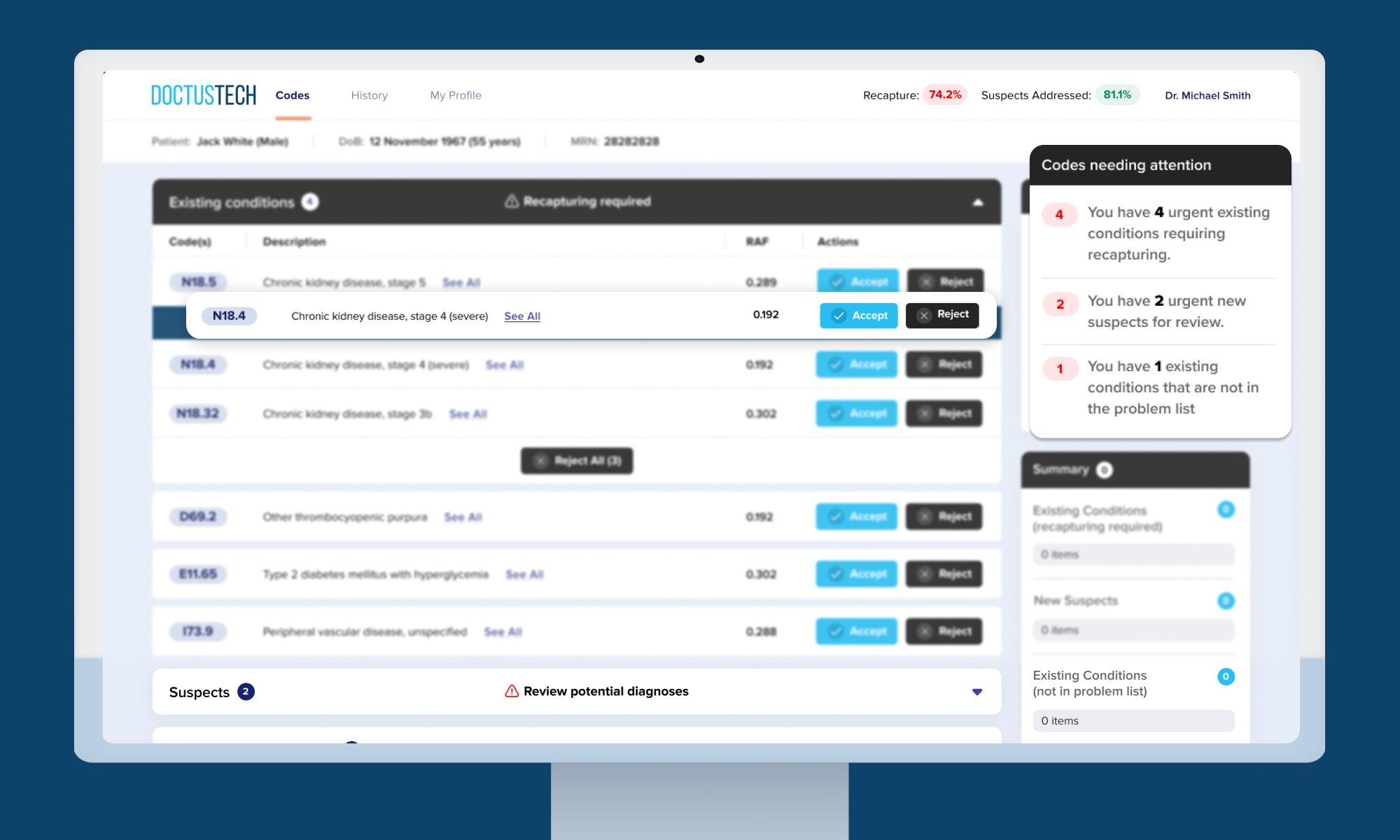
Technology now makes this easier. AI-assisted chart reviews, MEAT compliance sensors, and documentation feedback tools can screen 100% of notes, flagging small inconsistencies before they grow. Groups that self-audit regularly, train clinicians on evolving standards, and use these tools to ensure documentation completeness are far better prepared when payers come calling.
As payment models grow more complex, understanding audits and using technology to stay ahead turns exposure into stability.
If you’re ready to see how technology can make audit readiness part of your everyday workflow, book a demo with DoctusTech and discover what proactive documentation looks like in action.